Making prosthetics isn't a quick process; it involves making casts of legs. A kiln, pictured below, is used. The team made eight prosthetics this past week. They will also see the patients for adjustments as they get used to their new legs.
Friday, June 11, 2010
Of Amputees and Assumptions
For most of our week at the guest house near Les Cayes, a couple of guys from the United States have also been residents. One of them Peter, a recent high school graduate, was born in Haiti, but grew up in Florida. He was assisting Derek, a doctor and the other resident, with translating in a clinic where they were working. Peter's father is from this area, as his some of his family.
One evening, I was sitting at the desk in our room typing, I heard the front door slam. When I got up to look in the living room I saw it was Peter along with a man who didn't have any arms. "Wow, that guy really suffered in the earthquake," I thought as I ran through a list of everything he wouldn't be able to do: feed himself, get dressed, write, or even give someone a hug
Later in the evening, I asked Peter if the man he was with was one of his patients. Peter looked puzzled, so I continued. "The man who didn't have any arms."
"Oh," said Peter. "That was my dad."
Wow, talk about false assumptions.
We found out that Peter's dad lost his arms in a sugar cane auger when he was 13. One arm got trapped and he instinctively went for it with his other arm and it was trapped. He lost both of his arms right below his shoulders.
This was a reminder to me that Haiti was a dangerous place with numerous people who lost limbs BEFORE the earthquake. Now this awful natural disaster may have created 100,000 or more amputees.
Because the need for prosthetic limbs has always been great in Haiti, the hospital in Cite Lumieure, down the road from where we are staying, has a prosthetic unit that is pictured at the top of the page. It has been extra busy lately as teams from the United States and other countries fly to Haiti to make and fit prosthetics for people who need them.
This week we saw a young woman, whose leg was amputated well above the knee, receive her prosthetic limb. One of the woman on the team explained that it is much more difficult to learn to use an artificial limb when the loss of limb occurred above the knee. We watched this young woman walk gingerly back and forth across the room, getting used to the way the prosthetic bent.
Making prosthetics isn't a quick process; it involves making casts of legs. A kiln, pictured below, is used. The team made eight prosthetics this past week. They will also see the patients for adjustments as they get used to their new legs.
Hopefully, like Peter's dad, who has gone on to earn two degrees and raise a wonderful family, these people who have had such loss, can go on to lead productive lives.
Wednesday, June 09, 2010
Haitian Resilience?
I subscribe to the Bob Corbett list serve about Haiti. Recently on the Corbett site was a link to an interview of Michele Montas, a Haitian journalist and former spokesperson for UN Secretary General Kofi Ban Ki-moon by journalist Alice Speri. Here is an excerpt:
You talked about Haitian resilience. What does that mean really? What are some examples? Can that still happen?
It is happening. It has been happening since the quake. The day after the quake, when you had kids from the slums going into the university and getting students out of the rubble. There was no international assistance there, it was Haitians helping Haitians. It was people with their bare hands getting other people out of danger. The way people have bounced back… The way we have had for instance, life coming back to the streets, street sellers being back selling vegetables, selling rice, different things… The informal sector bounced back in an incredible way. Resilience is the Haitian’s way of accepting conditions. In any country of the world you would have what you had in Chile, you would have people looting, people just reacting violently. Haitians were incredibly disciplined after what happened. And I think it is something which is linked to Haitian experience, within the last two centuries. It’s something which is linked to a long history of resistance first and way after that facing incredible conditions of life.
You talked about Haitian resilience. What does that mean really? What are some examples? Can that still happen?
It is happening. It has been happening since the quake. The day after the quake, when you had kids from the slums going into the university and getting students out of the rubble. There was no international assistance there, it was Haitians helping Haitians. It was people with their bare hands getting other people out of danger. The way people have bounced back… The way we have had for instance, life coming back to the streets, street sellers being back selling vegetables, selling rice, different things… The informal sector bounced back in an incredible way. Resilience is the Haitian’s way of accepting conditions. In any country of the world you would have what you had in Chile, you would have people looting, people just reacting violently. Haitians were incredibly disciplined after what happened. And I think it is something which is linked to Haitian experience, within the last two centuries. It’s something which is linked to a long history of resistance first and way after that facing incredible conditions of life.
I think this is true. In our work in Haiti and in spending time with our Haitian Hearts patients, who are so sick and then usually come through major surgery in good fashion, we have seen this resilience. We also see it in our seven-year-old son. John often reminds us that it was Luke's ancestors who more than 200 years ago defeated Napoleon's troops. Haitians are tough and resilient.
Then, also recently, the following anonymous comment was posted on the Corbett list.
I have never posted due to the fact I live and work here as a private individual and have done for many years. I employ people and would not want to jeopardise mine or my friends' livelihoods by offending the wrong people with my subversive thoughts about reality, dignity and decency.
Anyway, my point -
The thing that troubles me is that I keep reading how resilient Haitians are.
Well the truth is that they are just like anybody else - they are upset and badly shaken by events like anybody would be. It is almost as if one has to worry less about Haitians in peril because
they can handle more stress than your average human being. Almost an excuse not to afford them the concern that one would an American, Frenchman, Paraguayan or whatever.
This is wrong.
I also agree with this comment. There is something self-serving, especially now, about focusing on the resilience of Haitians. If we think they are so tough, perhaps it gives us a pass on doing our part to help them. You know, "Oh, they're Haitians. They're tough. They'll be alright. Yes, I know they are missing limbs and family members, but they are used to things like this and it doesn't bother them as much as if it happened to, well, me." In some ways emphasizing Haitian resilience is dehumanizing.
If we want to speak of the Haitians' resilience, let's speak of admiring it, of it inspiring us to act, to show our own toughness in responding to a catastrophe of huge magnitude.
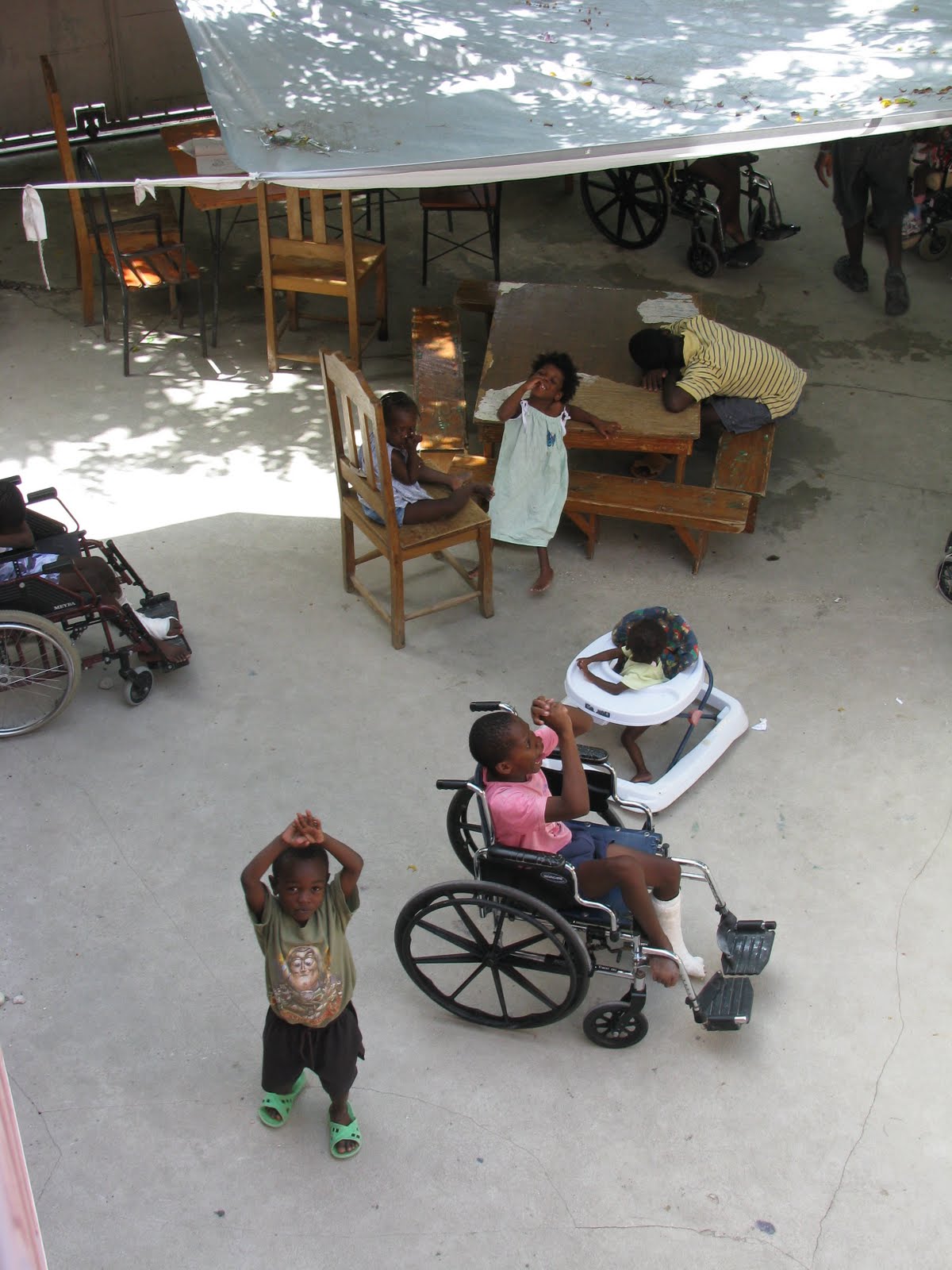
I'm sure the little girl pictured above is resilient. She is one of the children living at Gertrude's orphanage.
You Can Always Pray
Yesterday, John taught a clinical lesson at the Missionaries of Charity compound to the nurse practitioner students. One hundred or so children live here some temporarily and some permanently. One of the sisters was holding a three-year-old who was understandable sad: she came to the sisters after the earthquake and no one knows anything about her family. She must feel so incomplete and empty, as if an important part of her is missing.
I described the Missionaries of Charity to a couple of people in Haiti as the Marines of Catholic nuns: they can only go home once every ten years; they are never seen eating or drinking; and they wear these habits that I hardly see how they keep from passing out in. It is hot and humid in Haiti now; it seems like 30 seconds after you take a shower, you need another one and this is without wearing a couple of layers of head to toe clothing. Despite these hardships (or perhaps because of them?) the sisters are productive and do very difficult work caring for the poorest of the poor.
On our way home, our hostess Beth Newton asked me what I thought of the Sisters' place. I said that I had been to their building in Port-au-Prince, but, still, it was a shock to see so many children without parents. On the wall of the building, sayings from Mother Teresa, the founder of the order, are painted in Haitian Kreyol including, "Every child is precious and a gift from God." I wish the world's priorities reflected this truth. As we go about our busy days, it's never a waste to offer up a prayer for the abandoned children of the world.
Two Haitis
"There are two Haitis: Port-au-Prince and everything else," is a statement we hear a lot. Flying into Les Cayes, one of the passengers on the plane said, "I tell everyone that Port-au-Prince is not the real Haiti." As someone who has spent most of her time in Haiti in the capital, I had to agree that at least from the air, the Les Cayes area looked much different than Port-au-Prince. It was shockingly green, for one. And then on the ground, there aren't as many people around. Many of the roads in Les Cayes are much better than those in PAP.
The above photograph is from the balcony of the home of our friends, Tim and Joan Reinhold. They are Christian missionaries who live 10 months of the year in Haiti. They, with a lot of Haitian help, built their beautiful home by hand, which is how so many things are done in Haiti. Tim and Joan help put roofs on school and churches throughout the southern peninsula of Haiti. Teams from different Apostolic Christian churches in the United States come and aid them in their mission. Their accomplishments are very impressive.
After the earthquake, many of the Port-au-Princians headed to the provinces where they had family or friends they could stay with. But after a few months, it was time to return home, which in many cases was now a tent. The lives of the people in the provinces aren't exactly easy on a regular day and they couldn't continue to support their extended families any longer.
We have heard Gertrude's suggestion several times by our American friends in Les Cayes: that hopefully Haiti will become more decentralized after the earthquake with Port-au-Prince not having such a stranglehold on all the government functions. If there was more infrastructure and commerce in the rest of the country, people could find employment outside Port-au-Prince and the terrible crowding in the city would decrease. And then, maybe, we would speak of one Haiti instead of two.
Tuesday, June 08, 2010
A Teaching Stint in Les Cayes
One of the reasons that we are in Haiti now is because John was asked to teach at a school for nurse practitioners. This is his second stint teaching at the school in Les Cayes. Yesterday, he lectured on pediatric appendicitis and shock. Today, we will go to a clinic run by the Missionaries of Charity, and John will give the students a clinical lesson with the pediatric patients.
The students are very motivated. They work full time and then come to class in the late afternoon. Yesterday, they had taken a pharmacology exam prior to John's class. They paid close attention during John's lecture and took lots of notes. It helps that John can teach in Haitian Creole.
The nursing classes are held at a business/technology school downtown, next to the new Coast Guard building that is being constructed. Here is the view from campus:
Yes, that is a cow grazing by the ocean. A new pier is also being constructed and many of our American friends hope that container ships will be able to dock and unload at Les Cayes. Many people have told us that they hope one of the responses to the earthquake is that governmental control and functions are decentralized from Port-au-Prince, making functioning throughout the rest of the country more effective and efficient. We will see.
Monday, June 07, 2010
Tent City, Haiti
Almost six months out from the earthquake, the most noticeable change to my eye is the tents: they are everywhere, some places in huge camps, sometimes in small groups, and occasionally there will be a lone canvas pitched off by itself. The tents are in industrial areas, on private property, on government property. They are often found where houses were once located. There are even tents in the medians of roads.
This is not to say that other effects of the earthquake aren't obvious. Rubble is strewn everywhere, more than usual. Half completed buildings hang in ruins. Certain parts of the city were damaged more than others: the Delmas section of Port-au-Prince appears to have been particularly hard hit, A portion of the road Delmas 31 was destroyed and we had to hike down through a steep gully and cross a dirty stream to make our way down the street. The inpatient unit at Grace Children's Hospital on Delmas 31, a special place to us, is not functioning and tents serve as the outpatient clinics.
One of our Haitian Hearts patients, Jenny G., pictured below, is standing next to the car she slept in the first two months after the earthquake and the tent that served as her bedroom after this.
So it is the tents that may be the most ubiquitous symbol of the earthquake.
Saturday, June 05, 2010
Providence Guest House
Our friend Gertrude is doing a hero's work in Haiti. She runs a guest house/orphanage in LaPlaine. Gertrude's original guest house in Delmas was destroyed in the earthquake. Gertrude was sleeping at 4:52 pm when the earthquake struck. It woke her up and she was disoriented. She fell three times as she tried to run. "Jesus, help me," she cried. The rumbling stopped and she ran outside as her guest house was crashing down.
Prior to the earthquake, Gertrude had the house in LaPleine where abandoned children were staying. Fortunately, none of them was hurt in the earthquake. Some of the children she cares for were abandoned at the General Hospital. Some of them are disabled. The orphanage currently has 37 children. Her guest house, Providence, helps fund the orphanage. She has 22 staff members to care for these children. As you might imagine, there are many expenses in running an orphanage.
When I asked Gertrude what she would do if she were in charge of Haiti, she gave a three-part answer. First, she would feed the people. Next, she would focus on the long-term progress of the country, creating housing and jobs. Finally, she would build infrastructure throughout Haiti, not just in Port-au-Price. "If people had what they needed in the provinces, they wouldn't come to Port-au-Prince," she said.
"In the hour of our poverty, this is the time for it," she said.
Friday, June 04, 2010
Dr. John in Action
Dr. John helped a lot of children this past week, many of whom had ear infections. John said, "I think I have seen so many ear infections because people are living outside. And now it is starting to rain."
Examining children's ears can be a challenging process. Some of them look upon the otoscope as an instrument of evil. They want nothing to do with it. We had to hold one little girl down on an examining table to get a good look inside her ears. Others who aren't quite as afraid, put their shoulders up as John places the scope in their ear. He jokes, "Kids don't understand that when they put their shoulder up, it makes it hard to see in the ear. I've told them but they insist on doing it over and over."
Many children have temperatures and other symptoms that are caused by these ear infections, and so it is important to diagnose them so an antibiotic can be prescribed. We see one child's middle ear that is half-filled with puss. The babies feel much better when their ear infections are treated. And so do the moms.
She Needs the Knife
Meet the lovely Jenny G. She is 30-years-old, gainfully employed, and lives in a tent, which is better, I guess, than the first two months after the earthquake, when she slept in a car. Making Jenny’s life more difficult is that she has a severely ailing heart. The medical solutions are almost extinguished for her and as John would say, she needs the knife.
Jenny had surgery to repair heart valves in 1999; now she needs surgery to replace them. She looks good, but had to stop a couple of times and rest when she was climbing the stairs. She is in congestive heart failure, with a number of the symptoms that go along with this condition. If anyone reading has contacts with hospitals or medical centers or cardiac surgeons who might be interested in helping Jenny please e-mail me.
It’s hard to sit next to Jenny and know that she has a fixable problem, except for the fact that she was born in the wrong country.
Survivor Experiences of the Earthquake
We’ve heard several people’s stories about where they were and what they were doing during the earthquake. One woman was outside and realized what was happening, as she had felt tremors before. But some other people around her, didn’t know what was happening and thought the loud noises were shooting; they ran into their houses and then the houses collapsed and they were killed.
Another woman was at work, on the fourth story of a building. When the earthquake started, she sat frozen at her desk, while all of her co-workers fled the building. She is in poor health. She said the building first swayed to and fro and then it went up and down. But it didn’t collapse. When the earthquake was over, her colleagues rushed back into the building and helped her out, as her health isn’t good. When she walked home from work, she saw body parts in the street and heard people calling from buildings.
Another woman was in a large house during the earthquake. First she ran upstairs, and then she ran outside along with the other people in the building. No one was hurt, but the house was destroyed. She said that she couldn’t stop laughing. Even as people came by the house seriously injured, all she could do was laugh. Shock is displayed in different ways. How can this have happened? In 45 seconds 140,000 people lost their lives and there was billions of dollars in property damage. How could it seem real?
Bag On the Ground
After more than three years, this blog is now true to its name, Live From Haiti, as I am typing these words from a guest house in the LaPlaine district of Port-au-Prince. Today I accompanied John to the clinic run by the Daughters of Charity. Today and yesterday were feast days (The Feast of God) so there weren’t as many children and moms at the clinic as usual; several of them were patients John had seen before, and thanks to medicine and treatment, were doing much better.
John’s doctor bag in the above photo survived the earthquake. He had stored it at the sisters, and when he came in for his first day of work on this trip, it was sitting on the chair in his exam room as if nothing had happened. Even more amazingly, one of his suitcases, which was stored at a guesthouse which collapsed during the earthquake was pulled out of the rubble.
Monday, May 31, 2010
Dying in Haiti Like Never Before
John has been in Haiti for almost a week now. It's his first trip there since the earthquake. I can tell, even though he has made countless trips over the past 25 years and spent cumulatively years there, that he is shocked by what he is seeing. He's writing about much of it at his blog, Dying in Haiti
In an e-mail to me, John wrote:
The driver came and picked me up at 10:30 and he took me downtown where I met Frandy. Took about 300 pictures and walked through the middle of the tent cities until I was advised not to do that anymore by my driver for my own safety.
The Ministry of Health building is gone, the Minisitry of Justice is gone, the tax building is gone, the Palace is gone, the Cathedral is demolished, Sacre Couer Church where David Volk got married is gone, the nursing school is gone at General Hospital with 100 or so nursing students.
The tent city in front of the Palace goes on for blocks. It is called Champ Mars. Very dangerous place with dangerous guys I am afraid. Squalid, horrible, rotten, fetid conditions is the best I can say for 10's of thousands of people.
PAP is really destroyed. Have pictures of two collapsed hospitals. And the Pediatric Building at General Hospital is cracked and vacated. The little peds patients are in 3 big hot terrible tents outside. Horrible. And it has been 4 months. Babies appear sick.
The most shocking thing is the Cathedral. The power of nature.
In an e-mail to me, John wrote:
The driver came and picked me up at 10:30 and he took me downtown where I met Frandy. Took about 300 pictures and walked through the middle of the tent cities until I was advised not to do that anymore by my driver for my own safety.
The Ministry of Health building is gone, the Minisitry of Justice is gone, the tax building is gone, the Palace is gone, the Cathedral is demolished, Sacre Couer Church where David Volk got married is gone, the nursing school is gone at General Hospital with 100 or so nursing students.
The tent city in front of the Palace goes on for blocks. It is called Champ Mars. Very dangerous place with dangerous guys I am afraid. Squalid, horrible, rotten, fetid conditions is the best I can say for 10's of thousands of people.
PAP is really destroyed. Have pictures of two collapsed hospitals. And the Pediatric Building at General Hospital is cracked and vacated. The little peds patients are in 3 big hot terrible tents outside. Horrible. And it has been 4 months. Babies appear sick.
The most shocking thing is the Cathedral. The power of nature.
Saturday, May 29, 2010
Where It All Started

Today is John's and my 6th wedding anniversary. They have been an action-packed six years. I write this blog largely because of him. His dedication, perseverence, and hard work on behalf of Haitians give me something very meaningful to write about.
Many of these qualities John got from his mom, Mary Sullivan Carroll, who died last month at 95. We had spent much of the last three years caring for his mom, who was in declining health. At the end of the post, is her obituary which you can read if you'd like to learn about how amazing she was.
Mary had more in common with Haitians, with hardship, then we do. She was a young woman in the Depression when necessities like food and shelter weren't guaranteed. Her father and one of her three brothers died when she wasn't out of her teens. Her mother was sick and often needed care. But Mary didn't let these challenges stop her from becoming a stellar teacher or use them as excuses to complain about her lot. She cheerfully and energetically worked hard and inspired others, including her sons, to do so also. She helped build a wonderful life for her and her family.
Besides being generous financially, Mary helped Haitians in other ways by opening her home to them and most of all, raising a son who has been so committed to them. Thanks, John, for doing such a good job following the example of your mom. Happy Anniversary!
WEST PEORIA, IL - Mary Alta Sullivan Carroll, 95, of West Peoria died on Monday, April 26, 2010, at Methodist Medical Center, Peoria, IL, surrounded by her family.
She was born on July 12, 1914, in Macomb to Ambrose and Alta Arnold Sullivan. On Feb. 23, 1951, she married John Carroll, her beloved husband with whom she spent 27 wonderful years.
Mary was preceded in death by her husband on Jan. 14, 1978; her three brothers, Ambrose, John and Bill; and her grandson, Christopher.
She is survived by her two sons, John (Maria) Carroll of West Peoria and Tom (Diane) Carroll of Peoria; her six grandchildren, Jennifer (and fiance Loren), Tommy, John, Kate, Annie and Luke; and Young (Chhoung) La, who was like a son to her.
Mary received a bachelor of education degree from Western Illinois State Teachers College in 1935, and a master of science degree from the University of Illinois in 1949.
Mary was a teacher for 54 years at the grade school, high school, college and vocational levels. She taught everywhere from a one-room school house to Bradley University to Caterpillar. Other schools where she positively influenced hundreds of students include McKinley Grade School, Riverton, Springfield and Monmouth high schools, Peoria Central, Manual and Woodruff high schools, the University of Illinois and Manitoba Institute of Technology in Winnipeg, Canada, where Mary and her family spent two glorious summers. Mary primarily taught business and office occupation classes at the secondary and college levels.
Mary's vocation, both inside and outside the classroom, was helping people get the most out of their ability. She did this in such an inspiring, energetic, and indefatigable fashion that she had students from the 1930s and on who kept in touch with her and would often visit for a dose of her never-give-up optimism and advice. She was continually and enthusiastically helping friends and family with their projects and problems. She loved teaching her grandchildren and was a source of constant encouragement and support to them, holding vocabulary school around her kitchen table in the summer. She was active, walking and running well into her 80s and even went rock climbing on her 85th birthday. She was "sui generis."
Mary loved her home in West Peoria, which she and her husband built in 1957, and where she lived for 53 years. She filled it with beautiful objects, which she either created or negotiated bargain prices for. Her Catholic faith was of the utmost importance to her. She prayed the rosary frequently and demonstrated her beliefs through her actions and her courage.
Visitation will be from 5 to 7 p.m. Friday at the Immaculate Conception Convent, 2408 W. Heading Ave. in West Peoria with recitation of the rosary at 7 p.m. Mary and her family have had a long and close friendship with the Heading Avenue Sisters and she wanted her services conducted there, surrounded by the Sisters whom she loved. The funeral Mass will be held at the convent on Saturday, May 1, 2010, at 11 a.m., with visitation an hour before. The Rev. James King will officiate. Burial will be in St. Mary's Cemetery after the funeral.
Wright & Salmon Mortuary is in charge of arrangements.
Memorials may be made to Haitian Hearts, 2727 W. Heading Ave., West Peoria, IL 61604. Haitian Hearts is a charitable organization started by her son that brings children from Haiti to the United States for heart surgery and which Mary named.
Many of these qualities John got from his mom, Mary Sullivan Carroll, who died last month at 95. We had spent much of the last three years caring for his mom, who was in declining health. At the end of the post, is her obituary which you can read if you'd like to learn about how amazing she was.
Mary had more in common with Haitians, with hardship, then we do. She was a young woman in the Depression when necessities like food and shelter weren't guaranteed. Her father and one of her three brothers died when she wasn't out of her teens. Her mother was sick and often needed care. But Mary didn't let these challenges stop her from becoming a stellar teacher or use them as excuses to complain about her lot. She cheerfully and energetically worked hard and inspired others, including her sons, to do so also. She helped build a wonderful life for her and her family.
Besides being generous financially, Mary helped Haitians in other ways by opening her home to them and most of all, raising a son who has been so committed to them. Thanks, John, for doing such a good job following the example of your mom. Happy Anniversary!
WEST PEORIA, IL - Mary Alta Sullivan Carroll, 95, of West Peoria died on Monday, April 26, 2010, at Methodist Medical Center, Peoria, IL, surrounded by her family.
She was born on July 12, 1914, in Macomb to Ambrose and Alta Arnold Sullivan. On Feb. 23, 1951, she married John Carroll, her beloved husband with whom she spent 27 wonderful years.
Mary was preceded in death by her husband on Jan. 14, 1978; her three brothers, Ambrose, John and Bill; and her grandson, Christopher.
She is survived by her two sons, John (Maria) Carroll of West Peoria and Tom (Diane) Carroll of Peoria; her six grandchildren, Jennifer (and fiance Loren), Tommy, John, Kate, Annie and Luke; and Young (Chhoung) La, who was like a son to her.
Mary received a bachelor of education degree from Western Illinois State Teachers College in 1935, and a master of science degree from the University of Illinois in 1949.
Mary was a teacher for 54 years at the grade school, high school, college and vocational levels. She taught everywhere from a one-room school house to Bradley University to Caterpillar. Other schools where she positively influenced hundreds of students include McKinley Grade School, Riverton, Springfield and Monmouth high schools, Peoria Central, Manual and Woodruff high schools, the University of Illinois and Manitoba Institute of Technology in Winnipeg, Canada, where Mary and her family spent two glorious summers. Mary primarily taught business and office occupation classes at the secondary and college levels.
Mary's vocation, both inside and outside the classroom, was helping people get the most out of their ability. She did this in such an inspiring, energetic, and indefatigable fashion that she had students from the 1930s and on who kept in touch with her and would often visit for a dose of her never-give-up optimism and advice. She was continually and enthusiastically helping friends and family with their projects and problems. She loved teaching her grandchildren and was a source of constant encouragement and support to them, holding vocabulary school around her kitchen table in the summer. She was active, walking and running well into her 80s and even went rock climbing on her 85th birthday. She was "sui generis."
Mary loved her home in West Peoria, which she and her husband built in 1957, and where she lived for 53 years. She filled it with beautiful objects, which she either created or negotiated bargain prices for. Her Catholic faith was of the utmost importance to her. She prayed the rosary frequently and demonstrated her beliefs through her actions and her courage.
Visitation will be from 5 to 7 p.m. Friday at the Immaculate Conception Convent, 2408 W. Heading Ave. in West Peoria with recitation of the rosary at 7 p.m. Mary and her family have had a long and close friendship with the Heading Avenue Sisters and she wanted her services conducted there, surrounded by the Sisters whom she loved. The funeral Mass will be held at the convent on Saturday, May 1, 2010, at 11 a.m., with visitation an hour before. The Rev. James King will officiate. Burial will be in St. Mary's Cemetery after the funeral.
Wright & Salmon Mortuary is in charge of arrangements.
Memorials may be made to Haitian Hearts, 2727 W. Heading Ave., West Peoria, IL 61604. Haitian Hearts is a charitable organization started by her son that brings children from Haiti to the United States for heart surgery and which Mary named.
Thursday, April 01, 2010
Frontline on Haiti

A couple nights ago, we watched Frontline as it covered the affects of the earthquake in Haiti. Wow, what an aptly named program. The video on this show has such an immediacy and completeness about it--the camera seems to be in the middle of things, instead of merely recording the action--that you feel as if you're right there.
As I watched the hour-long show, I jotted down a few words from the program. Here they are.
The world is coming to an end.
The first thing I noticed is the dust. And then the crying: one in ten people died.
People who live and work here found themselves in a strange land.
The earthquake decimated a weak and inefficient government.
With the city in ruins, makeshift camps appeared everywhere.
More than one million people in Port-au-Prince are homeless.
What pain I'm in, my God. What suffering.
For many Haitians, their faith rests only in the hands of God.
Haiti's story is one of a dream denied.
The Bottom Billion by Paul Collier
When I went to Haiti, I saw a country that abounded in economic opportunities.
There was a real spirit and hope that at last things were going to improve.
Per capita, Haiti has one of the highest concentration of NGOs in the world.
capacity- the entrenched elite, a handful of families.
Nearly half of all American households have contributed to Haitian relief.
We are already invested and we don't want that investment to go to waste. We want a postive outcome.
One toilet per thousand.
The stench has moved from bodies to the stench of the living.
But the big worry for everyone was the coming rains.
The above picture of Fort National was taken by missionary Karen Bultje.
Tuesday, March 30, 2010
Successful Surgery for Medjina!
We are so happy to report that 7-year-old Medjina Bontemps had successful surgery to replace her mitral valve at St. Louis Children's Hospital. Medjina had the surgery six days ago, and will be discharged from the hospital today.
Medjina is the fifth Haitian child that St. Louis Children's has taken care of for Haitian Hearts. We are deeply grateful to them for the fine care they provide. We are also want to thank from the bottom of our hearts host family Jim and Jane Ebel who have taken such excellent, loving care of so many Haitian children.
Medjina is the first Haitian Hearts patient who has had surgery since the earthquake. We have another child, Winderlande, who is still in Haiti, but has been accepted by Sutter Memorial Hospital in Sacramento. We are actively working on getting Winderlande's passport updated and hope that she will be coming to California soon to have her heart repaired. You can read about the wonderful fundraiser that was held for Winderlande by the welcoming folks in California here. We are hopeful that Winderlande will be coming to California in the next few months.
Monday, February 22, 2010
Prisoners

For the last six months, I have been doing some research into the lives of those who were U.S. Prisoners of War in the Philippines during World War II. Many of them were survivors of the notorious Bataan Death March. They were subjected to starvation and malnutrition and the vitamin-deficiency diseases these conditions produce, including beriberi, scurvy and pellagra. Drinking dirty water led to dysentery. They were plagued by malaria, diphtheria outbreaks, and skin disorders. Their living conditions were substandard. As the United States concentrated on the European theater, they felt forgotten and abandoned. Some of them lost hope of ever being freed though for others, it was hope that kept them alive.
Their are obvious differences, but as I continue to read about these brave and resilient men, I am reminded of the Haitians. Not all of their problems are the same, but the Haitians suffer from many of the same hardships that the American POWs did. Even before the earthquake, parts of Haiti reminded me of POW camps. Poor Haitians are trapped in Haiti; other countries don't want them. Sometimes they sneak across the border and work as illegals in the Dominican Republic or take to the ocean in their makeshift boats. Once in awhile, a U.S. POW would escape.
I think for a long time, Haiti was a forgotten place, its people's sufferings unknown to others or ignored. At least for awhile, that has changed. And like the U.S. POWs, the Haitians don't give up. But also like the POWs, they need help. Let's give it to them in full measure.
The above picture was taken by Port-au-Prince resident Karen Bultje.
Saturday, February 20, 2010
Live From Haiti?
It's been three years since I've actually been Live From Haiti. Hard to believe. Three years ago yesterday John and I flew home from Port-au-Prince with our son Luke after a seven-month sojourn in Haiti waiting for his adoption to finalize.
Despite my absence from our second home, I've been able to report on the good work other people, mainly my husband John, have been doing there. I've also been able to report on our Haitian Hearts patients.
Everyone knows a little more about Haiti than they did two months ago. I wonder how many times the word Haiti has been uttered in January and February? More than all the years previous combined, I bet. I hope the attention will amount to some positive lasting changes for Haiti.
In the meantime, we'll keep writing and trying to help Haitians as we can. Here is an article about Haitian Hearts and here is an article about how John has influenced one young man making a difference for Haiti. And one of these days, I'll really be Live From Haiti again.
Despite my absence from our second home, I've been able to report on the good work other people, mainly my husband John, have been doing there. I've also been able to report on our Haitian Hearts patients.
Everyone knows a little more about Haiti than they did two months ago. I wonder how many times the word Haiti has been uttered in January and February? More than all the years previous combined, I bet. I hope the attention will amount to some positive lasting changes for Haiti.
In the meantime, we'll keep writing and trying to help Haitians as we can. Here is an article about Haitian Hearts and here is an article about how John has influenced one young man making a difference for Haiti. And one of these days, I'll really be Live From Haiti again.
Thursday, February 18, 2010
Marie Myrtha Amazan: Rest In Peace

We received some sad news the other day. One of our patients, beautiful Marie Amazan died. We don't think her death was directly related to the earthquake, but we aren't sure. It didn't help, that is for sure.
Marie's fiance Junior had been reporting to us that she hadn't been feeling well. A day or so before she died, she went into some kind of a coma. She had lost her medicines in the earthquake, and that could have been a contributing factor.
Marie was operated on by the superlative surgeon, Dr. Bryan Foy at Provena St. Joseph Medical Center in Joliet, Illinois. Dr. Foy has operated on a number of our Haitian Hearts' patients who have had complex heart problems. They have all done very well post-surgically.
We mourn the loss of Marie. We know that she would want us to keep on working for others in Haiti who have similar problems. We will.
Pictured above are Marie and her friend Anita
Sunday, February 07, 2010
Suffering
Our cousin is home from Haiti now. It seems like most of the teams go down for a week or at most two. I know of other teams going and hopefully this will continue for a long time. When you read the post below, you better understand why a week is about as much as a first worlder can take.
Another long, busy day in surgery full of fracture repairs and wound
debridement. The smell of the 3 week old wounds is overwhelming.
Poor sanitization conditions combined with long hot days spent in
crowded tents with little to no ventilation. Thank heavens for Vicks
Vaporub!
I left the hospital around 8pm to return to camp. We now have running
water! I immediately headed straight for a shower, which really
consists of bathtub and garden hose pulled through the bathroom
window. It's freezing cold, but I can't wait to "come clean" of
today. I yell for someone outside to "turn on the hose!" and not
more than 2 minutes later hear a voice outside running down the alley
& coming toward the clinic. A nurse from the hospital pounds on the
door of the clinic for me to "come quick" to the hospital..."a stat c-
section". Still soaking wet, I throw on scrubs, call for Sandra (the
other anesthetist; & native Haitian), and we follow her back to the
hospital.
We quickly gather whatever supplies we can find through all of the
mess of medical equipment just shipped in (thank you to all who
donated!). Turns out there are in fact 2 c-sections, but only one
surgeon. The most critical goes first: umbilical cord wrapped around
the baby's neck. Spinal block and within 4 minutes the baby is pulled
out, blue, completly limp, and lifeless. It was then that we realized
that there was no one available to take care of the baby, who is
cyanotic and silent. The surgeon continues to suture, while I leave
mom to help the baby ("patient abandonment" and illegal in the
US)...not to metion the fact that I know extremely little about labor
& delivery nursing! ...desparate times. Sandra takes over care of
mom, while I attempt to stimulate and suction the baby. Yes... I am
screaming for help the entire time. A Canadian ER doctor hears me
and comes to the rescue. Together we stimulate and suction large
amounts of aspirated meconium, and soon....crying. The most
beautiful sound in the world!
Sandra and I must quickly get ready for the 2nd c/sec. I wheel the
last newborn into the room with us. Again, there are so many things
wrong about the conditions we must work under, but we must just adapt
and adjust to what we have. There is no NICU. New babies and moms
get sent back outside to the yard (literally) just after delivering.
This baby was no where near stable enough to be left unattended.
Sandra & I were gettig ready to do a spinal block on the next mom when
a code was called on a baby that had been rushed into the hospital
from the "tent village". She just cried and pleaded (in Creole) to
help her baby. The infant was intubated and coded for over 20
minutes before time of death was called. I completely broke down. I
tried to hide behind my glasses ad mask as I cried right there on
front of everyone. It was unbearable. And even still, after
experiencing such heartache, I had to return to the OR to finish the
last c-section. I'm thankful I stayed. A difficult and cold as it
felt at the time, I needed a "happy ending". I got just that. One
loud, crying, healthy baby. As 2 new lives were brought into the
world tonight, one was taken away. A harsh and unjust life.
The hardest part about tonight was wondering and question to myself,
"what if?" ; "what if this baby had been in the US?". ...same baby,
same illness, only with better medical access. Would the outcome
have been the same?". I heavily doubt it. That's what makes it so
hard...wondering why some are so fortunate and priviledged, just by
the geographical location in which we have been born; while others are
born into nothing. It's just seems so unfair.
Another long, busy day in surgery full of fracture repairs and wound
debridement. The smell of the 3 week old wounds is overwhelming.
Poor sanitization conditions combined with long hot days spent in
crowded tents with little to no ventilation. Thank heavens for Vicks
Vaporub!
I left the hospital around 8pm to return to camp. We now have running
water! I immediately headed straight for a shower, which really
consists of bathtub and garden hose pulled through the bathroom
window. It's freezing cold, but I can't wait to "come clean" of
today. I yell for someone outside to "turn on the hose!" and not
more than 2 minutes later hear a voice outside running down the alley
& coming toward the clinic. A nurse from the hospital pounds on the
door of the clinic for me to "come quick" to the hospital..."a stat c-
section". Still soaking wet, I throw on scrubs, call for Sandra (the
other anesthetist; & native Haitian), and we follow her back to the
hospital.
We quickly gather whatever supplies we can find through all of the
mess of medical equipment just shipped in (thank you to all who
donated!). Turns out there are in fact 2 c-sections, but only one
surgeon. The most critical goes first: umbilical cord wrapped around
the baby's neck. Spinal block and within 4 minutes the baby is pulled
out, blue, completly limp, and lifeless. It was then that we realized
that there was no one available to take care of the baby, who is
cyanotic and silent. The surgeon continues to suture, while I leave
mom to help the baby ("patient abandonment" and illegal in the
US)...not to metion the fact that I know extremely little about labor
& delivery nursing! ...desparate times. Sandra takes over care of
mom, while I attempt to stimulate and suction the baby. Yes... I am
screaming for help the entire time. A Canadian ER doctor hears me
and comes to the rescue. Together we stimulate and suction large
amounts of aspirated meconium, and soon....crying. The most
beautiful sound in the world!
Sandra and I must quickly get ready for the 2nd c/sec. I wheel the
last newborn into the room with us. Again, there are so many things
wrong about the conditions we must work under, but we must just adapt
and adjust to what we have. There is no NICU. New babies and moms
get sent back outside to the yard (literally) just after delivering.
This baby was no where near stable enough to be left unattended.
Sandra & I were gettig ready to do a spinal block on the next mom when
a code was called on a baby that had been rushed into the hospital
from the "tent village". She just cried and pleaded (in Creole) to
help her baby. The infant was intubated and coded for over 20
minutes before time of death was called. I completely broke down. I
tried to hide behind my glasses ad mask as I cried right there on
front of everyone. It was unbearable. And even still, after
experiencing such heartache, I had to return to the OR to finish the
last c-section. I'm thankful I stayed. A difficult and cold as it
felt at the time, I needed a "happy ending". I got just that. One
loud, crying, healthy baby. As 2 new lives were brought into the
world tonight, one was taken away. A harsh and unjust life.
The hardest part about tonight was wondering and question to myself,
"what if?" ; "what if this baby had been in the US?". ...same baby,
same illness, only with better medical access. Would the outcome
have been the same?". I heavily doubt it. That's what makes it so
hard...wondering why some are so fortunate and priviledged, just by
the geographical location in which we have been born; while others are
born into nothing. It's just seems so unfair.
Sunday, January 31, 2010
Sullivans on the Scene

John's cousin's daughter, Emily, a newly minted nurse anesthetist, arrived in Haiti a few days ago. She is working at a hospital in or near Carrefour, which was the epicenter of the earthquake. It is also where Frandy lives, and wouldn't you know, he and Emily not only bumped into each other, but correctly guessed who the other person was. "Are you Emily?" "Yes. Are you Frandy?" "Yes." Pretty amazing.
This is Emily's first trip to Haiti. Her cousin Jesse, whom I wrote about here, helped arrange the trip. Jesse is volunteering at the Haitian embassy in Washington, DC, assisting with the tent cities. In her first e-mail home, Emily writes:
Conditions are worse than imaginable. The entire city has suffered distruction. The streets are lined with make-shift tents. Even families whose shelter remains standing choose to live in the streets for fear of after-shock. Recently orphaned children sit blank-stared on sidewalks just lost. As we drove to the hospital, the smells are overwhelming. Many bodies remain trapped under rubble...it has now been over 2 weeks. My team joined with other Doctors without Borders. We sleep in tents outside the Hope for Haiti clinic across the street from Hospital Adventista. My first night, I was woken up to someone from the hospital across the street calling for the "blonde-hair anesthesia". There are two anesthetists (myself included) to our team. I grabbed my new-found CRNA friend and ran next door. There was a stat c-section at the hospital. The conditions are unbelievable. Make-shift ORs with out-dated drugs that I have only read about. But we have an anesthesia machine!
This morning I worked in a public health clinic. 6 of us assessed over 250 Haitian men, women, and children. Later in the afternoon I went back to the hospital to help with anesthesia.
Tommorow more surgeries. Will try to keep in touch later.
Take nothing for granted.
This is Emily's first trip to Haiti. Her cousin Jesse, whom I wrote about here, helped arrange the trip. Jesse is volunteering at the Haitian embassy in Washington, DC, assisting with the tent cities. In her first e-mail home, Emily writes:
Conditions are worse than imaginable. The entire city has suffered distruction. The streets are lined with make-shift tents. Even families whose shelter remains standing choose to live in the streets for fear of after-shock. Recently orphaned children sit blank-stared on sidewalks just lost. As we drove to the hospital, the smells are overwhelming. Many bodies remain trapped under rubble...it has now been over 2 weeks. My team joined with other Doctors without Borders. We sleep in tents outside the Hope for Haiti clinic across the street from Hospital Adventista. My first night, I was woken up to someone from the hospital across the street calling for the "blonde-hair anesthesia". There are two anesthetists (myself included) to our team. I grabbed my new-found CRNA friend and ran next door. There was a stat c-section at the hospital. The conditions are unbelievable. Make-shift ORs with out-dated drugs that I have only read about. But we have an anesthesia machine!
This morning I worked in a public health clinic. 6 of us assessed over 250 Haitian men, women, and children. Later in the afternoon I went back to the hospital to help with anesthesia.
Tommorow more surgeries. Will try to keep in touch later.
Take nothing for granted.
We have our worries and frustrations
But our houses are standing and
when things go wrong,
there are people to help.
In Haiti a broken world explodes
and the people have to pick up the pieces.
Do You Hear Me Now?
My mom told me she thought, "Do you hear me now?" would be a good title for an article about Haiti, and she's right. Because for so many years, the suffering of the Haitian people has largely been ignored by the world. And the suffering is brutal.
I'll never forget the time we were returning from a trip to Haiti. We were flying from Miami to Chicago, and I sat next to an American who had grown up in Kenya and was making his way back to Africa, oddly, via Chicago, but anyway. I told him where I had been. He actually shuddered and said, "I imagine there should be a sign at Haiti's entrance that says, 'Abandon hope all ye who enter here,'" which of course was what was posted at the entrance to hell in The Divine Comedy. There was so much pain, and suffering, and premature dying in Haiti before and now this.
Our friend Mary who has made her home in Haiti for half of the year for more than a decade returned to Ohio from her recent trip to look for people. Mary writes:
No words can describe the incredible devastation the earthquake and incessant aftershocks have left behind. No words can describe the brutal injuries so, so many people have suffered. No words can describe the agony mothers, fathers, sisters, brothers, aunts, uncles, cousins and friends are experiencing as loved ones continue to suffer and die on a daily basis. No words can describe the distress these same family members are experiencing as they try to determine the whereabouts of love ones. And no words can describe the amazing faith and strength of the Haitian people. Maybe it's because they are already so accustomed to a life of misery that in ten days, I heard many prayers of thanksgiving, but not one whine or 'why us?' It seems like the whole world has responded and much relief has arrived. It's hard to know if it's getting everywhere it needs to. People can so easily fall in between the cracks. Recovery, if at all possible, will take years upon years. I hope the world doesn't forget Haiti again.
I'll never forget the time we were returning from a trip to Haiti. We were flying from Miami to Chicago, and I sat next to an American who had grown up in Kenya and was making his way back to Africa, oddly, via Chicago, but anyway. I told him where I had been. He actually shuddered and said, "I imagine there should be a sign at Haiti's entrance that says, 'Abandon hope all ye who enter here,'" which of course was what was posted at the entrance to hell in The Divine Comedy. There was so much pain, and suffering, and premature dying in Haiti before and now this.
Our friend Mary who has made her home in Haiti for half of the year for more than a decade returned to Ohio from her recent trip to look for people. Mary writes:
No words can describe the incredible devastation the earthquake and incessant aftershocks have left behind. No words can describe the brutal injuries so, so many people have suffered. No words can describe the agony mothers, fathers, sisters, brothers, aunts, uncles, cousins and friends are experiencing as loved ones continue to suffer and die on a daily basis. No words can describe the distress these same family members are experiencing as they try to determine the whereabouts of love ones. And no words can describe the amazing faith and strength of the Haitian people. Maybe it's because they are already so accustomed to a life of misery that in ten days, I heard many prayers of thanksgiving, but not one whine or 'why us?' It seems like the whole world has responded and much relief has arrived. It's hard to know if it's getting everywhere it needs to. People can so easily fall in between the cracks. Recovery, if at all possible, will take years upon years. I hope the world doesn't forget Haiti again.
No, let's not forget Haiti again. We do hear you now.
Things can't get any worseAnd then they do
But the bad times can't destroy hope.
Haitians Helping Haitians

As I mentioned on the Haitian Hearts website, we are going to provide earthquake relief by sending money directly to the people affected. The Western Union offices in Port-au-Prince reopened last week, and we finally were able to wire money to a number of our Haitian friends, all of whom lost their homes and are living on the street and, in one case, in a car. They have been very grateful and a few have thanked us via e-mail or phone call.
Jenny told us that she would use some of the money to help people who are worse off than she is, and we know that she will.
Katia writes: "hi dr john how r u maria and luk i call u to tell thank u. . . thank u very much dr God bless u and your family .i feel me bether only my head ake where the concrete fall in my head." Her English is better than my Kreyol.
Henri told me to, "Have a nice day." For the time being, Western Union is waiving their fee to send money to Haiti.
I borrowed the above picture from Dorothy Pearce an American woman who lives in Haiti and takes in sick babies. She posted it on Facebook. I thought it better shows what is going on in Haiti than the pictures of the looters.
Jenny told us that she would use some of the money to help people who are worse off than she is, and we know that she will.
Katia writes: "hi dr john how r u maria and luk i call u to tell thank u. . . thank u very much dr God bless u and your family .i feel me bether only my head ake where the concrete fall in my head." Her English is better than my Kreyol.
Henri told me to, "Have a nice day." For the time being, Western Union is waiving their fee to send money to Haiti.
I borrowed the above picture from Dorothy Pearce an American woman who lives in Haiti and takes in sick babies. She posted it on Facebook. I thought it better shows what is going on in Haiti than the pictures of the looters.
Our little bit of money
That we don't really miss
Helps them a lot.
Thursday, January 21, 2010
More Survivors Amid the Death and Wreakage
We find out about people in Haiti in bits and pieces from various places. We were very worried about Haitian Hearts' patient Willy Fortune's mom, who lives in the hard-hit Canape Verte section of Port-au-Prince. We were also worried about our Canadian friend Karen Bultje, who lives in Haiti, helping disabled children and really anyone in need. She blogs about her experiences at Coram Deo.
For days after the earthquake, Karen's last post was dated January 11. But then--Eureka!--she began posting again, and when we sent her an e-mail, telling her how happy we were to read that she was alright, she responded saying that Willy Fortune's mom, pictured above, had been by, asking about us. Eureka again!
We often stay at the Visa Lodge, a hotel near the airport, when we are in Haiti. We hadn't heard anything about the hotel until we came across this article in the Boston Globe. Mr. Herve Denis, one of the owners of the hotel, survived the earthquake, but his mother did not. Gratitude mixed with mourning everywhere.
Tuesday, January 19, 2010
Bless the Children
We received the sad news today that 10-year-old Dieula Jean Charles perished in the earthquake. Dieula was one of the people that our friend Mary Hurley travelled to Port-au-Prince to look for.
A few years ago, Dieula came to St. Louis for heart surgery, thanks to the efforts of Mary and her friend Marie. They worked so hard on Diuela's behalf because they loved her and knew that she deserved to have her heart repaired. The operation was a success, and Dieula returned to Haiti a healthy little girl. As Mary's sister who is keeping us updated on Mary's work in Haiti wrote,
"The pain in Mary's voice could be felt across the miles and miles of telephone lines and there really were no words of comfort I could offer her. Her hope is that Dieula did not suffer. I know we all share that hope."
In a later e-mail, we learned that Dieula probably died quickly. Her mother and siblings survived. What grief they are feeling. The enormous suffering that exists in Haiti today is hard to fathom.
A few years ago, Dieula came to St. Louis for heart surgery, thanks to the efforts of Mary and her friend Marie. They worked so hard on Diuela's behalf because they loved her and knew that she deserved to have her heart repaired. The operation was a success, and Dieula returned to Haiti a healthy little girl. As Mary's sister who is keeping us updated on Mary's work in Haiti wrote,
"The pain in Mary's voice could be felt across the miles and miles of telephone lines and there really were no words of comfort I could offer her. Her hope is that Dieula did not suffer. I know we all share that hope."
In a later e-mail, we learned that Dieula probably died quickly. Her mother and siblings survived. What grief they are feeling. The enormous suffering that exists in Haiti today is hard to fathom.
Monday, January 18, 2010
More Solidarity Than Looting
I am a member of Bob Corbett's Haiti listserv, which has been an invaluable source of information on Haiti before and after the earthquake. I know there has been some reporting on looting that is occuring in Port-au-Prince. I offer the two below reports from people who are currently in Haiti. These accounts were made yesterday, January 17. To them, I would add the following observations: on our trips to Haiti, we have always been amazed at the lack of crime (the gang/political crime, notwithstanding)on the part of almost all people, especially given the lack and incompetence of the police and judicial system. Also, I am afraid that if I were in the same situation as the people in Port-au-Prince, I would be doing what I could to get food and water for myself and my family, even if it meant looting.
First Report
Ciné Institute Director David Belle
reports from Port-au-Prince:
"I have been told that much US media coverage paints Haiti as a tinderbox
ready to explode. I'm told that lead stories in major media are of looting,
violence and chaos. There could be nothing further from the truth.
"I have traveled the entire city
daily since my arrival. The extent of damages is absolutely staggering.
At every step, at every bend is one horrific tragedy after another;
homes, businesses, schools and churches leveled to nothing. Inside every
mountain of rubble there are people, most dead at this point. The smell
is overwhelming. On every street are people -- survivors -- who have
lost everything they have: homes, parents, children, friends.
"NOT ONCEhave we witnessed a single
act of aggression or violence. To the contrary, we have witnessed neighbors
helping neighbors and friends helping friends and strangers. We've seen
neighbors digging in rubble with their bare hands to find survivors.
We've seen traditional healers treating the injured; we've seen dignified
ceremonies for mass burials and residents patiently waiting under boiling
sun with nothing but their few remaining belongings. A crippled city
of two million awaits help, medicine, food and water. Most haven't received
any.
"Haiti can be proud of its survivors. Their dignity and decency in
the face of this tragedy is itself staggering."
David Belle, January 17th, 2010
Second Report
I'm just passing this updated from Sasha Kramer of SOIL along:
"Apologies if these upcoming posts seem unpolished…that is because they are…we barely have time to write and internet is patchy so I will do what I can to get out information but I don’t promise eloquence.
Love to you all and know that we are safe and taking precautions.
Last night we arrived in Port au Prince just before sunset. As we came into the city with our truck piled full of water, gas, shovels and food we got a flat tire. The news reports of looting have been so exaggerated that we were concerned that a mob of people might come take everything before we even made it into the city. I am pleased to report that, as per usual, reports of violence in Haiti are largely disinformation. Yes, we did hear shooting late last night, and yes we did see a fight over a mattress at a camp in the city but our overall impression has been sheer amazement at the solidarity displayed by communities.
We drove into the city past the airport and along Delmas 33. Initially it looked like about 1 in 5 houses had sustained damage and perhaps 1 in 20 had completely collapsed. However as we got father in towards Delmas the damage looked much more severe with perhaps 1 in 5 buildings completely collapsed. I have never seen anything like this, honestly it is hard to even feel. People have not even begun to mourn as everyone is still in a state of crisis. As we drove by the police station on Delmas 33 we saw someone carrying a severed foot of a police officer out of the wreckage…I barely even blinked…everything is so surreal.
We went straight to Matthew 25, a guesthouse which remained relatively untouched by the quake. We went to locate our friend Amber who has been helping to coordinate volunteer efforts. We are so grateful for the way in which we have been received by the guesthouse, they immediately allowed us to remove all of the materials from the car and invited us to sleep in the backyard (no one is sleeping inside as the aftershocks have continued over the past few days). I was so amazed to run our dear friend Ellie Happel at the guesthouse. She flew in from NY the day after the quake to help with relief.
Once we had unloaded the car we all went with Marcorel to see his family in Jake. When we arrived it was already dark and there were people sleeping everywhere in the streets. As we waited for Marcorel to make his way through the camp to locate his family we saw several young men from the neighborhood setting up a large light rigged to some batteries. As light flooded the crowd of people they burst into song. Songs of solidarity, songs of grief, songs of thanks that they had survived. We followed Mako through the blankets and makeshift tents to where his family (8 brothers and sisters and his mom and dad) huddled together on a pile of blankets. They were so happy to see him and we all piled into their bed and Ellie, Paul, Cat and I were each handed a baby. The singing continued in the background as Marcorel’s family told the story of where they each were when the quake hit.
With love from Port au Prince,
Sasha "
First Report
Ciné Institute Director David Belle
reports from Port-au-Prince:
"I have been told that much US media coverage paints Haiti as a tinderbox
ready to explode. I'm told that lead stories in major media are of looting,
violence and chaos. There could be nothing further from the truth.
"I have traveled the entire city
daily since my arrival. The extent of damages is absolutely staggering.
At every step, at every bend is one horrific tragedy after another;
homes, businesses, schools and churches leveled to nothing. Inside every
mountain of rubble there are people, most dead at this point. The smell
is overwhelming. On every street are people -- survivors -- who have
lost everything they have: homes, parents, children, friends.
"NOT ONCEhave we witnessed a single
act of aggression or violence. To the contrary, we have witnessed neighbors
helping neighbors and friends helping friends and strangers. We've seen
neighbors digging in rubble with their bare hands to find survivors.
We've seen traditional healers treating the injured; we've seen dignified
ceremonies for mass burials and residents patiently waiting under boiling
sun with nothing but their few remaining belongings. A crippled city
of two million awaits help, medicine, food and water. Most haven't received
any.
"Haiti can be proud of its survivors. Their dignity and decency in
the face of this tragedy is itself staggering."
David Belle, January 17th, 2010
Second Report
I'm just passing this updated from Sasha Kramer of SOIL along:
"Apologies if these upcoming posts seem unpolished…that is because they are…we barely have time to write and internet is patchy so I will do what I can to get out information but I don’t promise eloquence.
Love to you all and know that we are safe and taking precautions.
Last night we arrived in Port au Prince just before sunset. As we came into the city with our truck piled full of water, gas, shovels and food we got a flat tire. The news reports of looting have been so exaggerated that we were concerned that a mob of people might come take everything before we even made it into the city. I am pleased to report that, as per usual, reports of violence in Haiti are largely disinformation. Yes, we did hear shooting late last night, and yes we did see a fight over a mattress at a camp in the city but our overall impression has been sheer amazement at the solidarity displayed by communities.
We drove into the city past the airport and along Delmas 33. Initially it looked like about 1 in 5 houses had sustained damage and perhaps 1 in 20 had completely collapsed. However as we got father in towards Delmas the damage looked much more severe with perhaps 1 in 5 buildings completely collapsed. I have never seen anything like this, honestly it is hard to even feel. People have not even begun to mourn as everyone is still in a state of crisis. As we drove by the police station on Delmas 33 we saw someone carrying a severed foot of a police officer out of the wreckage…I barely even blinked…everything is so surreal.
We went straight to Matthew 25, a guesthouse which remained relatively untouched by the quake. We went to locate our friend Amber who has been helping to coordinate volunteer efforts. We are so grateful for the way in which we have been received by the guesthouse, they immediately allowed us to remove all of the materials from the car and invited us to sleep in the backyard (no one is sleeping inside as the aftershocks have continued over the past few days). I was so amazed to run our dear friend Ellie Happel at the guesthouse. She flew in from NY the day after the quake to help with relief.
Once we had unloaded the car we all went with Marcorel to see his family in Jake. When we arrived it was already dark and there were people sleeping everywhere in the streets. As we waited for Marcorel to make his way through the camp to locate his family we saw several young men from the neighborhood setting up a large light rigged to some batteries. As light flooded the crowd of people they burst into song. Songs of solidarity, songs of grief, songs of thanks that they had survived. We followed Mako through the blankets and makeshift tents to where his family (8 brothers and sisters and his mom and dad) huddled together on a pile of blankets. They were so happy to see him and we all piled into their bed and Ellie, Paul, Cat and I were each handed a baby. The singing continued in the background as Marcorel’s family told the story of where they each were when the quake hit.
With love from Port au Prince,
Sasha "
Alive! Alive Alive!

We are getting more good news on many of our Haitian Hearts friends and patients. Katie Cesar is alive! Suze LaPierre is alive! Marie Myrtha is alive! Jenny Guilliame is alive! It feels so good to type those sentences. We have also learned that the families of some of our Haitian friends in the United States are alive: Katina's family, Fastina's family, Viviane's family.
They are alive now, but their situations are difficult and in some cases desperate. Their needs now and in the future will be great. We are hopeful that the aid will soon make its way to them. We are also anxious to get money to our Haitian Hearts patients and will do so as soon as the Western Union offices in Port-au-Prince reopen.
Pictured above is Marie Myrtha
Sunday, January 17, 2010
Who Should We Blame?
If I may state what I believe to be the truth-Haiti is a culture deeply steeped in voodoo. In 2003, the president officially recognized it as a national religion. This is dangerous stuff. IT CHASES GOD OUT. I pray for the people that they will reject all evils that bring the one known as 'the destroyer' (satan) to reign in their country.
With something as horrendous as the situation in Haiti before the earthquake and now with the incomprehensible disaster the shaking ground has wrought, it's understandable to want to try to explain things. And we would like explanations that absolve us from responsibility or guilt, thank you very much. So let's blame it on an alleged pact with the devil that, abetted by voodoo, curses Haiti to this very day.
If you are comfortable with that explanation, here's a question to ponder: Is it the perpetrators of evil or the victims of evil who are cursed?
Now, we don't usually describe natural disasters like earthquakes as evil, but I can tell you that Haiti has had a lot of evil directed its way, evil that contributed to the country's fragile state and making the earthquake so very destructive. Here's a short list:
In short order, Columbus and his fellow Europeans wiped out the Arawak Indians, the original inhabitants of Haiti. This led to. . .
Slavery. The French needed people to work the coffee and sugar plantations. They were so cruel to the slaves, that the slaves died faster than the birth rate could keep up, requiring the French to constantly kidnap more people from Africa.
After the independent Haitian republic was founded, the French demanded millions in repayment for lost profits from Haitian exports. Haiti paid the huge sum, which put the country perpetually behind the financial eight ball. Can you imagine the United States paying England for agricultural profits owed during the American Revolution?
Haiti was founded in 1804 but not recognized by its powerful neighbor to the north, the United States until 1862 when we were in the midst of the Civil War.
I'll stop here and save the rest of the world's sins for another post.
This weekend, Haiti was the subject of much preaching at places of worship. While disavowing Robertson's remarks, my pastor compared the situation to that of the Christian scripture story of Lazarus, the poor man. Lazarus, who suffered miserably on earth, went to heaven, but the rich man who ignored him went you-know-where.
So, who, exactly, is cursed?
A Friend on the Ground
Our friend Mary Hurley, who for years has lived six months of each year in Haiti, arrived there yesterday. As you can imagine, she knows many Haitians and the main purpose of her trip is to find and help people she knows, many whom are very poor. She will also be helping coordinate the efforts of others who want to help.
Mary works with Mother Teresa's order, the Missionaries of Charity who have several communities in Haiti. The Order was able to arrange jet transportation for Mary and her friend Marie, another Haiti veteran, from Miami to Port-au-Prince. Mary and Marie will be staying with the Sisters on Delmas 31, the site of the Sisters' home for children in Port-au-Prince. Mary usually works at San Fil, the home for the dying that the Sisters run elsewhere in Port-au-Prince. Sadly, now, much of the city has been turned into a place of the dying.
Mary is worried about many people--Kethia and Dieula, to name two. Thankfully, she has heard that Heurese, Guerline, and Gertrude, who runs the guesthouse where Mary usually stays, are safe. The guesthouse has been destroyed, but Gertrude is okay, as is her daughter Rosie who was in a boarding school in Port-au-Prince.
The Internet and cell phones are indispensible in communicating. Ten years ago, phone communication from Haiti necessitated a satellite phone. We have received cell calls from Frandy and Heurese. John has called Frandy on Skype, though he couldn't hear us. Frandy has actually been able to post on his Facebook account. The discrepancy of being able to communicate like this with people from around the world while you are homeless, hungry, thirsty, and don't know what is going to happen next is like some kind of science fiction gone wrong.
Even though Mary is a veteran of Haiti--indeed it is her home--even though she speaks Creole, even though she has spent most of her time in Port-au-Prince helping the most destitute of Haitians, she said to John, "We realize we don't know what we are getting into." It's not unlike a first trip to Haiti she said.
As we hear from Mary, we will keeo you posted.
Above: John in Haiti before the earthquake.
Saturday, January 16, 2010
Heurese!

We found out this morning that Heurese is alive along with her family! Heurese is a 30-year-old woman whom Haitian Hearts brought to the United States in 2008. She had surgery at Cleveland Clinic, which replaced her diseased heart valve with a state-of-the-art Onyx
artificial heart valve. Heurese stayed with us in Peoria for about five months while she recuperated.
Heurese has two young children. Today they are leaving for her hometown of Bainet on the southern coast of Haiti's peninsula, southwest of Port-au-Prince. It typically takes three hours to travel to Bainet from PAP. Who knows how long their journey will be today?
Heurese's mother and other family live in Bainet, and like many people in Port-au-Prince who survived the earthquake, she wants to leave the devastation of the capital.
In the midst of the tragedy and sorrow, we are so happy to get the good news of the survival of some of our friends. But we know many people have lost their children, their families, their friends, and we mourn along with them.
Friday, January 15, 2010
Haiti and the United States

Here are the things I am feeling positively about regarding the United States and its response to the earthquake in Haiti:
The United States has a Democratic administration.
President Barack Obama and First Lady Michelle Obama care about Haiti and are willing to commit American resources to helping the country. They are African-American; their skin color is the same as the Haitian people, which can only raise the esteem in which the Haitian people are held. I know this last sentence seems offensive and politically incorrect, but it is true.
Hillary Clinton, who early in her tenure as an Obama cabinet member, gave a major speech about Haiti, is Secretary of State.
Bill Clinton, who along with his wife has a special appreciation for Haiti, is the United Nations special envoy to Haiti.
President Obama today granted Haitians in the United States Temporary Protected Status.
One of the major tests of the Obama presidency will be our country's sustained response to this Haitian catastrophe.
Here are some depressing features of the U.S. relationship with Haiti:
The reason the U.S. Coast Guard was able to respond to the crisis so quickly is because the ships were in the area to intercept desperately poor Haitians trying to leave Haiti on rickety boats headed for the Bahamas or the United States and return them to Haiti.
The United States has a schizophrenic relationship with Haiti. The Clinton administration restored Haitian President Aristide to power. The Bush Administration escorted President Aristide from power. And now the Obama administration appears poised to make a major investment in the rebuilding of Haiti. All of this occurred in the span of 16 years. Prior decades reveal even worse dysfunction on the part of the United States (supporting dictators, occupying the country, not recognizing the country, etc.)
The United States initial response to the earthquake notwithstanding, the U.S. government has had a definite bias against Haitians as evidenced by our immigration policies: harsh treatment of detainees at Krome detention center, difficulty of Haitian in obtaining visas, reluctance until today to grant Haitians TPS when the citizens from other countries in far less dire straits were granted the designation.
Our tendency is to only worry about Haiti when the country is having an adverse affect on us-- like when Haitians wash up on Miami beaches, looking for the American dream).
Our incredibly short attention span and self absorption. Will we tire of this Haitian crisis?
What now?
This earthquake is an event in the hemisphere of an entirely different magnitude. Will something this major reset the board on U.S-Haitian relations? Will it traumatize Americans--in a positive way--to realize what is important and how U.S. power can be used peacefully to make a positive difference in people's lives?
If the Haitians can remain hopeful, then so can the rest of us.
Good News!

Frandy and his family are alive! John received a phone call from Frandy this afternoon. The call broke up frequently, but John was able to learn that Frandy and his mother and brother are unharmed, though their home was destroyed and they are without food and water. Can you imagine losing as much as they have and considering yourself one of the lucky ones? Such is the magnitude of this disaster.
More good news: we have also learned that Chris and Hal Nungester who run H.I.S. Home for Children Orphanage are okay along with the children in their care. They are having generator problems but are grateful to be alive.
We have friends who will be arriving in Port-au-Prince tomorrow, and we hope to have more updates on the situation in Haiti, including the status of our friends and patients.
Thursday, January 14, 2010
Where is Frandy?
We are worried about numerous people in Haiti, including Frandy Dejean. A poor boy, he grew up on the side of a mountain in Carrefour. He came to the attention of Haitian Hearts because of a heart problem. We brought him and his mother to St. Louis for medical care. Like many Haitians, Frandy fell in love with the United States, and it is his dream to return.
After Frandy returned to Haiti and with the help of his generous host family in St. Louis, he attended high school and passed all of the necessary exams. Frandy has been studying hard for the TOEFL (Test of English as a Foreign Language). A passing grade on this test would gain him admittance to a U.S. college.
Besides his academic work, Frandy has provided invaluable assistance to Haitian Hearts. He has located patients for us, taken them to medical appointments, helped them get passports. Everything is difficult in Haiti, and one of the above tasks can take days or weeks to coordinate. Frandy has persevered through all the obstacles--terrible roads, unreliable transportation, incompetent government.
Frandy's love for the United States has not always been returned. This past summer he applied for a visa to attend an English-language school in St. Louis. He had a sponsor, willing to host him and pay for his schooling. Nonetheless, he was denied a visa. I quote below from the letter we received from the U.S. consulate official:
Mr. Dejean was found ineligible for a visa under Section 214(b) of the U.S. Immigration and Nationality Act. Under this section of the law, all applicants for non-immigrant visas must demonstrate that they have a residence outside of the United States as well as professional, family, financial, and community ties which will ensure their return at the end of their authorized stay.
Let me unpack this for you. What the law basically says is that if you don't have a job or money to return to, you are not eligible for a non-immigrant visa. Or in other words, if you are poor, no visa.
Frandy is definitely poor. It didn't matter to the U.S. consulate that Frandy had worked hard to pass high school, that he had a sponsor for his schooling, that after the completion of this program, he wanted to return to the United States for college. He couldn't demonstrate sufficient ties to Haiti to satisfy the U.S. consulate (i.e. he is poor) and was denied a visa.
Frandy hasn't given up though. Give up isn't part of him, which is why we have hope that he is still alive. We have been watching the news, but their are huge portions of the Port-au-Prince that we know nothing about.
So we pray and wait.
The Work Continues
I've had a few people ask me if the earthquake is going to change the mission of Haitian Hearts. The answer is no. Our focus will continue to be two-fold: to bring young Haitians to the United States for life-saving heart surgery and to support the work of my husband Dr. John Carroll in hospitals and clinics in Haiti providing general medical care and medications to very poor people. Those needs will remain and even be intensified as a result of the earthquake.
We encourage people to donate to the organizations that are providing immediate relief. You can find a list of them here. Haitian Hearts will always accept your contributions, too. You can learn more about us at our website.
Haitian Hearts is committed to Haiti in the long term. We will continue to help Haitians, one at a time, as we have for the past 15 years.
Wednesday, January 13, 2010
Please Pray That They are Okay
I was driving my son Luke to school today. We adopted him from Haiti, so he hears about Haiti a lot. This morning he asked me, "Mommy, why is Haiti always in trouble?" I didn't have a good answer for him.
I don't have any answers. Like many people, we are waiting to hear about those we know and love in Haiti. People like Frandy, a hard-working, young man, who, as a very poor Haitian, is defying the odds, educating himself, studying like mad to pass the TOEFL (Test of English for Foreign Language students) so that he can come to the United States for college. Or Heurese, the young woman who spent five months with us last year as she recovered from open heart surgery. Both Frandy and Heurese live in Carrefour, which was the epicenter of the earthquakc. They are both very poor and I am hoping, however perversely, that this will somehow work in their favor for survival; they don't live in big houses, just little shacks made of concrete blocks. We grasp at straws where we can.
U.S. Secretary of State Hillary Clinton referred to the "biblical" nature of the earthquake. It's really the only scale that makes any sense. Because a normal day in Haiti is like a natural disaster: lack of water, lack of food, unpassable or barely passable roads, epidemics with no adequate medical response. Add a devastating earthquake to these already impossible conditions and we run out of words to describe the situation. If you think about what happens in the United States when disasters strike--everything from car accidents to N1H1 to tornados--there is a professional, adequate response--ambulances, police, doctors, government bureaucrats--lots of people tackle the problem. When I think about the people lying under the rubble in Haiti: there is no one from Haiti that is going to be coming to their rescue soon, save their families and neighbors. I just heard Anderson Cooper bemoan the fact that he had seen no heavy earth moving equipment on the scene. Welcome to Haiti, Anderson. The existing hospitals are totally inadequate for every day circumstances; there is no military, there is no National Guard, there are no ambulances or road crews, or maintenance people to fix a practically non-existent infrastructure, there is a barely functioning police department. Really, there is nothing at all in Haiti to respond to a disaster of this magnitude.
So we are left asking, "How could this happen? How could God let this happen? What kind of social Darwinistic law rules the universe and insists that the harshest things must happen to the people who are already suffering the most?"
I'm not going to count on answers to these questions; we have to roll up our sleeves and work.
Pictured above, Chris Nungester who along with her husband Hal, runs an orphanage, H.I.S. Home for Children, and one of the children in her care
Friday, January 01, 2010
Medjina Has Arrived
Seven-year-old Medjina got her biggest present ever this Christmas: a trip to St. Louis where she will have surgery to fix her faulty heart valve.
On December 18, Medjina flew to the United States with her American friends and spent Christmas with them in Ohio. They then drove Medjina to St. Louis, where she will be staying with Jim and Jane Ebel, who have graciously hosted a number of Haitian Hearts patients. Medjina had her first appointment at St. Louis Children's Hospital on December 30.
John traveled to St. Louis to be with Medjina and Jane Ebel during the appointment. He was able to provide medical history on Medjina and also translate for her.
Because of her damaged heart valve and the consequent inefficiency, Medjina's heart has gotten huge. She easily becomes short of breath, a symptom that would worsen without the surgery she needs.
Medjina has a huge heart in another way, too. She has calmly come without family to a strange country that is much different from Haiti. John reported that as she sat on his lap when the nurse had to draw blood, she didn't so much as flinch when the needle entered her skin.
We are grateful to all who have made it possible for Medjina to be helped.
Thursday, November 12, 2009
New Website!

Haitian Hearts has a new website1 It's at the same address as our old site: http://www.haitianhearts.org/ It is clean, easy to navigate, and up to date site, filled with John's wonderful photographs.
Please check it out when you have a minute!
Sunday, October 18, 2009
Poor and Alone
John is in Haiti now, so I'll be able to indirectly and vicariously post live from Haiti
He spent his first week teaching at a nursing school in Les Cayes, the third largest city in Haiti, on the coast of the southern penisula. As part of one class, John interviewed a 19-year-old who was in the hospital by herself. Her story was sad; she was sick, possibly with AIDS, and had a baby who was somewhere in Port-au-Prince.
They were about done with the questioning when one of the student nurses asked her if she had anything else to add. The young woman said she felt bad because unlike the other patients in the hospital, no one visited her, no one brought her anything.
Class concluded and John noticed the nurses in a little group. They were taking up a collection for the young woman.
It isn't the poor in Haiti who are the problem.
Wednesday, September 16, 2009
Good News!
I am very happy to announce that we recently have had two patients accepted at hospitals! Given the current economic/health care environment, these are huge successes. Much credit goes to my husband John for his persevernce in advocating for his Haitian patients. He has to hear a lot of "no's" before a patient is finally accepted.
With one of these patients, the details are still being worked out, so I'll leave those for a future post. But today I can tell you that 7-year-old Modjina has been accepted by St. Louis Children's Hospital. You can see Modjina's picture and read more about her here.
Haitian Hearts has had a long and happy relationship with St. Louis Children's. Modjina is the fifth patient they have accepted in the past several years.
We are looking forward to completing the paperwork and bringing Modjina to St. Louis sometimes this fall.
Pictured above are two healthy girls in Haiti
Subscribe to:
Posts (Atom)