Showing posts with label Haitian history. Show all posts

Tuesday, August 23, 2011

Some Haitian Culture


On Sunday, we had the opportunity to visit the Musee du Pantheon National Haitian, located across from the National Palace. The museum is built into the ground and--I don't know if this is the reason--sustained little damage in the earthquake.


The museum has two small wings, one devoted to the seven epochs of Haitian history and the other to artwork. A guide led us through both air-conditioned wings.


The historical wing was fascinating. As best I can remember, the seven eras of Haitian history are: the native period, the Spanish colonial period, the slavery period, the revolution period, two empire periods, and the presidential period.


The most famous artifact in the museum is the anchor from the Santa Maria, one of the three ships that Christopher Columbus sailed on his initial voyage. We snapped a few pictures before the guide told us no photography allowed, so we didn't get a photo of the anchor. However, we estimate it was about 10 feet tall and had the typical shape of an anchor.


The museum also contains the remains of the four men considered to be Haiti's founders: the great Touissant L'Overture, leader of the revolution, Jean Jacques Dessalines, founder of Haiti, Henri Christophe, the builder king, and Alexandre Petion, founder of the republic.


Pictured below are irons that would be put on slaves who escaped (maroons) and were recaptured. They would have to carry the 50-pound weight on their head. To this day, when Haitians refer to something very heavy, they say, "Cinquante livres," or 50 pounds.


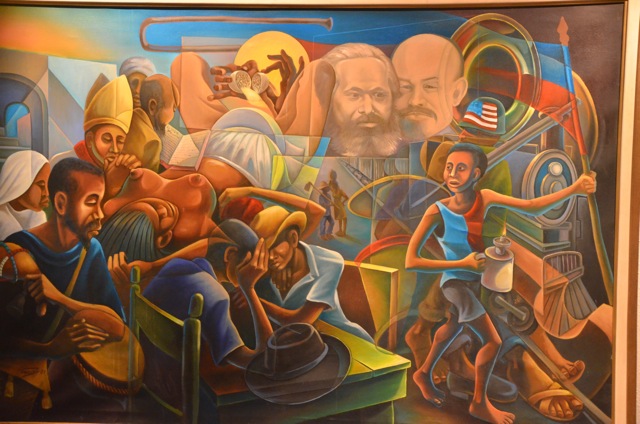
Pictured above is a painting from the art wing of the museum. It shows the metaphorical birth of Haiti, with many of the country's influences.


Bel


Saturday, June 12, 2010

Digging Up Haitian History


Since John's last trip to Les Cayes, he had been wanting me to meet a German man, Johannes, who lives in the area and knows a lot about Haitian history. As you will see, in fact, he and his wife Luise are living on top of it.

We met them at their home just up the hill from our guest house. Johannes and Luise have been living in Haiti since 1975. Since then, Johannes has learned a lot about Haitian history. He explained to us the difference between the two native groups who populated Haiti before Christopher Columbus arrived. The Tainos, the majority group, were originally from Brazil and were peaceful. The more aggressive Arawks, who came from the northern islands of South America, like Guyana, would send attacking parties to fight the Tainos, and, according to Johannes, also practiced cannibalism.

Johannes then brought out some of the pottery and other artifacts that he has found on his property.


The dirt holds layers of history: the lower you go, the more ancient the history. He has also found bottles and other things that the French brought over. Johannes held out a part of a bone and said, "Here's just a little piece of someone's body that tells how they died." It was a vertebrae with part of a iron rod through it.


The Haitian Revolution, which started in the 1790s was a bloody war. "It was based on dishonesty," said Johannes. The French told the slaves that if they helped them defeat the Spanish, who were attacking from the east side of the island and the English, who were attacking from the sea, that the French would give the slaves their freedom. Napoleon reneged on the deal, though, and things got ugly. With its massive production of coffee, sugar, and other products, he thought Haiti, the richest French colony and one of the richest colonies in the world, was too valuable of a colony to lose. When the Haitian slaves defeated Napoleon's troups, the first and only black republic started by freed slaves was born.
The picture at the top of this post is a view from Johannes' backyard. After breakfast, we went outside and Johannes showed us a wall of dirt where he began picking out little pieces of property. It's amazing what history we are living on top of!


Tuesday, April 07, 2009

Catching Up with the News

A few weeks ago, Clinton, pictured above with UN Secretary-General Ban Ki-moon, Haitian-American singer Wyclef Jean, and most importantly, a sister we know and beautiful Haitian children, traveled to Haiti.

In the above picture, which I found at Wyclef Jean's website, Clinton and company are visiting an oasis in Cite Soleil run by the Daughters of Charity. In their complex, the Sisters have schools, a medical clinic, programs to teach women how to sew, a malnutrition program for children and other things I know I am forgetting. In the squalor and harshness of Cite Soleil, the Sisters' place is a calm, beautful setting where people are safe and cared for, at least for awhile.

John has volunteered at their medical clinic. It is one of his favorite places to work in all of Haiti.

Clinton traveled to Haiti, where he is very popular, thanks to his role in restoring Aristide to power in 1994, to encourage the international community to invest in Haiti. There are a lot of people in Haiti who want work and who will work hard.

Also in the news recently was Cardinal Francis George of Chicago's welcome call for President Aristide to extend Temporary Protected Status (TPS) to Haitians currently in the United States. Here's an excerpt from the Cardinal's excellent letter:

Haiti meets the standard for TPS because it has experienced political tumult, four natural disasters, and severe food shortages in the last year, not to mention the devastation of Hurricane Jeanne in 2004. In April 2008, starving citizens took to the streets to protest rising food prices, causing political instability.

In August and September 2008, Hurricanes Gustav and Ike and Tropical Storms Fay and Hanna passed through Haiti, causing severe damage and the death of close to 700 persons. Massive flooding from the storms has destroyed homes, crops, roads, and bridges, and largely rendered areas like Gonaives inaccessible to relief workers. Over 90 percent of Haiti has been impacted. Tens of thousands have been displaced, and the fate of thousands more is unknown. More than 300,000 children have been affected.


As the Cardinal goes on to say, the conditions in Haiti are as bad as or worse then El Salvador, Nicaragua, and Honduras, where TPS was recently extended.

Here's hoping the Cardinal's letter helps.

Thursday, January 01, 2009

Bring on 2009!


Whoopee! Happy New Year's everyone. It's a very big day in Haiti, as January 1 is also their independence day. In 1804 on this date, the bloody, more-than-10-years-long Haitian Revolution finally came to an end, with the former slaves defeating Napoleon's finest. Haiti became the world's first and only country established through a slave rebellion.

Here's an interesting and important way that the Haitian war for independence affected American history. As Napoleon and France went down in defeat to the Haitians, the Emperor decided to sell the Louisiana Territory to the United States for $15 million dollars, or less than three cents an acre. The Louisiana Purchase, which now comprises 13 states, doubled the size of the United States.

With the loss of Haiti, called the Pearl of the Antilles for its rich agricultural output, as a French territory, Napoleon lost one of France's cash cows. Some thought that Napoleon had designs on North America, but the difficulty he had in Haiti forced him to forfeit these plans and sell the Louisiana Territory.

So the United States owes Haiti. We repaid them by not recognizing Haiti for more than 50 years, as we didn't want our own slaves getting any ideas about revolutions.

Fast forwarding to today:with four hurricanes and their resulting damage, skyrocketing food costs, widespread malnutrition and even starvation, more kidnappings, etc. etc., 2008 was not one of Haiti's better years. I guess that's true for the rest of the world too, Obama's election notwithstanding.

And on a personal level, I'm glad to see 2008 come to an end.

Let's work to make 2009 a better year for Haiti and all of us.

Saturday, February 03, 2007

The Aristide Years: Haitian History Part III


Jean Bertrand Aristide, formerly a Catholic priest, was Haiti’s first democratically elected leader. Widely popular among the poor, whom he served as a parish priest, Aristide won the presidential election in 1991 with 67% of the vote. But Aristide served only 8 months of his term before he was overthrown in a military coup led by Raoul Cedras. Aristide spent part of his exile in the U.S. In 1994 with the help of U.S troops, Aristide was restored to power. However, the embargo against Haiti during his enforced absence along with terror of the Cedras regime crippled Haiti’s economy. Aristide disbanded the national army, which was guilty of severe human rights violations. He finished out his aborted term in 1996. Rene Preval, Haiti’s current president, followed Aristide, serving from 1996-2000.

In 2000, Aristide ran for president again and won, this time with almost 92% of the vote. But again, Aristide was not able to serve out his full term. A rebellion led by many former army officials took control of the northern part of the country in 2004. As they were advancing to Port-au-Prince, Aristide was escorted by U.S. military to a plane and flown to the Central African Republic. Aristide asserts that he was kidnapped by the U.S. government.

Aristide is a controversial figure among many people. Some have tried to link him to drug dealings and opposition killings. Others were unhappy with him because he did not embrace American-style development. But even those who view him negatively would grudgingly admit that he was overwhelmingly elected president of the country twice. Aristide’s elections, ousters, and legacy may embody better than anything the clash in Haiti between the poor who are the majority and the rich who hold the power. It is an old story.

And things have not gotten better in the three years that Aristide’s been gone.

Friday, January 12, 2007

Haitian History Part II


The United States’ treatment of Haiti did not improve markedly in the 20th century. From 1915 to 1934, U.S. forces occupied Haiti. Why? Many of a nation’s seemingly inexplicable decisions can be deciphered by one formula: follow the money. Woodrow Wilson ordered the forces to Haiti because he was concerned about how much economic control that Germany and other countries had in Haiti. Germany controlled 80 percent of foreign trade. Perhaps the U.S. was worried about how this foreign influence would affect its interests: a U.S. owned bank, National City Bank (now Citbank) controlled Haiti’s national bank and railroad.

The U.S. did some good stuff while we were in Haiti. Schools, roads, and hospitals were built. But the U.S. imposed presidents, a constitution, and legislation, including a forced labor provision, on Haiti. A rebellion against the occupation was put down by the American military with the resulting death of 13 American soldiers and 3,071 Haitians. The occupation also resulted in a centralization of government and industry from the countryside to Port-au-Prince, destabilizing the socio-economic structure of the country and causing a huge influx of people into the city.

After the U.S. left Haiti, the country went through a series of presidents until Francois Duvalier (Papa Doc) became president in 1957. He appointed himself as President for Life in 1964 and terrorized the citizenry with his personal militia, the notorious Tonton Macoutes. Under Duvalier, Haiti became one of the most repressive regimes in the hemisphere. One estimate is that 30,000 people were killed by Duvalier. The United States was obsessed with Cuba and anti-communism, so we weren’t substantially critical of Papa Doc’s government.

Thank you for your patience as we take this brief tour through Haitian history. We’re almost finished and then we will get to the what-can-we-do-now part of this series.

I encourage everyone, including me, to learn more about Haitian history. There are dozens of books on the subject. Two I would suggest are:

Written in Blood: The Story of the Haitian People 1492-1995 by Michael Heinl
and others. This is the most comprehensive English language account of Haiti’s
history.


The Uses of Haiti by Paul Farmer. Dr. Farmer is a physician who spends much of
his time in Haiti and has introduced ground breaking programs to treat HIV, TB,
and other diseases in the developing world.

Sunday, January 07, 2007

Haiti Started Rough


I’m of the past is prologue school more than the past is a bucket of ashes school. So I have to start this discussion of Haiti with a very brief tour of its history.

Haiti occupies the western third of the island that Columbus named Hispaniola. The natives who lived here prior to the arrival of the Europeans in the 1490's called their home Hayti, which means high country. After these Indians were exterminated by the Spanish, the colony became known as St. Domingue.

The French, who came after the Spanish, turned the colony into their richest overseas possession. But not by themselves. In 1791, the population of the colony was: 39,000 white people, 27,000 people of mixed blood, and 452,000 slaves. You can guess who was doing the majority of the work on the sugar and coffee plantations, which were so productive that Haiti was called “the pearl of the Antilles.”

The Haitian slaves were treated brutally and died early and often. As a result, 20,000 new slaves had to be kidnapped from Africa each year to keep the plantations running. Consequently, two-thirds of the slaves living in the colony in 1791 had been born in Africa. They spoke Creole, a hybrid of French and African languages, which is still spoken today. They had memory of being free.

In 1789 there was a little thing called the French Revolution. The slaves heard about concepts like “the Rights of Man” and took them seriously. In 1791, slave uprisings launched the Haitian Revolution, a fractious, brutal, bloody 13-year-war, which ended when the slaves drove Napoleon’s troops from the island. Haitian independence was declared on January 1, 1804. It was an uneasy alliance between the blacks and the people of mixed blood—there were 64 different shades of color identified—fraught with counter-productive power struggles and violent skirmishes. But the white slave owner ruled no more.

Haiti became the first and only country established by a slave rebellion and the first black republic. Do you think France, whose rule the slaves overthrew, or the United States, Haiti’s democracy-loving, revolution-fomenting, but—alas—slave-holding neighbor to the north west, was thrilled about these firsts? No, they were not. The U.S instigated trade blockades and didn’t recognize Haiti until 1862. France demanded that Haiti pay 90 million in gold francs as restitution to French plantation owners. It took Haiti 100 years to pay this surreally unfair levy.

Haiti, welcome to the league of nations.