Showing posts with label John. Show all posts

Tuesday, June 23, 2009

We Are All Broken

I thought maybe I could use a funny photo to help make a point about Haiti, which I will get to eventually. One of John's childhood neighbors sent him this picture yesterday. It was taken sometime around 1964. John is on the right in the back row and his brother Tom is sitting next to him shirtless. The boys are acting goofy, as young boys often take pleasure in acting.

Over the past few days, I've been reading a book, Living Gently in a Violent World by Stanley Hauerwas and Jean Vanier. Stanley is a university theologian and Jean Vanier founded L'Arche, "an international network of communities where people with and without intellectual disabilities experience life together as human beings who share a mutuality of care and need."

So much of what is in the book reminds me of Haiti. First, just the juxtaposition of the words Gently and Violent in the title, for Haiti and Haitians are both gentle and violent. I find the people to be gentle and when they are not, it is often the violence of the poverty that elicits the violence.

Jean Vanier talks about God's vision for the world: "It is a promise that people can get together. It is a vision of unity, peace and acceptance. It is a promise that the walls between people and groups can fall, but that this will not be accomplished by force. It will come about through a change of heart--through transformation. It will begin at the bottom of the ladder of our societies." (Italics mine)

It will begin in places like Haiti.

I want to quote a number of passages in the book where Jean Vanier is talking about people with disabilities. What he says, I think, also applies to Haiti.

"Jesus wants to break down the walls that separate people and groups. How will he do this? He will do it by saying to each one, 'You are important. You are precious.' There can be no peacemaking or social work or anything else to improve our world unless we are convinced that the other is important. Your are precious. You--not just 'people' but you."

"When we listen to stories of terrible pain and know we can't do anything about it, we touch our own vulnerability. We have heard the scream of pain, but we don't know what to do with it. None of us knows what to do with the deep brokenness of our world. Maybe that realization can bring us back to community. We can do nothing on our own. We need somewhere to be together."

"We must begin at the bottom. Jesus came to announce good news to the poor, freedom to captives, liberty to the oppressed, sight to the blind. Let's help the poor to rise up, and then help those who have power and money to see that for the sake of peace, which is the greatest good human beings can seek, they too should enter into this vision and start helping the weak to rise up."

"Jesus came to change a world in which those at the top have privilege, power, prestige and money while those at the bottom are seen as useless. Jesus came to create a body. Paul, in 1 Corinthians 12, compares the human body to the body of Christ, and he says that those parts of the body that are the weakest and least presentable are indispensable to the body. . . Who really believes it?. . .Do we really believe that the weakest, the least presentable those we hide away--that they are indispensable? If that was our vision of the church, it would change many things."

"I have been trying to point out that our deep need is to meet those on the other side of the wall, to discover their gifts, to appreciate them. We must not get caught up in the need for power over the poor. We need to be with the poor. That can seem a bit crazy because it doesn't look like a plan to change the world. But maybe we will change the world if we are happy. Maybe what we need most is to rejoice and to celebrate with the weak and the vulnerable. Maybe the most important thing is to learn how build communities of celebration. Maybe the world will be transformed when we learn to have fun together. I don't mean to suggest that we don't talk about serious things. But maybe what our world need more than anything is communities where we celebrate life together and become a sign of hope for our world. Maybe we need signs that it is possible to love each other."

My head is swirling with the truth of these statements. Let me just add a few more thoughts. Sometimes I get a little nervous when people start talking about how happy the poor are, not that I think that's what Jean Vanier is doing at all. People living in poverty have much to teach us about what is important. But I also think that some of the horrid, torturous conditions that I have seen children living in shouldn't be tolerated and we should work fervently to alleviate those conditions.

Secondly, when I think about how people at the bottom of the ladder are seen as worthless by the rest of the world, I think of my son. My son, who is an absolute dynamo, smart, compassionate, athletic, loving, my son was on the last rung of this ladder until God brought him to us. For me, he represents all of the children in the developing world who exist in such conditions that their gifts are lost to them and to the world. We are not seeing clearly.

Thirdly, we are all broken. All of us, probably none so much as those of us overachievers in the First World. Even those cute, little boys in the picture at the top, who all went on to become successful men. But as Jean Vanier would point out, they are having fun.

Because I've been so inspired by him, I'll give the last words to Jean Vanier: "The heart of L'Arche is to say to people, 'I'm glad you exist.'"

Tuesday, June 16, 2009

Home Away From Home


John is off for Haiti today. Because of the fruit-basket-upset nature of our lives, he's never quite sure he's going to go until the night before he is scheduled to depart. There's always a lot to coordinate here and in Haiti. He's pretty much got packing down to a science; the indispensibles are: two cell phones, computer, camera and attachments, batteries, headlight, passport, scrubs, and lots of medicines. John always has to make at least one run to a pharmacy to get meds for our Haitian patients. We are also grateful to the many people who donate medicines, including the Heading Avenue Sisters.

It's a relatively short trip this time, but John will get a lot done, like he always does. His plans include: working in the clinic at the Daughters of Charity's place in Cite Soleil; examining a child who has Down Syndrome and a heart problem which can accompany this syndrome; delivering medicines and other supplies to our patients and their families; examining new and old Haitian Hearts patients, bringing Frandy a TOEFL book and a surprise; attending the funeral of Father Gerry Jean-Juste at the cathedral in Port-au-Prince and also his burial in Cavaillon. Of course, the unplanned activities take up a lot of time too

When he left this morning, John wasn't sure where he would be staying during his trip. Some guesthouses and hotels are full, a good sign for the country. But he will manage, in this place that lays claim to a big part of his heart.

Saturday, March 22, 2008

Attorney for the Poor


I don't think I've written enough about how much I admire my husband John for his work in Haiti and on behalf of Haitians. He gives his all in so many ways. The clinics and hospitals where he works in Haiti are jam packed with patients, many of whom are very sick. John loves being able to give these babies and children the medicines they need, medicines that often save their lives. But it is hard not to have all the tools and medicines to appropriately treat every patient he sees. And even when children are cured, knowing that they return to the same poverty-stricken environment that may have given rise to their illness is a psychological burden.

Bringing children to the States for surgery is an endeavor requiring a Sisyphusian-amount of effort. Children with heart problems have to be identified and sent for an echocardiogram. The parents must keep in touch with us and obtain a passport for their child. Up north, John asks hospitals and doctors if they would be willing to accept a Haitian patient for free or at a greatly reduced cost. He hears no much more often than yes. When a hospital does accept a child, a raft of paperwork must be completed and sent to Haiti so that the U.S. consulate will grant a visa for the child. Then the Haitian state has to give their permission for the child to leave without a parent. . . more paperwork. Airplane tickets and host families must be arranged for. When the child arrives, usually with John accompanying him, all kinds of medical, language, and other details need to be taken care of until the child returns to Haiti. John always follows up with the children on later trips to ensure their recovery is going well.

I guess the thing I find the most admirable about all that John does is that he doesn't have to do it. The heartbreaking reality is that no one--or very few people--care about these children and the awful circumstances of their lives. If enough people cared, the world would change. There is no political, social, or economic pressure to get these children care; in fact, I would say that there is pressure not to get them care. It would be so easy to forget these kids when the Haiti trip is over. But John doesn't.

So I am glad when John receives recognition for his hard work. It is nice to have it appreciated and it encourages us to keep on. In the next post, I'll reprint a commendation John and Haitian Hearts recently received from the Haitian consulate in Chicago.

"The physicians are the natural attorneys of the poor, and the social problems should largely be solved by them." Rudolf Virchow

Monday, August 14, 2006


Ceftriaxone and the Purpose of Life:

“It’s not good when you see nine and ten-month-old babies with dirt under their fingernails,” says John of some of his patients. It means they are spending too much time on the ground in the filth. This isn’t a safe place for anyone, much less babies.

Some of these babies also have high fevers, brought on by various infections. Bacterial infections are treated with antibiotics. We brought 30 grams of ceftriaxone with us, a heavy duty, injectible antibiotic. This drug went generic last summer. Under the brand name, Rocephin, it cost $40 a gram. Now, it’s only $10 a gram in the United States and $33 U.S. a gram in Haiti, which is still much too expensive for the average poor Haitian.

John can usually get about two doses from each gram, depending on the size of the child. Many times he will have a nurse give one injection and have the mom and baby return the next day for another. Often after the first dose, the child will be much improved the next day. Three weeks into this trip, John has already administered about 30 injections.

Of course, the source of many of these infections is dirty water and other unsanitary conditions. Given that we aren’t eliminating the source of the infection, does our work seem pointless? No, and I’m going to let Dr. Francis Collins, who directed the Human Genome Project, one of the most scientifically significant projects ever, tell you why:

“I went to West Africa to work in a small mission hospital for a month. I went there in the midst of all sorts of other scientific endeavors. It was a bad time to leave, but I really wanted to do this. I went there with this image that I was going to make a profound difference in that situation. After a couple of weeks, I was really depressed. Here was a circumstance where all the patients I was trying to take care of had diseases that didn't have to be. They were the consequence of poor public health, of contaminated water, of inadequate nutrition. I knew I could pull some of these people back from death, but I knew they'd go right back out to that situation. My dreams of myself as the healer for this large population were lying in pieces on the floor.

“One morning I walked in to see a young farmer who we had treated the day before for tuberculosis, and he looked at me and he said, 'You know, I get the feeling that you're wondering why you're here.' He said, 'You came here for one reason. You came here for me, and that ought to be enough.' And that sticks in my mind -- more than any moment I think I have experienced in my life -- as truth. We should have our grand dreams, we should pursue them, that's what being human is all about, that's part of the nobility of our enterprise. But we should never forget that what really matters is what you do one-on-one with a single human being. Where you reach out and you try to help them make their life a little better. And if that's all you do, your whole life is to do that occasionally, then you have succeeded.”

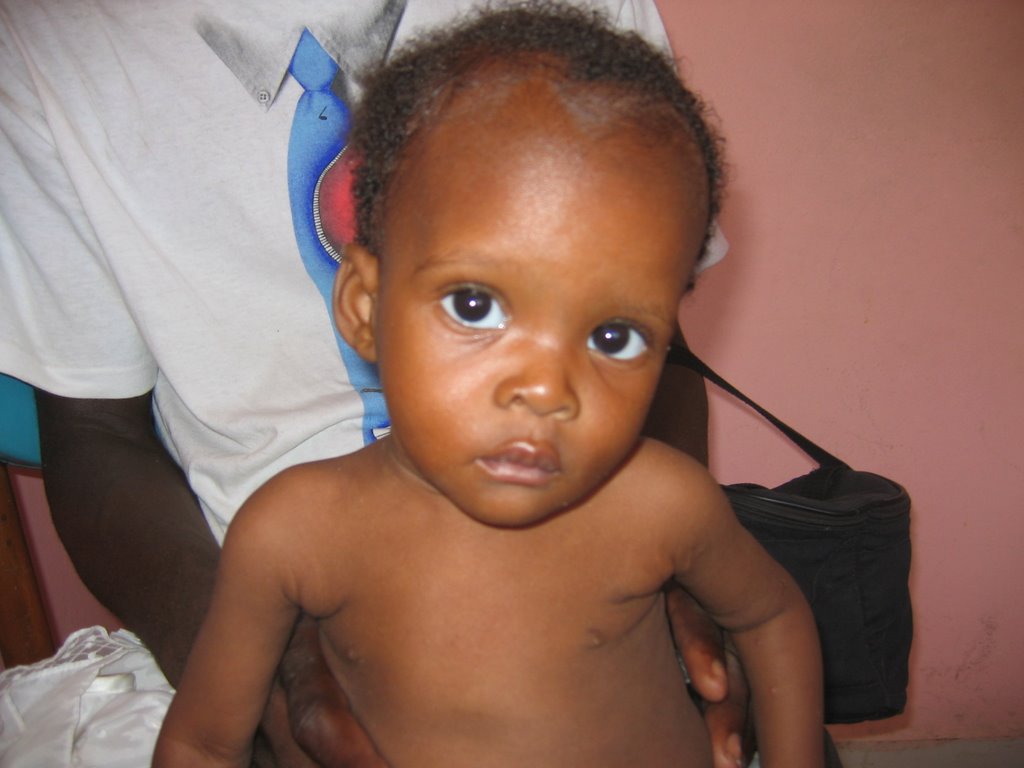
John treated the child pictured above at the pediatric clinic at Grace Children's Hospital in Port-au-Prince.

Friday, March 31, 2006

Sister Sophie’s Clinic:

John has been coming to this clinic for many years. Mondays, Wednesdays, and Fridays are pediatric days, and the moms begin lining up with their children at 3 a.m. The clinic averages 50,000 patient visits a year, comparable to a good-sized U.S. emergency room. When John isn’t there, the clinic is staffed by two doctors, a few nurses, and some pharmacy techs. One of the nice features of this clinic is that one small fee covers the appointment and any necessary medicines.

Given the violence, we haven’t been here since September and it is good to see Sister Sophie again. We catch up on all the news in the neighborhood. Despite the reduction in violence, a neighborhood vagabond was shot 17 times and killed (redundant) by a rival gang the prior evening not far from the clinic.

The first child John sees has swollen, hardened lymph nodes under his arms so John orders a chest x-ray. The next few kids have mild fevers, coughs, and running noses—the Haitian crud, John calls it. He attempts to look in the children’s ears with his otiscope as they sit on their mothers’ laps. The otiscope with its pointy probe must look like an instrument of evil to the kids, as they want nothing to do with it. But ear infections are rampant in Haiti, so it’s important for him to check. As we lay the third screaming child on the cot to hold her down so that John can get a good look in her ear, he jokes, “ It must be bad child day today.” In reality, John likes to take care of kids because they have no interest in being seen by a doctor, which to him is a sensible attitude. “I didn’t ask to come here today and have that thing stuck in my ear,” he imagines the child saying to his mother. Many adults, on the other hand, are only too happy to go on and on about what ails them and will take all the attention a doctor can give them.

Being Friday, it’s a fairly light day at the clinic. We will see what next week holds.

Saturday, December 24, 2005

A Working Doctor’s Day in Haiti:

John’s workday is slightly more productive than mine. While I head for my courtyard seat, he passes through the waiting area of the clinic, lined with mothers sitting on wooden benches holding babies, to the office that he shares with Dr. Jean-François, a young Haitian pediatrician. They will spend the next several hours examining and treating sick babies and children. Dr. John and Dr. Jean-François are physicians cut from the same scrubs; they love to consult with each other about patients and discuss different protocols for treatment.

We met Dr. Jean-François about a year ago. He is 38, drives a Toyota Tercell, which he’s owned for seven years, and dresses in neat long sleeved cotton shirts, always adorned with a tie. He is a short, compact, friendly man, who exudes competence and calmness. The first day we came to clinic, he burst into the exam room laughing with happiness at seeing John. It’s great for him to have an American doctor to talk with.

Dr. Jean-François is an excellent pediatrician; during his residency, he was the head resident. He is very precise in his exams, his documentation, and his prescriptions. He loves to teach, as does John, so they teach each other. John brought him some Christmas presents: several issues of the New England Journal of Medicine and The Lancelet, a British medical journal.

The last patient the two doctors are seeing today is a three-month-old baby with a terrible grunting cough and a temp of 102. His parents from Croix des Boquets (Cross of Flowers), a town on the outskirts of PAP, where much of the area’s beef comes from, look as poor as the dirt on their clothes. John has given them 500 gourdes (about $12 U.S.) to help pay for the tests and any medicines that will be prescribed. Sometimes parents will bring their child in for an exam ($2 U.S.), but they won’t have the money for the blood tests, xrays, or medicines that are needed. This is one of the frustrating realities of practicing medicine in Haiti, especially for American docs.

This baby likely has pneumonia. The question is: what is causing it? The cause will determine treatment. Due to the baby’s dry cough, Dr. Jean-François feels 80 percent certain a virus is the culprit. He declines John’s offer of a heavy duty antibiotic, Rocephin, generic name ceftraxione. We have brought this precious medicine from the U.S. as it is expensive and in short supply in Haiti.

In the U.S., not giving this sick of a baby an antibiotic could result in a malpractice suit. As a rule, bacterial pneumonias kill more rapidly than those caused by viruses (untreatable) or tuberculosis (treatable). As John points out, if Dr. Jean-François is wrong about the cause, he is taking a big risk not giving the baby antibiotics. Dr. J-F looks at it a little differently. In Haiti, Rocephin is as scarce and valuable as gold; his philosophy is that he doesn’t want to waste it on a baby who doesn’t need it. Plus, it’s never good for a baby who doesn’t need an antibiotic to receive it; it leads bacteria to become resistant to the medicine.

John is picturing what he would do for this baby if he presented at the emergency room with these conditions: blood tests, x-rays, antibiotics, and an admittance to the hospital would greet the baby. Anything less could be grounds for a lawsuit. Dr. J-F understands the differences between practicing medicine in Haiti versus Miami. It’s just that he’s in Haiti.

Tuesday, December 20, 2005

The Knowing or Unknowing Boy?

A 13-year-old boy, all arms and legs, has come in. He is sweet-looking and quiet, in the throes of gangly adolescence. His skin is pale, and the collar on his denim shirt is dusty. He has HIV. In Haiti, the acronym for AIDS is SIDA, backwards like many things.

John asks the woman with him if she is his mother. “Wi,” and “Non,” she confusingly replies, both shaking and nodding her head, as she stands behind the boy. Dr. Jean-François, the young Haitian pediatrician, who sees all of the children at the clinic with HIV, says to us in his ever-improving English, “I will explain to you later.”

But while the boy and woman are still in the room, Dr. Jean-François begins his explanation, still in English, of the reason for her ambivalent reply. “This is the boy’s aunt. His mother is dead, and he thinks his aunt is his mother.”

At the end of the exam, John tosses the boy a piece of gum across the desk. He catches it with ease, and says, “Thanks.” I am a little alarmed by this English response, wondering how much of our talk the boy understood.

After they have left, Dr. Jean-François tells us that the boy has said to his aunt, “If I have the bad disease, I will kill myself.” I hope this isn’t a warning, because he seems too smart to fool.