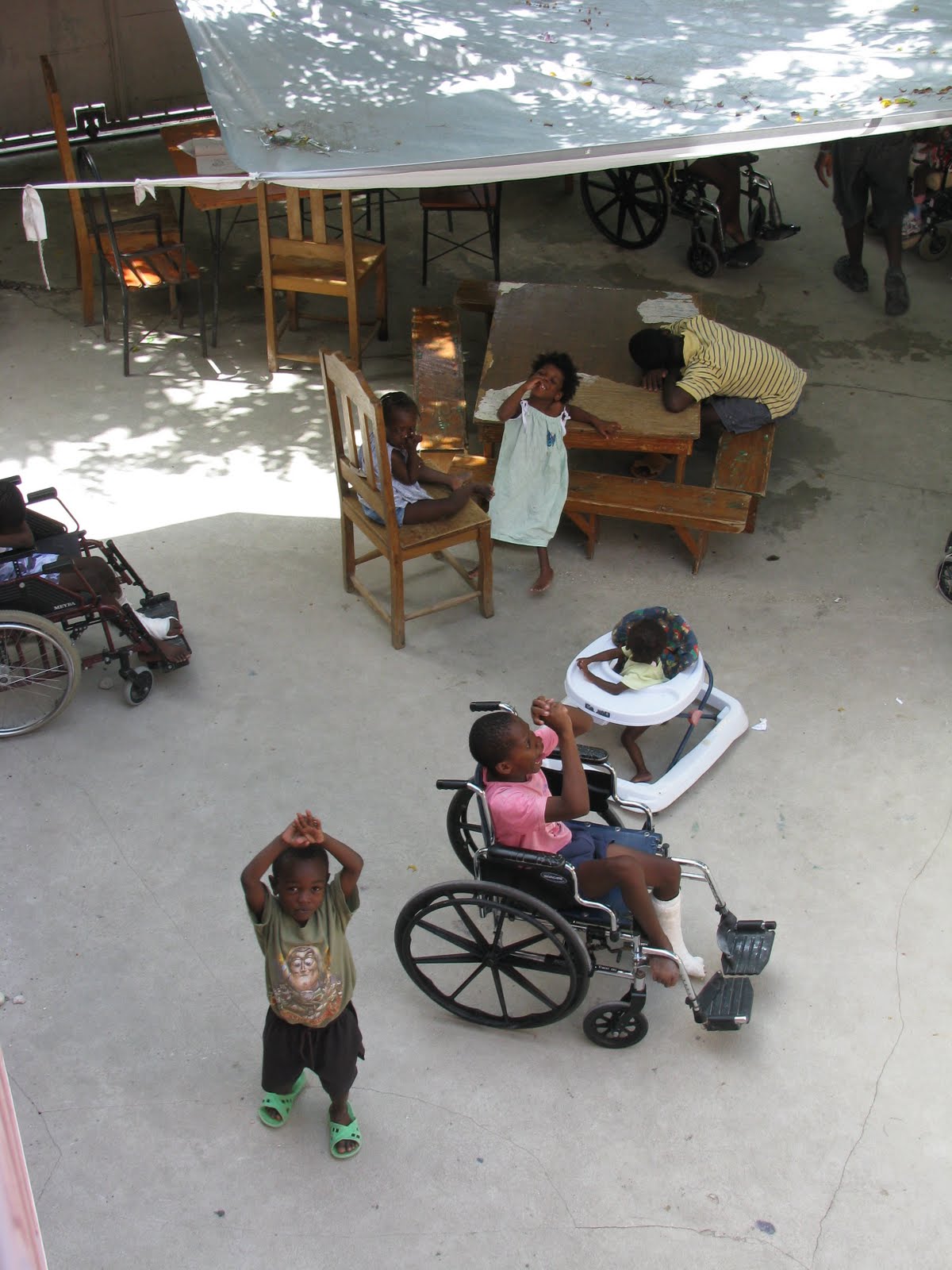
Here is an excellent guest post from my husband John. It describes what we saw in Haiti on our recent trip and some thoughts about it.
My wife Maria and I worked in Haiti during part of the months of May and June. We stayed in a guesthouse-orphanage just outside of Port-au-Prince.
A lady named Yolande lived right across the street from us.
Yolande is 78 years old and lives under a blue tarpaulin which encloses a small pup tent inside.
During the earthquake on January 12 her shack, which was located several miles away, was so damaged that she had to move out. Yolande suffered some leg injuries at the time of the quake and still has one lower leg wrapped in a rag. But Yolande smiled and told me that her legs were "much better".
One afternoon shortly after we arrived, I entered an opening in Yolande's blue tarp. The stifling heat, humidity, mosquitoes, and flies were overwhelming.
The tarp was fastened to thin wooden poles and tied above with shoe laces and other fragments of cloth.
Yolande's family brings her rice and vegetables when they can and she cooks in a metal bowl over pieces of charcoal.
I found Yolande to be a practical and pleasant woman. She did not complain about her living arrangements and even said that Americans are the most charitable people in the world. I sure did not feel that way right then as I hurried out from under the tarp so I could get a breath of cooler air in the street.
During this time of the year in Haiti, the rain comes in torrents in the late afternoon or evening, and now this rain seeps through Yolande's tarp and leaks into her tent. So on top of roasting, Yolande and her family are wet much of the time too.
These hardships are not isolated to Yolande.
Haiti has an estimated 9 million people with one third of the population living in the capital, Port-au-Prince. In this city there are over one thousand tent cities, and an estimated 1.5 million people are still homeless five months after the quake. Many people told me that they are simply too afraid to move back inside of their houses. If their houses are still standing, the walls may have been fissure (cracked) and people fear they will collapse on top of them.
Several miles from us downtown Port-au-Prince looks like a nuclear bomb struck it. The once beautiful Haitian National Palace is collapsed and the majority of nearby Haitian government ministry buildings downtown were destroyed in the 47 second earthquake. Haiti's tax building is pancaked just across from the Palace with its director's body and many employees still inside under tons of concrete.
A densely populated tent city now sits in front of the vacant Palace in Port-au-Prince's largest square called Champs de Mars. A young man who identified himself as Carlos told me some of their problems after I walked through his section of the tent city. Carlos seemed fatalistic and did not see any end in sight to their misery.
Rape is common in Port-au-Prince's tent cities and seldom gets reported. Poor women in tent cities have no rights.
Fountains and small decorative pools in Champs de Mar have turned into large toilets filled with stagnant sewage. Kids play nearby with their family's tent abutting these toxic cesspools. Sewage drainage and treatment facilities are more or less nonexistent.
In the chaotic months following the quake, millions of dollars flowed into Haiti from generous people all over the world. (One out of two American households gave to the Haitian relief efforts.)
And five billion more dollars from the international community has been pledged to Haiti over the next two years. Bill Clinton who is UN Special Envoy to Haiti. Recently Mr. Clinton along with Haitian officials have been in charge of the Interim Haiti Reconstruction Commission. One of the objectives of this Commission is to allocate these funds to ensure that the money is used in a transparent fashion for Haiti's post earthquake reconstruction.
Mr. Clinton and Haiti's Prime Minister Belleriviere announced the Commission's first approved spending projects:
- $45 million from Brazil and Norway in direct funds for the Haitian government, closing a quarter of its estimated $170 million budget shortfall.
- $1 million from the Clinton Foundation for buildings that can be used as storm shelters in the quake-ravaged towns of Leogane and Jacmel, which are often in the path of Atlantic hurricanes.
- A $20 million fund to provide loans to small- and medium-sized Haitian businesses.
But despite international pledges of some $5 billion over two years at the United Nations donors' conference for Haiti in March, only a fraction has actually been delivered - just $40 million from Brazil.
Even though other pledges are supposed to be delivered soon, I spoke to no Haitians during our entire time in Haiti who trusts that the money will be spent properly. People that I spoke with don't really trust Mr. Clinton any more than they do their own fragmented and dysfunctional government. Many are very angry with Haitian President Preval for his perceived lack of leadership and poor communication through Haiti's largest crisis in its history. They also feel he is cuddling up to international powers for business interests that will exclude the majority of poor Haitians.
And why should 9 million poor Haitians trust any one? They and their ancestors have been on the short end of the stick since Haiti was founded as a Republic more than 200 years ago. The corrupt Haitian state is considered to be a fact of life... not unlike corrupt Illinois politics.
So what do "we" do with hundreds of thousands of displaced and homeless Haitian people? Although Haitians are a tough lot, they are not as resilient as our defense mechanisms would like us to believe. And on top of this earthquake which was "biblical" in size, the U.S. National Oceanic and Atmospheric Administration has predicted a terrible tropical storm season coming Haiti's way in several months.
But so far (as of this writing) the Haitian government has relocated only about 7,000 vulnerable people to two safer camps. The relocation is slow because the crippled government doesn't have enough money to complete a job that includes not just setting up new tents, but providing work, schools and services.
First of all, should the tent cities continue to exist? Are they good enough?
No. These places are inhuman and horrible. Lack of food and water, lack of security, and the rain are a few reasons.
And the rain is quickly bringing more problems.
Malaria and typhoid fever were everyday occurrences in the area of the city where I was working. Stagnant dirty puddles of water are everywhere and are good breeding grounds for mosquitoes who will carry disease. I saw a teen-aged boy scooping up water in his hands drinking from a puddle in the road. Medical and public health interventions will not help the majority of Haitians unless their dangerous living environment is changed.
Also, heavy rains tempt unstable hillsides to unleash their mud. And serious flooding and mudslides could endanger not only Haitians but relief workers also.
Port-au-Prince, before the earthquake could have accommodated 300,000 people, not three million people. There has been decades of urban decay. This city is doomed right now unless a paradigm shift in thinking takes place.
We need to be honest and understand that many people are dying now and are still going to die no matter what is done. I saw children starving in front of me. I often wondered what good was my stethoscope in times like this.
So what needs to happen? What interventions will minimize the final death count? How can Haiti's problems be prioritized and triaged appropriately? What can be done to give some dignity to the life of over one million displaced Haitians? How do we stop the violence aimed at Haitian society's unfortunate losers?
Haitians tell me they want jobs. Who would have thought?
Jobs earn them money to repair their lives and their family's lives. Jobs allow one parent to stay at home during the day and take care of their babies and toddlers. Kids suffer alot mentally and physically when they are alone or being watched by a neighbor who is already swamped with problems. Children are literally down in the dirt and sewage and their chances for survival diminish without a parent home.
Mother's can breastfeed if they are home. And when mother's breastfeed, they save money because they do not need to purchase milk. And if they purchase powdered milk, they may accidentally prepare it with dirty water which can sicken their children.
With the billions of dollars that hopefully will come to Haiti, big firms with heavy equipment should be hired. Skillful urban planners from all over the world need to work with the Haitian government.
And most importantly poor Haitians need to be hired.
Hundreds of thousands of young, strong Haitian men and women that live in the capital would jump at the chance for a job. Hire them and pay them fairly so they can feed their families while they make a new and better Haiti. The billions of dollars of international pledges need to go for displaced Haitians while they perform the back breaking reconstruction of Haiti.
Pay Haitians in tent cities to repair or rebuild their own homes--the structures where they were living pre earthquake. Or pay the man that rents the home to these people. And these homes need to be earthquake proof homes using Western building codes. Earthquakes don't kill people, bad buildings do.
The huge mounds of rubble on the Port-au-Prince streets needs to be cleared so the streets can be navigated by cars and big equipment. The traffic jams in the capital now slow progress for everyone.
Many people have returned to their neighborhoods after inspections found their homes safe, but often return to the tent camps when word of aid distribution spreads. So food and water distribution needs to be local--- brought to people in their neighborhoods as their homes are rebuilt.
Port-au-Prince needs to be decentralized. The earthquake negatively influenced 80% of Haiti's economy because PAP was and is the hub of the country. Now the hub is critically ill. The capital is built over fault lines and this all could happen again. Three million miserable people living on top of each other need to be spread back out to Haiti's provinces.
But for people to move to the Haitian countryside or smaller cities outside of PAP, there has to be jobs, family members with adequate housing that can accept their homeless relatives, and some basic services like schools, roads, water, electricity, and medical care.
Trees need to be planted and gardens started in these communities. Listening to Haitian grass roots organizations and the Haitian farmer is very important. These people know what they need to stay alive.
The local Haitian community in the province needs to be involved in all decision points.
Foreign aid that flowed into Haiti after the quake has hurt the Haitian farmers. Most of the people in Haiti's central plateau (L'Artibonite) earn their living by growing and selling rice, Haiti’s staple food. But the influx of foreign food aid has meant that many Haitians can now get rice for free. As a result, the price of rice grown in Haiti has plummeted and the Haitian farmer finds himself in more trouble.
Several months ago even Mr. Clinton was quoted as saying, "...we made a devil's bargain" when he was President. He publicly apologized for forcing Haiti to drop tariffs on imported, subsidized US rice. His policy hurt Haitian rice farming and, as reported by Kim Ives, "seriously damaged Haiti's ability to be self sufficient".
And let us not forget that Haiti, believe it or not, is in the digital age. The Haitian people in the countryside have cell phones and access to the Internet. Many Haitians are adept at using both. This means that they still communicate with Haitian relatives, the diaspora, overseas.
Haiti's diaspora has sent back billions of dollars over the past few decades to needy Haitian relatives, but this obviously has not been enough. The diaspora need to physically come back to Haiti and revitalize Haiti's industrial sector. But they won't come back and invest in Haiti unless than can do so safely. Most diaspora tell me they fear for their personal safety in Haiti. Security everywhere needs to be improved. And the economic climate for joint business ventures, to stimulate Haiti's diaspora to invest in Haiti, has to be improved by the Haitian government.
In conclusion, Haiti was a severely damaged country before the January earthquake and is even more damaged now.
Haitians are a beautiful and wonderful people, but they are not as "resilient" as we would like to believe.
Yolande, the little old tent lady who lived near us, should not be living like this. If Yolande were your grandmother, you wouldn't refer to her as "resilient" as she suffers the Haitian heat and mosquitoes, would you?
The huge international monetary pledges need to be allocated in a transparent fashion to help these neediest Haitians.
My wife Maria and I worked in Haiti during part of the months of May and June. We stayed in a guesthouse-orphanage just outside of Port-au-Prince.
A lady named Yolande lived right across the street from us.
Yolande is 78 years old and lives under a blue tarpaulin which encloses a small pup tent inside.
During the earthquake on January 12 her shack, which was located several miles away, was so damaged that she had to move out. Yolande suffered some leg injuries at the time of the quake and still has one lower leg wrapped in a rag. But Yolande smiled and told me that her legs were "much better".
One afternoon shortly after we arrived, I entered an opening in Yolande's blue tarp. The stifling heat, humidity, mosquitoes, and flies were overwhelming.
The tarp was fastened to thin wooden poles and tied above with shoe laces and other fragments of cloth.
Yolande's family brings her rice and vegetables when they can and she cooks in a metal bowl over pieces of charcoal.
I found Yolande to be a practical and pleasant woman. She did not complain about her living arrangements and even said that Americans are the most charitable people in the world. I sure did not feel that way right then as I hurried out from under the tarp so I could get a breath of cooler air in the street.
During this time of the year in Haiti, the rain comes in torrents in the late afternoon or evening, and now this rain seeps through Yolande's tarp and leaks into her tent. So on top of roasting, Yolande and her family are wet much of the time too.
These hardships are not isolated to Yolande.
Haiti has an estimated 9 million people with one third of the population living in the capital, Port-au-Prince. In this city there are over one thousand tent cities, and an estimated 1.5 million people are still homeless five months after the quake. Many people told me that they are simply too afraid to move back inside of their houses. If their houses are still standing, the walls may have been fissure (cracked) and people fear they will collapse on top of them.
Several miles from us downtown Port-au-Prince looks like a nuclear bomb struck it. The once beautiful Haitian National Palace is collapsed and the majority of nearby Haitian government ministry buildings downtown were destroyed in the 47 second earthquake. Haiti's tax building is pancaked just across from the Palace with its director's body and many employees still inside under tons of concrete.
A densely populated tent city now sits in front of the vacant Palace in Port-au-Prince's largest square called Champs de Mars. A young man who identified himself as Carlos told me some of their problems after I walked through his section of the tent city. Carlos seemed fatalistic and did not see any end in sight to their misery.
Rape is common in Port-au-Prince's tent cities and seldom gets reported. Poor women in tent cities have no rights.
Fountains and small decorative pools in Champs de Mar have turned into large toilets filled with stagnant sewage. Kids play nearby with their family's tent abutting these toxic cesspools. Sewage drainage and treatment facilities are more or less nonexistent.
In the chaotic months following the quake, millions of dollars flowed into Haiti from generous people all over the world. (One out of two American households gave to the Haitian relief efforts.)
And five billion more dollars from the international community has been pledged to Haiti over the next two years. Bill Clinton who is UN Special Envoy to Haiti. Recently Mr. Clinton along with Haitian officials have been in charge of the Interim Haiti Reconstruction Commission. One of the objectives of this Commission is to allocate these funds to ensure that the money is used in a transparent fashion for Haiti's post earthquake reconstruction.
Mr. Clinton and Haiti's Prime Minister Belleriviere announced the Commission's first approved spending projects:
- $45 million from Brazil and Norway in direct funds for the Haitian government, closing a quarter of its estimated $170 million budget shortfall.
- $1 million from the Clinton Foundation for buildings that can be used as storm shelters in the quake-ravaged towns of Leogane and Jacmel, which are often in the path of Atlantic hurricanes.
- A $20 million fund to provide loans to small- and medium-sized Haitian businesses.
But despite international pledges of some $5 billion over two years at the United Nations donors' conference for Haiti in March, only a fraction has actually been delivered - just $40 million from Brazil.
Even though other pledges are supposed to be delivered soon, I spoke to no Haitians during our entire time in Haiti who trusts that the money will be spent properly. People that I spoke with don't really trust Mr. Clinton any more than they do their own fragmented and dysfunctional government. Many are very angry with Haitian President Preval for his perceived lack of leadership and poor communication through Haiti's largest crisis in its history. They also feel he is cuddling up to international powers for business interests that will exclude the majority of poor Haitians.
And why should 9 million poor Haitians trust any one? They and their ancestors have been on the short end of the stick since Haiti was founded as a Republic more than 200 years ago. The corrupt Haitian state is considered to be a fact of life... not unlike corrupt Illinois politics.
So what do "we" do with hundreds of thousands of displaced and homeless Haitian people? Although Haitians are a tough lot, they are not as resilient as our defense mechanisms would like us to believe. And on top of this earthquake which was "biblical" in size, the U.S. National Oceanic and Atmospheric Administration has predicted a terrible tropical storm season coming Haiti's way in several months.
But so far (as of this writing) the Haitian government has relocated only about 7,000 vulnerable people to two safer camps. The relocation is slow because the crippled government doesn't have enough money to complete a job that includes not just setting up new tents, but providing work, schools and services.
First of all, should the tent cities continue to exist? Are they good enough?
No. These places are inhuman and horrible. Lack of food and water, lack of security, and the rain are a few reasons.
And the rain is quickly bringing more problems.
Malaria and typhoid fever were everyday occurrences in the area of the city where I was working. Stagnant dirty puddles of water are everywhere and are good breeding grounds for mosquitoes who will carry disease. I saw a teen-aged boy scooping up water in his hands drinking from a puddle in the road. Medical and public health interventions will not help the majority of Haitians unless their dangerous living environment is changed.
Also, heavy rains tempt unstable hillsides to unleash their mud. And serious flooding and mudslides could endanger not only Haitians but relief workers also.
Port-au-Prince, before the earthquake could have accommodated 300,000 people, not three million people. There has been decades of urban decay. This city is doomed right now unless a paradigm shift in thinking takes place.
We need to be honest and understand that many people are dying now and are still going to die no matter what is done. I saw children starving in front of me. I often wondered what good was my stethoscope in times like this.
So what needs to happen? What interventions will minimize the final death count? How can Haiti's problems be prioritized and triaged appropriately? What can be done to give some dignity to the life of over one million displaced Haitians? How do we stop the violence aimed at Haitian society's unfortunate losers?
Haitians tell me they want jobs. Who would have thought?
Jobs earn them money to repair their lives and their family's lives. Jobs allow one parent to stay at home during the day and take care of their babies and toddlers. Kids suffer alot mentally and physically when they are alone or being watched by a neighbor who is already swamped with problems. Children are literally down in the dirt and sewage and their chances for survival diminish without a parent home.
Mother's can breastfeed if they are home. And when mother's breastfeed, they save money because they do not need to purchase milk. And if they purchase powdered milk, they may accidentally prepare it with dirty water which can sicken their children.
With the billions of dollars that hopefully will come to Haiti, big firms with heavy equipment should be hired. Skillful urban planners from all over the world need to work with the Haitian government.
And most importantly poor Haitians need to be hired.
Hundreds of thousands of young, strong Haitian men and women that live in the capital would jump at the chance for a job. Hire them and pay them fairly so they can feed their families while they make a new and better Haiti. The billions of dollars of international pledges need to go for displaced Haitians while they perform the back breaking reconstruction of Haiti.
Pay Haitians in tent cities to repair or rebuild their own homes--the structures where they were living pre earthquake. Or pay the man that rents the home to these people. And these homes need to be earthquake proof homes using Western building codes. Earthquakes don't kill people, bad buildings do.
The huge mounds of rubble on the Port-au-Prince streets needs to be cleared so the streets can be navigated by cars and big equipment. The traffic jams in the capital now slow progress for everyone.
Many people have returned to their neighborhoods after inspections found their homes safe, but often return to the tent camps when word of aid distribution spreads. So food and water distribution needs to be local--- brought to people in their neighborhoods as their homes are rebuilt.
Port-au-Prince needs to be decentralized. The earthquake negatively influenced 80% of Haiti's economy because PAP was and is the hub of the country. Now the hub is critically ill. The capital is built over fault lines and this all could happen again. Three million miserable people living on top of each other need to be spread back out to Haiti's provinces.
But for people to move to the Haitian countryside or smaller cities outside of PAP, there has to be jobs, family members with adequate housing that can accept their homeless relatives, and some basic services like schools, roads, water, electricity, and medical care.
Trees need to be planted and gardens started in these communities. Listening to Haitian grass roots organizations and the Haitian farmer is very important. These people know what they need to stay alive.
The local Haitian community in the province needs to be involved in all decision points.
Foreign aid that flowed into Haiti after the quake has hurt the Haitian farmers. Most of the people in Haiti's central plateau (L'Artibonite) earn their living by growing and selling rice, Haiti’s staple food. But the influx of foreign food aid has meant that many Haitians can now get rice for free. As a result, the price of rice grown in Haiti has plummeted and the Haitian farmer finds himself in more trouble.
Several months ago even Mr. Clinton was quoted as saying, "...we made a devil's bargain" when he was President. He publicly apologized for forcing Haiti to drop tariffs on imported, subsidized US rice. His policy hurt Haitian rice farming and, as reported by Kim Ives, "seriously damaged Haiti's ability to be self sufficient".
And let us not forget that Haiti, believe it or not, is in the digital age. The Haitian people in the countryside have cell phones and access to the Internet. Many Haitians are adept at using both. This means that they still communicate with Haitian relatives, the diaspora, overseas.
Haiti's diaspora has sent back billions of dollars over the past few decades to needy Haitian relatives, but this obviously has not been enough. The diaspora need to physically come back to Haiti and revitalize Haiti's industrial sector. But they won't come back and invest in Haiti unless than can do so safely. Most diaspora tell me they fear for their personal safety in Haiti. Security everywhere needs to be improved. And the economic climate for joint business ventures, to stimulate Haiti's diaspora to invest in Haiti, has to be improved by the Haitian government.
In conclusion, Haiti was a severely damaged country before the January earthquake and is even more damaged now.
Haitians are a beautiful and wonderful people, but they are not as "resilient" as we would like to believe.
Yolande, the little old tent lady who lived near us, should not be living like this. If Yolande were your grandmother, you wouldn't refer to her as "resilient" as she suffers the Haitian heat and mosquitoes, would you?
The huge international monetary pledges need to be allocated in a transparent fashion to help these neediest Haitians.