Wednesday, January 26, 2011

Widnerlande's Successful Surgery!


At long last, Widnerlande had surgery at Sutter Memorial Medical Center in Sacramento on Monday. I am happy to report that the surgery was very successful and her recovery is going well. In the operating room, they discovered that she had two VSDs (Ventrical Septal Defects), which are openings between the lower chambers of the heart. One was so small, it wasn't visible to the naked eye. Both openings have been patched. This surgery will add decades to Widnerlande's life. Her resting heart rate would go has high as 164 a minute and her respiration rate could get to 80 breaths a minute. These were signs that her little heart was having to work too hard. With the repairs, her heart and lungs and whole body will have an easier time of it.

So many people helped make this happen, (please read John's account) but the two guys most responsible are pictured above: my wonderful husband John Carroll, who for six years, never gave up on Widnerlande and Dr. Teimour Nasirov a great guy and a great surgeon who worked his magic in the operating room.

We also thank from the bottom of our hearts, Sutter Memorial Medical Center for their generosity to Widnerlande. Because of everyone's efforts, a little girl from a very poor family in Haiti will live decades longer than she would have.

Thursday, January 20, 2011

The Patient Gets Sick


So at 5:30 this morning, I'm helping Widnerlande get dressed, as today is the big surgery day, and as my hand brushes her stomach, I think, "Gee, she feels warm. Really warm." And, of course, she was running a 101 degree temp and, of course, surgery was postponed until Monday. I say of course, because if you've been following the journey of Widnerlande then you know it's been full of obstacles, large and small. In the scheme of things, this is a small one, though, of course, it's easy to get a little discouraged.

But what is the point in that? We are so blessed to be here in Sacramento, so blessed to have Widnerlande accepted by Sutter Memorial and Dr. Teimour Nasirov, who will fix the hole in her heart on Monday, instead of Friday, so blessed to be getting a break from the harsh Midwestern winter, and so blessed to have met so many wonderful people. Blessed, even, to discover that Widnerlande has a little virus before surgery. We can't control everything and there is no use fretting about what we can't, a lesson I seem to have to relearn on a regular basis.

One of the things we can control are the choices we make in this moment, this one right now. We can choose our attitude, and I'll leave you with a quote that helps me with mine.

"The longer I live, the more I realize the impact of attitude on life. Attitude, to me, is more important than facts. It is more important than the past, than education, than money, than circumstances, than failure, than successes, than what other people think or say or do. It is more important than appearance, giftedness or skill. It will make or break a company. . . a church. . . a home. The remarkable thing is we have a choice everyday regarding the attitude we will embrace for that day. We cannot change our past. . .we cannot change the fact that people will act in a certain way. We can not change the inevitable. The only thing we can do is play on the one string we have, and that is our attitude. I am convinced that life is 10% what happens to me and 90% how I react to it. And so it is with you. . . we are in charge of our Attitudes."- Charles R. Swindoll

Wednesday, January 19, 2011

A Reprieve Before Surgery


Today was the day in between the medical tests of yesterday and the surgery which is tomorrow. I'd like to use this lull before the storm to talk about the Sacramento Ronald McDonald House, where we are staying. This is our second experience staying at Ronald McDonald House, the first being in Cleveland, and both experiences have me thinking that we should run our communities in a similar manner.

Both of the facilities are very nice. In Sacramento, we are staying in a lodge-like building. We have a nice room with three beds, a futon, linens, towels, and a bathroom, one of eight such rooms in the building. There is a common kitchen (each room has its own refrig and cupboard), dining room, play room, computer room, a couple of lounges and two washers and dryers. There are also cool play areas outside with equipment and toys. We use punch codes to get into the facility, building, and room, so no need for keys. Volunteer foster grandparents bring in soup twice a week for supper and bake cookies. The kitchen is fully applianced and stocked with dishes, etc. We are responsible for our own meals, cleaning up, and watching our children when they are in the common areas. The rules are strictly enforced.

The cost for staying at Ronald McDonald in Sacramento is $20 a night, if a family can afford it. Many of the expenses of the house are underwritten by McDonalds and other corporate sponsors. We feel grateful to be able to stay here; it's much better than a hotel. As I said, maybe we should run the world more like a Ronald McDonald house.
Above, Widnerlande and Luke with Ronald in Sacramento

Tuesday, January 18, 2011

Widnerlande Will Have Surgery!


We found out today that, without a doubt, Widnerlande needs surgery. Part of her heart is as big as an adult size heart, and as John says, physically but not metaphorically speaking, "A big heart is a bad heart." The hole between the lower chambers of her heart needs to be patched or she will run into big problems as she grows.


Widnerlande's surgery is scheduled for the day after tomorrow. I will post updates, but in the meantime, I will leave you with a piece that ran this past Saturday in the Peoria Journal Star.

Haitian girl finally makes it to the U.S. for surgery.

By PAM ADAMS (padams@pjstar.com)
Journal Star
Posted Jan 14, 2011 @ 10:58 PM
Last update Jan 14, 2011 @ 11:59 PM

WEST PEORIA —
Widnerlande sat at the kitchen table Friday afternoon, smiling and singing to a Barbie doll, oblivious to the harsher details of her biography as told by the adults in the room.

She is 7, her name sounds a little like Gwendolyn. Dr. John Carroll, founder of Haitian Hearts, met her and her mother six years ago when he examined her at a clinic just north of Haiti's capital, Port-au-Prince. He heard a loud murmur in her heart during the exam.

Ever since, he's been trying to get her to the United States to repair the small hole in the wall of the lower chambers of her heart. Finally, she's sitting at a table in his West Peoria home.

Widnerlande Jean Louis arrived in Peoria on Wednesday, the anniversary of the deadly earthquake in homeland. The Carrolls will take her to California on Sunday for an evaluation and, probably, heart surgery.

"She has survived almost everything she can survive," Carroll said.

Somewhere between three hurricanes and a tropical storm in 2008, her medical records were destroyed. Her family has been living in a hut of rock and mud since the earthquake, which left upwards of 300,000 dead and millions displaced. Her village happens to be located on the river at the epicenter of a deadly cholera outbreak, unseen in Haiti in 200 years.

This does not include several moves, food riots, political unrest, the bureaucratic wrangle of getting a visa for a Haitian child, or her mother's decision to place, then remove her from an orphanage after she realized the orphanage was as poor as she was.

Widnerlande's mother managed to stay in contact with Dr. Carroll. His initial plans to bring her to the United States fell through because of the earthquake.

"A lot of the patients John sees are almost self-selected," Maria King Carroll said. "They're the ones whose parents don't give up."

In the past 15 years, Haitian Hearts has brought more than 140 young Haitians to the United States for medical care. Most were heart surgeries and, originally, almost all of them were performed at OSF Saint Francis Medical Center in Peoria. Since 2003 - after Dr. Carroll and St. Francis, his former employer, split over the program - about 80 of those surgeries have been performed at medical centers in 10 different states, from Florida to New Hampshire.

Volunteer doctors at Sutter Children's Center in Sacramento will do the evaluations and perform Widnerlande's surgery.

Though Haitian Hearts has less of a medical presence in central Illinois, many local residents still support the program with donations and other services. One woman dropped off a large bag of clothes for Widnerlande on Thursday morning. Others donated toys and, of course, money.

"Her case epitomizes Haiti a little bit," Maria King Carroll said. "We met her before the hurricanes, before the earthquake, before the cholera. There's just always obstacles to get something accomplished."

Pam Adams can be reached at 686-3245 or padams@pjstar.com.
Copyright 2011 pjstar.com. Some rights reserved

Monday, January 17, 2011

California, Here We Are


After a smooth, four-hour flight from Chicago's Midway Airport, we landed in Sacramento at 11 am yesterday. We were met by the host family at the airport and are now happily ensconced at the Ronald McDonald House near the campus of the University of California-Davis School of Medicine. Tomorrow, Widnerlande will have a presurgical work up, including an echocardiogram, at Sutter Memorial Medical Center.

Little Miss Jean-Louis has been with us for almost five days and here is what I can tell you about her:

She has a very good appetite and loves eggs.

She likes to mimic us, especially Luke, and I calm him down by telling him this is how she will learn English.

She is a good colorer and stays neatly within the lines. She also did a very good job tracing and then writing the letters A and B.

She sleeps very well.

She took the midwestern cold and snow in stride.

She loves to play with dolls and demonstrates excellent fine motor skills.

She loves to laugh and sing and dance.

We will know more details about her medical situation tomorrow after she has her state of the art medical workup.


Wednesday, January 12, 2011

Widnerlande is Here!


On the day of this terrible anniversary, I am happy to report some good news about a Haitian. After a six year odyssey, seven-year-old Widnerlande was last week granted a visa by the US embassy in Port-au-Prince and arrived in Miami yesterday. In keeping with the obstacles that have hampered this entire process, of course, the flight to Chicago was cancelled yesterday. However and hooray, the flight actually landed early today and we were at O'Hare to greet Widnerlande as the American Airlines employee pushed her in a wheelchair to the baggage area. We owe grant thanks to Gertrude and Rachel in Haiti who were instrumental in getting Widnerlande a visa and Joanna, who accompanied Widnerlande from Haiti to Chicago.


Our lovely Haitian patient arrived in Illinois on the one year anniversary of the earthquake. And now the American portion of the journey begins!

Friday, December 31, 2010

Annus Horribilis for Haiti


No one who cares about Haiti can be too sorry to see 2010 end. I wrote an essay that was recently published in a local newspaper and I will share it here. Here's hoping that 2011 begins the resurrection for Haiti

My husband John Carroll and I are asked to give presentations on Haiti and the work that we do with our organization, Haitian Hearts. Haitian Hearts brings children and young adults from Haiti to the United States for heart surgery and also supports general medical care in Haiti. During the question and answer period after the presentation, we sometimes are asked, “Do they know about birth control?

I confess to feeling upset when I hear this question. I don’t like what the question implies: “It would be in those people’s best interest if their parents had used birth control, and they didn’t exist.” Despite their difficult circumstances, the Haitians themselves are glad they are alive, just as we who are more materially privileged and have less life-threatening problems are glad we exist. Upon hearing this question, I wish I had the magical ability to transport the person to Haiti. When you are sitting in front of a person who needs food, or medical care, or even a hug, their existence seems inevitable and good, just like yours and mine does.

When we think of people in an abstract way—as huge masses of the suffering, poor—we are more likely to draw conclusions that aren’t respectful of human dignity and the right to life. We view the people themselves as the problem and not the appalling conditions that exist in the world and that our sinfulness has helped create. This distancing is a form of denial.

The answer to the problem of poverty that kills is not birth control; it is living the Gospel, bringing the Kingdom of God to our world. Jesus personified it and preached it, and 2,000 years of Church tradition reinforce it. Perhaps Jesus’ strongest statement about how we are to treat the poor is in Matthew 25, where he links our care of those most in need to our salvation. Those who feed the poor, clothe the naked, care for the ill, visit the prisoner inherit the kingdom.

From the document, The Church in the Modern World, comes these challenging words: “. . . the right of having a share of earthly goods sufficient for oneself and one’s family belongs to everyone. The Fathers and Doctors of the Church held this opinion, teaching that men are obliged to come to the relief of the poor and to do so not merely out of their superfluous goods. If one is in extreme necessity, he has the right to procure for himself what he needs out of the riches of others. Since there are so many people prostrate with hunger in the world, this sacred council urges all, both individuals and governments, to remember the aphorism of the Fathers: ‘Feed the man dying of hunger, because if you have not fed him, you have killed him.’”

Before 2010, a good day in Haiti, particularly in Port-au-Prince, was already like the aftermath of a natural disaster. But this past year, the people of Haiti have borne an inconceivable level of suffering: a devastating earthquake that killed tens of thousands of people in a matter of seconds; seemingly permanent tent and tarp cities with all their problems of poor sanitation, lawlessness, and inadequate protection from the elements, including hurricanes; and as I write this, a deadly cholera outbreak that will likely kill thousands more people. The people of Haiti seem to be carrying the cross for the entire western hemisphere.

I don’t like typing that word thousands in the paragraph above—too many people gone and no names, faces, or stories with the number—so let me tell you about one bright spot: a four-year-old girl who survived for several days in a collapsed building destroyed by the earthquake, trapped next to her father who was dead. A relative brought her to a hospital where John was working and upon exam, he detected a heart murmur and sent her for an echocardiogram. She has a fixable heart problem, and we are searching for a hospital for her. So there is hope for her.
Faith, the faith of the Haitian people and our own faith, gives me hope. Poor Haitians who have so little materially have the greatest faith. They are constantly praising God and depending on Him. They show no self pity in the face of such painful, heartbreaking circumstances. When I get discouraged thinking about Haiti, I try to contemplate Jesus. God sent His only Son to walk among us and how did we treat him? How much darker can things get for us than God nailed to a cross? And yet, this was not the end and out of the Crucifixion came the Resurrection. I have faith that if we follow God’s great commands to love Him and each other, Haiti, too, will have a resurrection.

Sunday, December 12, 2010

Patient 142 Has Been Patient


We have many challenges in bringing patients from Haiti to the United States for medical care. From the moment John hears a not-so-innocent murmur as he listens to a child's heart, a process is set in motion, which if it is successful, results in the child coming to the United States for surgery.
In a normal situation--as if there was such a thing as normal in Haiti--John gives the family money and instructs them to take the child to a cardiologist for an echocardiogram. This test is recorded on a videocassette, which the family must bring back to John. Then if the child doesn't have a passport, one must be procured. The family is instructed to check in regularly with our Haitian helpers. All of this must be done in a country with roads that wouldn't be called roads elsewhere, where death trap transportation is the main mode of travel and by families with few resources, who are struggling just to live.
In the United States, we send the echocardiogram around to doctors who have expressed an interest. And we tap any connection we can think of to find a hospital that might be willing to accept a charity international case.
Once we get yes from a hospital and doctor, we look for a host family. Then we have to get through a whole lot of visa and travel paperwork that I won't bore you with describing right now. Really, it takes a series of miracles for us to get anyone out of Haiti and to the United States.
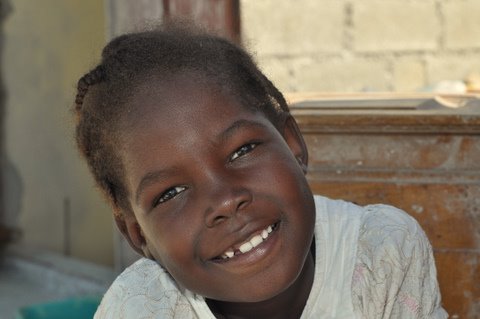
That is doubly, triply, quadruply the case for Widnerlande, pictured above. John first saw her in a clinic and sent her mom and her off for an echo when she was 18 months old. She is now seven. Some of the obstacles included: an echo that got lost in Haiti. inability to contact the family, who lives hours from Port-au-Prince (this always makes things more difficult as passports and visas can only be gotten in the capital), and lack of passport for Widnerlande until recently, to say nothing of the natural disasters that have hit Haiti--hurricanes and the earthquake that devastated the country. For weeks, we didn't even know if Widnerlande and her family were alive. And now cholera is blighting the land.
Despite all of this, we found a surgeon, a hospital, and a host family. Our Haitian helper assisted Widnerlande in getting a passport. All of the visa paperwork has been sent to the embassy. Widnerlande and her mother are in the capital and so is John to transport her to the United States, and we have someone in country to help get the visa. And so it appears that our--can I dare say?--last obstacle is the political violence in Haiti, which has shut down the airport and the embassy and made travel in Haiti dangerous. It will eventually end, and we have faith we will get the visa.
We thank Widnerlande for her patience.

Monday, December 06, 2010

The Price of Cholera


Meet Renaldo. I wish we could. He died this morning about an hour after this picture was taken. His mother is terribly sick with cholera and was too weak to even react when her son died.

Renaldo had been admitted to one of the Cholera Treatment Centers yesterday with diarrhea. The nurses said that he didn't look too badly. But he began vomiting this morning. Cholera can kill quickly.
God bless Renaldo and God help us.

Sunday, November 14, 2010

He Should Be Mad: "Haitian Government, Release Those Containers!"


After watching the weak 60 Minutes report on Haiti this evening, I feel validated in my opinion that Haiti's government doesn't know what it's doing and also an awful sense of deja vu. Part of the story focused on a man from South Africa with the 7th Adventist Church who is building housing in Haiti. His organization had shipped containers filled with building supplies to Haiti for 1,200 temporary houses. However, the 24 containers were sitting at the Haitian port where they had been for months, despite the South African having all the necessary documentation and a $6,000 check to pay the Haitian government for storage costs.

When the 60 Minutes correspondant Byron Pitts described this situation to the Haitian Prime Minister Jean-Max Bellerive, he agreed with the Pitts leading statement that obviously something had not been done properly or the containers would have been released. (Nice hard hitting reporting)

Shortly after the interview, the containers were released. The South African was told the containers had been missing a Haitian government seal. Yes, for months the containers filled with materials to build houses for people living in tarps were held up because they lacked a government seal. Why did Pitts not press Bellerive on what was either a lie or gross incompetence?

The old, missing seal story is a familiar one to us. After our son Luke's adoption was completed by the Haitian court, the papers had to make the rounds of many Haitian ministries for their seal. In one case, we were told the stamp was broken and they had to send to Germany for another stamp. I kid you not.

Wednesday, November 10, 2010

For Those Who Would Like To Become Haitian: Dual Citizenship


If you didn't have time to read the lengthy and thought-provoking article by Rene Bruemmer of the Montreal Gazette that I posted last week, here are some of the points that drew my attention.

"Political instability and poor governance [are] the most important drivers of failure from which all other negative consequences follow."

Building roads, school, and hospitals is relatively easy compared to maintaining and running them. The latter takes an educated bureaucracy to manage the never ending tasks associated with governing and running institutions.

Sixteen thousand civil servants were killed in the earthquake, more than 20% of the country's public administration workforce. There is joke in Haiti that those killed were the most dedicated employees as they not only bothered to show up for work, but were still there late in the afternoon when the earthquake hit.

Powerful elites limit institutions because the institutions usurp the elite's power. Instead the elites create patronage networks, based on loyalty to the elites.

Eighty percent of Haiti's college graduates flee their homeland "for the brighter future of elsewhere."

Non-governmental organizations (NGOs) provide 75% of the health care in Haiti.

One of Bruemmer theses is that Haiti needs educated bureaucrats who can help run the state. He believes that some of the money pledged to help Haiti should go for this purpose. He acknowledges that the process of building institutions takes years or even decades.

Haiti needs an influx of educated people to help build these institutions. One could argue that Haiti has that in the many NGO's and the UN which have a presence in Haiti, but given their huge presence, the successes seem minimal. As well meaning as all these outsiders are, they remain, to some extent outsiders. A lack of experienced, educated, committed Haitians exists. What to do?

As I pondered this question, a thought popped into my mind: What about dual citizenship? What if the United States, Canada, and France, with Haiti's permission, allowed their citizens to have dual citizenship with Haiti? These three countries come to mind because of their historical relationships with Haiti and also because of the large numbers of Haitians who live in these countries, particularly the U.S. and Canada. People of Haitian descent or others who have a connection to Haiti--perhaps those who have adopted children--might be interested in becoming citizens of Haiti and more fully participating in the building of the country if they could retain their current citizenship.

I realize this idea is a little half baked, and I will explore its pros and cons in further posts. But things must change in Haiti, or as Bruemmer says, the tragedies of the present will join the tragedies of the past that are"waiting in the wings to hobble the future."

Tuesday, November 02, 2010

Cholera Update


I know that in my last post I said that the next post--this post--would be about the problems of a (non) functioning government in Haiti. But in the meantime, the AP ran an article about the source of the cholera in Haiti. I won't reprint the entire article, but here are some excerpts:

A cholera outbreak that has killed more than 300 people in Haiti matches strains commonly found in South Asia, the U.S. Centers for Disease Control and Prevention said Monday.

The finding intensifies scrutiny on a U.N. base above a tributary to the Artibonite River that is home to a contingent of recently arrived peacekeepers from Nepal, a South Asian country where cholera is endemic and which saw outbreaks this summer.

The Associated Press found questionable sanitation conditions in an unannounced visit to the base last week and an exclusive tour of the facility given by peacekeepers Sunday. The U.N. defends its sanitation practices and has repeatedly denied it was a source of the infection. The peacekeeping mission said officials were looking into the matter Monday following the announcement.

The AP visited the base last Wednesday to follow up on a statement by the mission that its sanitation measures met U.S. and U.N. standards. The area between the base and the river reeked of human waste. Several pipes were leaking, including a broken plastic pipe emitting a foul-smelling black liquid near what the soldiers identified as latrines. The dump site for the waste was a few hundred yards (meters) away in shallow, shovel-dug pits, next to several homes. Neighbors said the pits often overflow and run to the river, and they stopped drinking from the river and sought fresh water uphill.

Okay, so we don't know for certain if the cholera came from the UN forces. But it seems like this is a likely possibility. One of the mysteries of the outbreak is where the bacteria came from as cholera is not endemic to Haiti. We now have at least a hypothesis.

So if the cholera is coming from the troops, it would mean that the UN forces who are in Haiti as peacekeepers. to protect Haitians-though many living there would say that the UN troops make Haiti a more dangerous place--have spread a deadly disease because they did not properly dispose of their waste. The deadliness overwhelms the irony.


Monday, November 01, 2010

How Do You Have a Country Without a Functioning Government?


The title of my post is a questions that has perplexed me for sometime. In my opinion, one of Haiti's main problems is that it doesn't have a competent, functioning government. This was true before the earthquake and it is even more painfully true now.

I read the article below from the Montreal Gazette on the Corbett listserv. It articulates this problem in much detail. The article is lengthy, but worth the read. In my next post, I'll offer some thoughts on Haiti's lack of governance.

Haiti civil service in ruins
Montreal Gazette By Rene Bruemmer, October 27, 2010


How do you fix a failed state? How can the world help a nation in wretched disrepair, unable to feed, educate, employ or heal the majority of its people, become self-sufficient and capable of giving its citizens decent lives?

The short answer, according to one school of thought gaining currency in international development circles, is bureaucrats. Train and hire lots and lots of bureaucrats. And use them to bolster and maintain the institutions that manage the endless day-to-day needs of providing potable water, health care, schooling, land titles, policing and justice.

Foreign governments and NGOs can build all the roads, hospitals and schools they want in Haiti, Andrew S. Natsios, the former administrator of the U.S. Agency for International Aid, said in an interview with The Gazette. But without a functioning public service in place to manage them, those roads, hospitals and schools are doomed to fail.

"Clearly, port facilities, roads, bridges, schools, health clinics and water systems (which were already crumbling before the earthquake) must be rebuilt," Natsios said in his testimony before the U.S. Senate's Foreign Relations Committee Hearing on Haiti last May. "But, if that is the extent of our reconstruction efforts, then Haiti will simply revert to its failed state status and whatever is reconstructed will begin to crumble over time without institutions to ensure maintenance."

The magnitude of the tragedy surrounding January's earthquake, which killed more than 230,000 people and left 1.3 million homeless, is in many ways due to Haiti's lack of institutions -a man-made tragedy. Buildings were poorly constructed with shoddy materials on unstable land, with no government system to inspect them, no legal system to punish builders, no insurance system to allow citizens to bury and rebuild. A similar magnitude quake in Chile that occurred six weeks after Haiti's resulted in just 500 deaths, due in large part to Chile's push to build earthquake resistant buildings. Chile is considered among Latin America's best-governed countries.

The problem, Natsios said, is that while rebuilding roads and schools is relatively easy, creating institutions -a functioning ministry of health, for example -is complex, costly and can take decades. It is also risky, as Haiti's political instability could destroy much of the work done, as it has in the past. Humanitarian food aid and health care make up the majority of
foreign assistance to Haiti. Compared with handing out bags of rice to the starving or building a hospital, the work that goes into building institutions -educating workers, bettering management systems, improving transparency to limit corruption, developing clear hiring and promotion practices based on merit -is not very visible. The benefits can also be hard
to quantify. All of these elements make it difficult for the political leaders of foreign nations, who have to justify their expenses to their taxpayers and voters, to invest heavily in institution building.

But as Haiti slowly rebuilds after the earthquake, development experts warn that reconstructing infrastructure without addressing the country's governance issues could be akin to throwing the money into a bottomless pit. In Haiti in the Balance: Why Foreign Aid Has Failed and What We Can Do About It, author Terry Buss notes that unlike many failed states, Haiti has received billions of dollars in foreign support, along with the aid of
thousands of non-governmental organizations (NGOs) and the presence of UN security troops. International governments and organizations gave more than $5 billion in foreign aid between 1990 and 2005, yet the standard of living in Haiti dropped in that period.

"Aid shortcomings likely originated because donors collectively fail to deal with political instability and poor governance as the most important drivers of failure, from which all other negative consequences would follow," Buss wrote.

Businesses, Buss noted, do not invest in failed states, buy their exports, or start companies there. Without investment and jobs, there is little tax revenue with which to pay for civil servants to run the state. It is a vicious circle.

In the absence of institutions, NGOs have moved in to fill the void -well-intentioned, for the most part, but also a crutch the Haitian government has come to rely on, at the expense of creating its own civil service networks that could oversee the needs of the whole populace. NGOs provide 75 per cent of health care in Haiti.

The problem has become even more dire today. The earthquake killed 16,000 civil servants, more than 20 per cent of the country's total public administration workforce. (A cynical Haitian joke grounded in truth notes that those who were killed were the good civil servants -the ones who actually showed up to work, or bothered to stay until 4:53 p.m., when the
earthquake struck).

Most of the ministry buildings, with their tax receipts and property titles and legal records, were destroyed in the quake. Most of the government ministers were killed.

Ten months after the earthquake, Philippe Mathieu, the country's former agriculture minister and now the Haiti director for the Quebec branch of international aid organization Oxfam, is still living in a tent beside his home. Repairs are needed to secure his house, but repairs are slow in coming, even for a former agriculture minister.

Asked how a lack of public service institutions has affected his country, he offers this example: In his district of upper Delmas in Port-au-Prince, there are now about 60 tent camps for the homeless. Some house as many as 600 people, yet many camps have not reported any cases of diarrhea for months. Camp residents have organized themselves to ensure water delivered
to the cisterns is treated regularly with chlorine, and tested to make sure it is free of bacteria and hasn't been over chlorinated.

"People realize this, that the water is better than before the earthquake," Mathieu said. He is part of a group trying to get clean water to the entire district. Except they can't because many of the pipes are broken, leaking water out and letting filth in, and the pumping capacity isn't strong enough to get the water up to the higher regions in hilly Port-au-Prince. The
organizing committee can't find the plans for the aqueduct system to tell them where the pipes are located -either because the records were destroyed in the quake, or because they never existed in the first place.

"Before the earthquake, water was purchased -people had to pay for it. . . . All countries get treated water. Why can we not do this in Haiti? You see the government has no global idea of how to manage the country.

"As a Haitian, this is what bothers me -there are no real plans. It's like all Haitians have the capacity to think, but they think only for themselves.

"We will never get the people out of the camps and back to their homes because they won't have water -the conditions will be worse than in the camps."

The hardships of the average Haitian's life are difficult to fathom for residents of comfortable nations like Canada. Three-quarters of the population lives on less than $2 a day, and more than half live in extreme poverty on less than $1 a day, Buss notes. Half the population of 9 million has no access to potable water, and 90 per cent don't have electricity. Half the population can't read, and less than one quarter of rural children go to school.

Two examples of the impact of the lack of public administration on the lives of Haitians: Eighty per cent of the schools are private so many Haitians can't afford to go, and they're of "dismal quality anyway," Buss writes. And only 24 per cent of pregnancies are attended by a trained health professional -most Haitian women give birth outside of a hospital or clinic,
without medical help, reports the International Monetary Fund.

According to the UN Development Program, Haiti ranks at 154th out of 177 countries on its Human Development Index, which measures life expectancy, education and standard of living. Every country below Haiti is in sub-Saharan Africa, and "Haiti ranks at the average of all sub-Saharan African countries," Buss notes. The nations of the Caribbean and Latin America, Haiti's geographical cousins, rank much higher.

How Haiti came to this miserable state of governance is the stuff of tragic history, foreign interventionism and chronic political instability. The only slave colony to win its independence from its colonial rulers through armed revolt, Haiti became an international pariah after becoming a free nation in 1804. It was forced to pay the equivalent of $22 billion in reparations to France for that country's "losses" in revenue from its slave-operated coffee
and sugar plantations, a debt that was only cleared in 1947 after more than a century of payments and hobbles the country's development to this day. It was the victim of numerous economic blockades by foreign powers trying to control its lucrative export trade, especially by the United States, which did not want Haiti's example inciting slave revolutions on its own
territories.

Meanwhile, the Haitian revolution gave rise to two distinct populations: a small urban elite and a Creole-speaking majority of subsistence farmers. "The mercantile elite and thus the state derived their income from taxing the export of the peasant surplus, via custom houses," says the CDA Collaborative Learning Projects, a Massachusetts-based non-profit research centre. "The structure of this economic division . . . gave shape to the extractive, predatory nature of the state that has lasted into the present."

The state itself was volatile, with its leaders more intent on preserving power and fighting with parliament than ensuring the well-being of its citizens, especially those living in rural regions. Of its 55 elected presidents since 1806, Buss writes, only nine completed their full term -the rest were overthrown, killed or died in office. Such instability does not
lend itself to the creation of a stable, well-functioning public administration.

What was created, as is the case in most developing nations, was a patrimonial state -"a state in which the power of the government and even the private sector is in the hands of an elite that uses the levers of economic and political power to retain control," said Natsios, the former administrator of USAID, the United States government's main agency for providing international assistance, and now a professor of foreign policy at Georgetown University in Washington. "I don't mean necessarily repressive control. Through patronage jobs, contracts, monopolistic control of the economy -they develop patronage networks."

Government ministries, Natsios said, don't necessarily do ministry work. "The government hires people who are part of networks, sort of like tribal chiefs, and they have followers and you basically give the followers paid jobs. They don't necessarily show up or have
qualifications, but they remain loyal to the regime.

"That is characteristic of a lot of poor countries, but Haiti is the most thoroughly patrimonial state in Latin America."

A World Bank study found that 30 per cent of civil service workers were phantom employees. One ministry had 10,000 employees, only about half of whom were ever at work.

"People think it's corruption," Natsios said. "It's not corruption ‹ people are using the system as a glue that holds the society together."

That being said, corruption is endemic -Transparency International ranked Haiti as among the fifth most corrupt countries in the world in 2004, 2005 and 2006.

Natsios refers to the recent book Violence and Social Orders, written by Nobel-prize winning economist Douglass North as well as John Wallis and Barry Weingast, in which the authors say it is the density of institutions that distinguishes rich from poor nations. Countries like America and Canada have groups that administer public service, keep public order, ensure the
rule of law and build a market economy. Organizations, the authors note, keep governments and societies in check by controlling conflicting interests of various groups in an impersonal manner, maintaining public accountability and transparency, and on the economic side "ensure open entry and competition in many markets, free movements of goods and individuals," and use the creation of institutions to promote opportunities, protect property
rights and control violence. Free markets spur the economy and aid political stability, the authors write, which in turn allows governments to provide services.

More traditional societies, like Haiti, have powerful elites that limit these types of institutions because they impede their power -instead, they create patronage networks through the government to restrict economy to their own class and hand out public service jobs to their own supporters to keep them loyal. In these societies, it is who you know that counts, whereas
in institutionalized societies, it is largely impartial bureaucracies that make decisions based on impersonal regulations, equal to all.

In Haiti, public service is not a popular profession, due mainly to low wages, especially compared with what could be earned in the private sector. There's a lack of skilled people to fill the jobs, anyway -80 per cent of Haiti's college graduates flee their homelands for the brighter future of elsewhere. Less than one per cent of Haiti's population is employed in the public sector, as compared with two per cent in Africa and more than seven per cent in many developed nations. The lack translates into gridlock in all areas, including economic -a World Bank study found that the average time to start a new business was 25 days in the most developed countries, 75 days in Latin America, and more than a year in Haiti. It was also relatively much more expensive.

"Without formal institutions capable of providing the enforcement mechanisms necessary to decrease risk and uncertainty, businesses will not pursue economic opportunities," Natsios said. "Thus any effort to build new institutions must incorporate private sector development; it cannot solely target the Haitian state in a vacuum."

Without a proper public sector, the IMF notes, Haiti is even unable to properly manage the money that is flowing in from donors.

How then, do you fix a broken public sector? One way is to ensure a good portion of the $11 billion in aid promised to Haiti is earmarked for civil service reform, creating jobs and helping to institute an incentive and accountability program that would reward and motivate its employees. Natsios urges incentives for Haiti's vast educated diaspora, numbering more than 2 million in the United States and Canada alone, to be allowed to return, if only temporarily, to help its country rebuild. He also called on the U.S. government to reinstate a university scholarship program that used to bring 18,000 students a year to American schools to be trained, with the proviso that they had to return to their homelands to work and rebuild.

There are signs of hope. In the decade before the earthquake, Haiti made efforts to improve its governance issues, saw a decrease in gang violence and lawlessness and experienced five straight years of economic growth. After the earthquake, Haiti's government presented its Action Plan for National Recovery and Development of Haiti, which focused heavily on
improving governance and decentralizing services, giving powers to smaller, provincial governments spread throughout the country, instead of concentrating them all in the capital, Port-au-Prince.

Haiti and the international community have set up the Interim Haiti Recovery Commission (IHRC) to oversee allocation and spending of all donations over $500,000 and deal with administrative issues like issuing permits to build hospitals and schools, as well as carry out economic development projects. Included among more than $1.7 billion in projects approved by the IHRC in August for new roads, housing and agriculture, was $25 million to go toward
a project to help the government provide services and increase transparency and reduce corruption.

In Montreal earlier this month for a conference to promote business ties between her countryand Quebec, Haitian Commerce and Industry Minister Josseline Colimon Fethiere said the government is aware of its shortcomings, and trying to address them. The government has created lists of its remaining employees, those who were not killed or fled the country, and
continues to employ and pay them as long as they show up to work. Training programs are planned, as are improved computer systems. And the time to start a new business in Haiti has been reduced to six weeks, she pledged.

"What we're doing is trying to rebuild the structure," she said. "We're making steps in the right direction."

Now all Haiti needs, in theory, is the political stability to maintain the progress. But the ability of the country to host fair presidential elections Nov. 28 is already being put in doubt. Haiti's electoral commission has excluded 15 candidates without giving a reason, and blocked the Lavalas Party, popular with rural voters, from running. In addition, the names of at
least 230,000 dead have to be purged from the voter roles and 1.3 million homeless need to be re-registered, Newsweek reported.

In Haiti, the tragedies of the past are ever present, waiting in the wings to hobble its future.

Wednesday, October 27, 2010

Mass Production of Mud Cookies. Really.


Maybe you've heard of mud cookies before. If you have, you probably try not to think about it. We have a couple sitting on top the piano in our living room. They are a reality check. They are a perspective check.

Here's the reality: people are so hungry in Haiti they will resort to eating mud cookies to fill their stomachs. In Cite Soleil, John came upon a place where, as you can see in the pictures above, they mass produce mud cookies. The woman who makes them say that the dirt comes from Hinche, a town of 50,000 in central Haiti. We haven't been able to discover why the dirt from Hinche is special. The woman making the cookies said that pregnant women eat the mud cookies.
It is really difficult to think about people eating mud cookies. Sometimes when we've shown people in the United States our mud cookies, we get blank faces in response, as if they can't or don't want to acknowledge the reality of what the mud cookie means. It does put one's own problems into perspective. To some, it may seem cruelly unnecessary to show people the mud cookies when it doesn't seem as if there is anything they can directly do about the conditions that cause people to eat mud cookies. But you never know when an experience like this will change a person's life. And at the least, as Dr. Albert Schweitzer says, the encounter may encourage people to "Think occasionally of the suffering of which you spare yourself the sight."


Tuesday, October 26, 2010

Cholera: A Terrible Disease


"We found Radha lying on a thin blanket in her hut. Her body was twisted into a knot of pain. Her hair was wet, saturated with sweat, as was the pink sari she wore. The smell in the hut was terrible. . . (her) mother was trying to keep her clean, but Radha's fever rendered her incoherent and incontinent. She vomited again violently as we watched, and that provoked a new dribble of diarrhea. . . what kills people who are contaminated with the cholera bacterium is dehydration . . The word cholera comes from the Greek word kholera, meaning diarrhea. The diarrhea of the cholera sickness has a singularly vile smell, and you never get used to it."

I shuddered when I read the above passage, just a few months ago, from the novel Shantaram by Gregory David Roberts. The novel is based on Roberts' experiences in India. I remarked to John how horrible cholera sounds and he confirmed that it is.
Cholera hasn't occurred much in Haiti. Back in 1990 when I went to the country for the first time, the health department recommended many vaccinations (typhoid fever, hepatitis) for travel to Haiti but not cholera, though the vaccination was suggested for travel to other parts of the world. (Note: if I read the literature properly, for the last several years, cholera vaccinations have not been recommended for travelers going anywhere).

Things have changed in the last few days and now Haiti is battling this terrible scourge. Cholera can kill in hours. The loss of fluids causes extreme dehydration, which leads to dangerous electrolyte imbalances.

The treatment for cholera is Oral Rehydration Therapy (ORT), a solution of sugar, salt, and other minerals dissolved in water that is administered to patients to keep them from getting dehydrated. In time, the bacteria works its way out of the patient's system.

We hope and pray that the cholera is contained and does not spread to the camps or other places in Port-au-Prince.

Monday, October 18, 2010

Valses to Voodoo


This past Friday we attended a piano concert at Bradley University's Dingledine Music Center. Pianist Joshua Russell played pieces composed by Haitian pianist and composer Ludovic Lamothe, pictured above.
The concert was a revelation. I didn't know that Haiti had a tradition of classical music. The music was energetic and full of surprises. Russell, who teaches at Bradley and who has taught music in Haiti and did his doctoral dissertation on Lamothe, described hearing a recording of Lamothe's playing as life changing. He said that even though the compositions were all written, Lamothe sounded as if he was inprovising, playing with a captivating freedom. Russell has recently released a CD of Lamothe's music called Valses to Voodoo.
In Lamothe's compositions, one can hear the influences of Haitian folk music, the rhythms of voodou drums, Latin American rhythms, and the music of Frederic Chopin. Lamothe was sometimes referred to as the black Chopin.
It's impossible to convey the magic of music in words, but if you want to learn more about Joshua Russell's interpretation of Lamothe's music, check out his website.

Wednesday, September 29, 2010

Big Problems; Little Solutions


The illnesses and injuries that John saw in patients on his most recent trip to Haiti were staggering. One woman's foot was literally rotting off her leg due to untreated diabetes. Because there was no anesthestist available, the woman had to wait a week for surgery. So instead of having her foot amputated, she had to have her leg amputated below the knee because the gangrene had spread.

The left side of one man's face was swollen to unbelievable proportions because of untreated tongue cancer that had spread to his jaw and neck. All John could do was give him pain medication.

One man had lockjaw from tetanus. His family would bring him liquid food that they were able to feed him.

A 30-year-old man fell out of a tree and broke his back. The staff was trying to figure out the best way to tell him that he would never walk again.

A married woman was trying to come to terms with the fact that both she and her husband tested positive for HIV.

Delayed treatment, lack of prevention, a hazardous envirnoment, lack of adequate medical care--these are some of the reasons that people are so ill. It can be overwhelming to learn about, so much so that we can throw up our hands and say, "It's beyond me."

But that attitude ensures that things will stay the same. I want to challenge everyone reading this to do one small thing to help Haiti. Think about what that could be.

Sunday, September 26, 2010

Haiti and Murphy's Law


This past Friday just after 3:30 pm, John received an e-mail from our friend Frandy in Haiti. It was short and in its entirety read:

A big wind is hitting Port-au-Prince this afternoon.I wished i could take pictures but i had to run in order to protect myself.Please pray for Haiti!

We didn't know exactly what to make of this e-mail. A big wind? There were no hurricanes heading toward Haiti. However, we found out just how big of a wind over the next couple of days. This from a contributor to Bob Corbett's list:

We've just gone through an hour of the worst Wind and rain storm I've
encountered in my 13 years here. It was worse than any hurricane I;ve gone
through. I kept thinking it was like a typhoon - it was so strong and very
frightening.I was sure all the trees would come down with the force. It was just awful. There's still thunder around but the rain and the wind have calmed down now.
I'm trying to find out something on the Radio. A friend rang me from Jacmel
and he said he had heard that there was a problem in Delmas so this is why
he called. He said people were saying the "earth had turned" - not an
earthquake, but "terre viré". He said people said that many people had died,
but I don't know if this is true.What I can say is, I don't know how the tent people have survived this, if indeed it is throughout PauP and not just in Delmas.

We're still finding out how many "tent people" died, but according to one report, the freakish storm destroyed or damaged at least 8,000 tents.

Let's do more than just pray for Haiti.


Saturday, September 11, 2010

See No Evil


When we are in Haiti, we take a lot of pictures and use them in our blogs. Some of the pictures are of people who are suffering terribly due to illness or injury. We sometimes send these pictures to people in efforts to find medical care in the U.S. for people who are beyond the help of Haiti's meager system. Such is the case with the man pictured above who likely has cancer of the tongue and has received no treatment for it. All John can do for him is medicate his pain. Sometimes we send pictures to show people the kinds of problems that people in Haiti have. We also give presentations at home and we use the pictures to illustrate the difficulties of life in Haiti. Sometimes, as with the picture above, these pictures are hard to look at.

At least on the surface, people's responses to disturbing pictures fall into one of a few categories: shock and sadness; apathy (what can I do about these problems that have been around as long as human beings themselves); anger (either at the situation or at us for showing them the pictures); or a non-response (perhaps this is a form of overwhelm).

With our 24 hour media beaming images of the latest disaster into our living rooms round the clock it's not surprising that people can become jaded. We're all busy with important things and having our attention grabbed however momentarily by a picture like the one above isn't a pleasant experience. For myself, though, and despite the much greater exposure we have to the world's suffering than we did even 25 years ago, I find seeing pictures like this a necessary experience. For despite my access to information, it's too easy for me to forget.

As I was pondering the above issues earlier in the week, I came across a bumper sticker with the following wisdom:

Think occasionally of the suffering of which you spare yourself the sight.-Albert Schweitzer

So at least for today, we are not spared.


Monday, August 23, 2010

A Grateful Family


Poor people with heart problems in Haiti are in a lot of trouble. Most of the time, they die deaths that could be avoided with surgery that we in the United States take as our birthright if we need it. Once in awhile, though, a miracle occurs, and a patient is accepted for medical care in the United States or another country. I call it a miracle, and given the rarity of the situation, it is. But it takes a lot of hard work on the part of my husband John. Through his efforts, a man with a serious heart problem was accepted for medical care in Florida. As you can read from his nephew's letter below, Haitian people have a great capacity for gratitude and a beautiful manner of expressing it, even in another language.

Dear doctor,

May God Bless you and your family for longer! doctor me and all my family we're very happy that God sent you on our way just to help us with this great problem.Beleive me we haven't enough words to show you franckly our joys for that.In more ,say to you only "Thank you"it's too light.Cause you merit more.So,as we know God has eyes open on everything we do good or bad.Of there,we hope deeper of our heart he will reward you not only for today.But for all the rest of your life.And why not of generation in generation.

In fact doctor,as i said to you we had an appointment yesterday to the american consulate.thanks to the lord they gave to my uncle the visas for a short time,three months.then we are grateful toward jesus for that.Cause he's done the main thing for us.And then ,after all things you did also,i see it's not good to keep on calling you:dear doctor, dear doctor... it could be better to consider you as a member in our family.cause the job that you've just done for our family seems like the job of a cousin,a brother a father and so on.For all things, i decide to pray for you and write you every time i get chance to do it just to get informed about you.Of all my heart you're a good one. . .

Don't forget to let the other doctor to know how much we were so happy when he did accept to write the American consulate a kind of letter to help my uncle found the visas.We need to think your wife also doctor.Cause,we saw her determination to help us to succeed too.Please say "hi" to her for us.

Doctor,as a good one. stay like that,don't be changed.Cause God has a plan for you too.Beleive in that,there will be a day you will feel it.Yeah! you deserve that!!!!!!

Blessing,

D