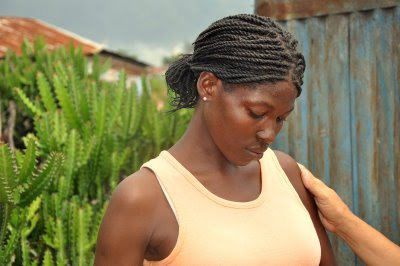
Sunday, February 07, 2010

Suffering


Our cousin is home from Haiti now. It seems like most of the teams go down for a week or at most two. I know of other teams going and hopefully this will continue for a long time. When you read the post below, you better understand why a week is about as much as a first worlder can take.

Another long, busy day in surgery full of fracture repairs and wound
debridement. The smell of the 3 week old wounds is overwhelming.
Poor sanitization conditions combined with long hot days spent in
crowded tents with little to no ventilation. Thank heavens for Vicks
Vaporub!

I left the hospital around 8pm to return to camp. We now have running
water! I immediately headed straight for a shower, which really
consists of bathtub and garden hose pulled through the bathroom
window. It's freezing cold, but I can't wait to "come clean" of
today. I yell for someone outside to "turn on the hose!" and not
more than 2 minutes later hear a voice outside running down the alley
& coming toward the clinic. A nurse from the hospital pounds on the
door of the clinic for me to "come quick" to the hospital..."a stat c-
section". Still soaking wet, I throw on scrubs, call for Sandra (the
other anesthetist; & native Haitian), and we follow her back to the
hospital.

We quickly gather whatever supplies we can find through all of the
mess of medical equipment just shipped in (thank you to all who
donated!). Turns out there are in fact 2 c-sections, but only one
surgeon. The most critical goes first: umbilical cord wrapped around
the baby's neck. Spinal block and within 4 minutes the baby is pulled
out, blue, completly limp, and lifeless. It was then that we realized
that there was no one available to take care of the baby, who is
cyanotic and silent. The surgeon continues to suture, while I leave
mom to help the baby ("patient abandonment" and illegal in the
US)...not to metion the fact that I know extremely little about labor
& delivery nursing! ...desparate times. Sandra takes over care of
mom, while I attempt to stimulate and suction the baby. Yes... I am
screaming for help the entire time. A Canadian ER doctor hears me
and comes to the rescue. Together we stimulate and suction large
amounts of aspirated meconium, and soon....crying. The most
beautiful sound in the world!

Sandra and I must quickly get ready for the 2nd c/sec. I wheel the
last newborn into the room with us. Again, there are so many things
wrong about the conditions we must work under, but we must just adapt
and adjust to what we have. There is no NICU. New babies and moms
get sent back outside to the yard (literally) just after delivering.
This baby was no where near stable enough to be left unattended.

Sandra & I were gettig ready to do a spinal block on the next mom when
a code was called on a baby that had been rushed into the hospital
from the "tent village". She just cried and pleaded (in Creole) to
help her baby. The infant was intubated and coded for over 20
minutes before time of death was called. I completely broke down. I
tried to hide behind my glasses ad mask as I cried right there on
front of everyone. It was unbearable. And even still, after
experiencing such heartache, I had to return to the OR to finish the
last c-section. I'm thankful I stayed. A difficult and cold as it
felt at the time, I needed a "happy ending". I got just that. One
loud, crying, healthy baby. As 2 new lives were brought into the
world tonight, one was taken away. A harsh and unjust life.

The hardest part about tonight was wondering and question to myself,
"what if?" ; "what if this baby had been in the US?". ...same baby,
same illness, only with better medical access. Would the outcome
have been the same?". I heavily doubt it. That's what makes it so
hard...wondering why some are so fortunate and priviledged, just by
the geographical location in which we have been born; while others are
born into nothing. It's just seems so unfair.

Sunday, January 31, 2010

Sullivans on the Scene


John's cousin's daughter, Emily, a newly minted nurse anesthetist, arrived in Haiti a few days ago. She is working at a hospital in or near Carrefour, which was the epicenter of the earthquake. It is also where Frandy lives, and wouldn't you know, he and Emily not only bumped into each other, but correctly guessed who the other person was. "Are you Emily?" "Yes. Are you Frandy?" "Yes." Pretty amazing.

This is Emily's first trip to Haiti. Her cousin Jesse, whom I wrote about here, helped arrange the trip. Jesse is volunteering at the Haitian embassy in Washington, DC, assisting with the tent cities. In her first e-mail home, Emily writes:

Conditions are worse than imaginable. The entire city has suffered distruction. The streets are lined with make-shift tents. Even families whose shelter remains standing choose to live in the streets for fear of after-shock. Recently orphaned children sit blank-stared on sidewalks just lost. As we drove to the hospital, the smells are overwhelming. Many bodies remain trapped under rubble...it has now been over 2 weeks. My team joined with other Doctors without Borders. We sleep in tents outside the Hope for Haiti clinic across the street from Hospital Adventista. My first night, I was woken up to someone from the hospital across the street calling for the "blonde-hair anesthesia". There are two anesthetists (myself included) to our team. I grabbed my new-found CRNA friend and ran next door. There was a stat c-section at the hospital. The conditions are unbelievable. Make-shift ORs with out-dated drugs that I have only read about. But we have an anesthesia machine!

This morning I worked in a public health clinic. 6 of us assessed over 250 Haitian men, women, and children. Later in the afternoon I went back to the hospital to help with anesthesia.

Tommorow more surgeries. Will try to keep in touch later.

Take nothing for granted.


We have our worries and frustrations

But our houses are standing and

when things go wrong,

there are people to help.

In Haiti a broken world explodes

and the people have to pick up the pieces.

Do You Hear Me Now?


My mom told me she thought, "Do you hear me now?" would be a good title for an article about Haiti, and she's right. Because for so many years, the suffering of the Haitian people has largely been ignored by the world. And the suffering is brutal.

I'll never forget the time we were returning from a trip to Haiti. We were flying from Miami to Chicago, and I sat next to an American who had grown up in Kenya and was making his way back to Africa, oddly, via Chicago, but anyway. I told him where I had been. He actually shuddered and said, "I imagine there should be a sign at Haiti's entrance that says, 'Abandon hope all ye who enter here,'" which of course was what was posted at the entrance to hell in The Divine Comedy. There was so much pain, and suffering, and premature dying in Haiti before and now this.

Our friend Mary who has made her home in Haiti for half of the year for more than a decade returned to Ohio from her recent trip to look for people. Mary writes:

No words can describe the incredible devastation the earthquake and incessant aftershocks have left behind. No words can describe the brutal injuries so, so many people have suffered. No words can describe the agony mothers, fathers, sisters, brothers, aunts, uncles, cousins and friends are experiencing as loved ones continue to suffer and die on a daily basis. No words can describe the distress these same family members are experiencing as they try to determine the whereabouts of love ones. And no words can describe the amazing faith and strength of the Haitian people. Maybe it's because they are already so accustomed to a life of misery that in ten days, I heard many prayers of thanksgiving, but not one whine or 'why us?' It seems like the whole world has responded and much relief has arrived. It's hard to know if it's getting everywhere it needs to. People can so easily fall in between the cracks. Recovery, if at all possible, will take years upon years. I hope the world doesn't forget Haiti again.

No, let's not forget Haiti again. We do hear you now.

Things can't get any worse
And then they do
But the bad times can't destroy hope.


Haitians Helping Haitians


As I mentioned on the Haitian Hearts website, we are going to provide earthquake relief by sending money directly to the people affected. The Western Union offices in Port-au-Prince reopened last week, and we finally were able to wire money to a number of our Haitian friends, all of whom lost their homes and are living on the street and, in one case, in a car. They have been very grateful and a few have thanked us via e-mail or phone call.

Jenny told us that she would use some of the money to help people who are worse off than she is, and we know that she will.

Katia writes: "hi dr john how r u maria and luk i call u to tell thank u. . . thank u very much dr God bless u and your family .i feel me bether only my head ake where the concrete fall in my head." Her English is better than my Kreyol.

Henri told me to, "Have a nice day." For the time being, Western Union is waiving their fee to send money to Haiti.

I borrowed the above picture from Dorothy Pearce an American woman who lives in Haiti and takes in sick babies. She posted it on Facebook. I thought it better shows what is going on in Haiti than the pictures of the looters.
Our little bit of money
That we don't really miss
Helps them a lot.

Thursday, January 21, 2010

More Survivors Amid the Death and Wreakage


We find out about people in Haiti in bits and pieces from various places. We were very worried about Haitian Hearts' patient Willy Fortune's mom, who lives in the hard-hit Canape Verte section of Port-au-Prince. We were also worried about our Canadian friend Karen Bultje, who lives in Haiti, helping disabled children and really anyone in need. She blogs about her experiences at Coram Deo.

For days after the earthquake, Karen's last post was dated January 11. But then--Eureka!--she began posting again, and when we sent her an e-mail, telling her how happy we were to read that she was alright, she responded saying that Willy Fortune's mom, pictured above, had been by, asking about us. Eureka again!


We often stay at the Visa Lodge, a hotel near the airport, when we are in Haiti. We hadn't heard anything about the hotel until we came across this article in the Boston Globe. Mr. Herve Denis, one of the owners of the hotel, survived the earthquake, but his mother did not. Gratitude mixed with mourning everywhere.

Tuesday, January 19, 2010

Bless the Children


We received the sad news today that 10-year-old Dieula Jean Charles perished in the earthquake. Dieula was one of the people that our friend Mary Hurley travelled to Port-au-Prince to look for.

A few years ago, Dieula came to St. Louis for heart surgery, thanks to the efforts of Mary and her friend Marie. They worked so hard on Diuela's behalf because they loved her and knew that she deserved to have her heart repaired. The operation was a success, and Dieula returned to Haiti a healthy little girl. As Mary's sister who is keeping us updated on Mary's work in Haiti wrote,

"The pain in Mary's voice could be felt across the miles and miles of telephone lines and there really were no words of comfort I could offer her. Her hope is that Dieula did not suffer. I know we all share that hope."

In a later e-mail, we learned that Dieula probably died quickly. Her mother and siblings survived. What grief they are feeling. The enormous suffering that exists in Haiti today is hard to fathom.

Monday, January 18, 2010

More Solidarity Than Looting


I am a member of Bob Corbett's Haiti listserv, which has been an invaluable source of information on Haiti before and after the earthquake. I know there has been some reporting on looting that is occuring in Port-au-Prince. I offer the two below reports from people who are currently in Haiti. These accounts were made yesterday, January 17. To them, I would add the following observations: on our trips to Haiti, we have always been amazed at the lack of crime (the gang/political crime, notwithstanding)on the part of almost all people, especially given the lack and incompetence of the police and judicial system. Also, I am afraid that if I were in the same situation as the people in Port-au-Prince, I would be doing what I could to get food and water for myself and my family, even if it meant looting.

First Report

Ciné Institute Director David Belle
reports from Port-au-Prince:
"I have been told that much US media coverage paints Haiti as a tinderbox
ready to explode. I'm told that lead stories in major media are of looting,
violence and chaos. There could be nothing further from the truth.

"I have traveled the entire city
daily since my arrival. The extent of damages is absolutely staggering.
At every step, at every bend is one horrific tragedy after another;
homes, businesses, schools and churches leveled to nothing. Inside every
mountain of rubble there are people, most dead at this point. The smell
is overwhelming. On every street are people -- survivors -- who have
lost everything they have: homes, parents, children, friends.

"NOT ONCEhave we witnessed a single
act of aggression or violence. To the contrary, we have witnessed neighbors
helping neighbors and friends helping friends and strangers. We've seen
neighbors digging in rubble with their bare hands to find survivors.
We've seen traditional healers treating the injured; we've seen dignified
ceremonies for mass burials and residents patiently waiting under boiling
sun with nothing but their few remaining belongings. A crippled city
of two million awaits help, medicine, food and water. Most haven't received
any.

"Haiti can be proud of its survivors. Their dignity and decency in
the face of this tragedy is itself staggering."

David Belle, January 17th, 2010

Second Report

I'm just passing this updated from Sasha Kramer of SOIL along:

"Apologies if these upcoming posts seem unpolished…that is because they are…we barely have time to write and internet is patchy so I will do what I can to get out information but I don’t promise eloquence.

Love to you all and know that we are safe and taking precautions.

Last night we arrived in Port au Prince just before sunset. As we came into the city with our truck piled full of water, gas, shovels and food we got a flat tire. The news reports of looting have been so exaggerated that we were concerned that a mob of people might come take everything before we even made it into the city. I am pleased to report that, as per usual, reports of violence in Haiti are largely disinformation. Yes, we did hear shooting late last night, and yes we did see a fight over a mattress at a camp in the city but our overall impression has been sheer amazement at the solidarity displayed by communities.

We drove into the city past the airport and along Delmas 33. Initially it looked like about 1 in 5 houses had sustained damage and perhaps 1 in 20 had completely collapsed. However as we got father in towards Delmas the damage looked much more severe with perhaps 1 in 5 buildings completely collapsed. I have never seen anything like this, honestly it is hard to even feel. People have not even begun to mourn as everyone is still in a state of crisis. As we drove by the police station on Delmas 33 we saw someone carrying a severed foot of a police officer out of the wreckage…I barely even blinked…everything is so surreal.

We went straight to Matthew 25, a guesthouse which remained relatively untouched by the quake. We went to locate our friend Amber who has been helping to coordinate volunteer efforts. We are so grateful for the way in which we have been received by the guesthouse, they immediately allowed us to remove all of the materials from the car and invited us to sleep in the backyard (no one is sleeping inside as the aftershocks have continued over the past few days). I was so amazed to run our dear friend Ellie Happel at the guesthouse. She flew in from NY the day after the quake to help with relief.

Once we had unloaded the car we all went with Marcorel to see his family in Jake. When we arrived it was already dark and there were people sleeping everywhere in the streets. As we waited for Marcorel to make his way through the camp to locate his family we saw several young men from the neighborhood setting up a large light rigged to some batteries. As light flooded the crowd of people they burst into song. Songs of solidarity, songs of grief, songs of thanks that they had survived. We followed Mako through the blankets and makeshift tents to where his family (8 brothers and sisters and his mom and dad) huddled together on a pile of blankets. They were so happy to see him and we all piled into their bed and Ellie, Paul, Cat and I were each handed a baby. The singing continued in the background as Marcorel’s family told the story of where they each were when the quake hit.


With love from Port au Prince,
Sasha "

Alive! Alive Alive!


We are getting more good news on many of our Haitian Hearts friends and patients. Katie Cesar is alive! Suze LaPierre is alive! Marie Myrtha is alive! Jenny Guilliame is alive! It feels so good to type those sentences. We have also learned that the families of some of our Haitian friends in the United States are alive: Katina's family, Fastina's family, Viviane's family.

They are alive now, but their situations are difficult and in some cases desperate. Their needs now and in the future will be great. We are hopeful that the aid will soon make its way to them. We are also anxious to get money to our Haitian Hearts patients and will do so as soon as the Western Union offices in Port-au-Prince reopen.
Pictured above is Marie Myrtha

Sunday, January 17, 2010

Who Should We Blame?

Pat Robertson's comment about Haiti being cursed because of a deal its founding fathers made with the devil is getting a lot of play. Unfortunately, this belief isn't that uncommon among certain Christian denominations, some which have groups that work in Haiti. John has heard it for years (often in tandem with anti-Catholicism). A poster on the Corbett listserv has a page on her blog with links to different groups that espouse this view. I had a comment on this post from someone who seems to be in the Rev. Robertson camp:

If I may state what I believe to be the truth-Haiti is a culture deeply steeped in voodoo. In 2003, the president officially recognized it as a national religion. This is dangerous stuff. IT CHASES GOD OUT. I pray for the people that they will reject all evils that bring the one known as 'the destroyer' (satan) to reign in their country.

With something as horrendous as the situation in Haiti before the earthquake and now with the incomprehensible disaster the shaking ground has wrought, it's understandable to want to try to explain things. And we would like explanations that absolve us from responsibility or guilt, thank you very much. So let's blame it on an alleged pact with the devil that, abetted by voodoo, curses Haiti to this very day.

If you are comfortable with that explanation, here's a question to ponder: Is it the perpetrators of evil or the victims of evil who are cursed?

Now, we don't usually describe natural disasters like earthquakes as evil, but I can tell you that Haiti has had a lot of evil directed its way, evil that contributed to the country's fragile state and making the earthquake so very destructive. Here's a short list:

In short order, Columbus and his fellow Europeans wiped out the Arawak Indians, the original inhabitants of Haiti. This led to. . .

Slavery. The French needed people to work the coffee and sugar plantations. They were so cruel to the slaves, that the slaves died faster than the birth rate could keep up, requiring the French to constantly kidnap more people from Africa.

After the independent Haitian republic was founded, the French demanded millions in repayment for lost profits from Haitian exports. Haiti paid the huge sum, which put the country perpetually behind the financial eight ball. Can you imagine the United States paying England for agricultural profits owed during the American Revolution?

Haiti was founded in 1804 but not recognized by its powerful neighbor to the north, the United States until 1862 when we were in the midst of the Civil War.

I'll stop here and save the rest of the world's sins for another post.

This weekend, Haiti was the subject of much preaching at places of worship. While disavowing Robertson's remarks, my pastor compared the situation to that of the Christian scripture story of Lazarus, the poor man. Lazarus, who suffered miserably on earth, went to heaven, but the rich man who ignored him went you-know-where.

So, who, exactly, is cursed?

A Friend on the Ground


Our friend Mary Hurley, who for years has lived six months of each year in Haiti, arrived there yesterday. As you can imagine, she knows many Haitians and the main purpose of her trip is to find and help people she knows, many whom are very poor. She will also be helping coordinate the efforts of others who want to help.

Mary works with Mother Teresa's order, the Missionaries of Charity who have several communities in Haiti. The Order was able to arrange jet transportation for Mary and her friend Marie, another Haiti veteran, from Miami to Port-au-Prince. Mary and Marie will be staying with the Sisters on Delmas 31, the site of the Sisters' home for children in Port-au-Prince. Mary usually works at San Fil, the home for the dying that the Sisters run elsewhere in Port-au-Prince. Sadly, now, much of the city has been turned into a place of the dying.

Mary is worried about many people--Kethia and Dieula, to name two. Thankfully, she has heard that Heurese, Guerline, and Gertrude, who runs the guesthouse where Mary usually stays, are safe. The guesthouse has been destroyed, but Gertrude is okay, as is her daughter Rosie who was in a boarding school in Port-au-Prince.

The Internet and cell phones are indispensible in communicating. Ten years ago, phone communication from Haiti necessitated a satellite phone. We have received cell calls from Frandy and Heurese. John has called Frandy on Skype, though he couldn't hear us. Frandy has actually been able to post on his Facebook account. The discrepancy of being able to communicate like this with people from around the world while you are homeless, hungry, thirsty, and don't know what is going to happen next is like some kind of science fiction gone wrong.

Even though Mary is a veteran of Haiti--indeed it is her home--even though she speaks Creole, even though she has spent most of her time in Port-au-Prince helping the most destitute of Haitians, she said to John, "We realize we don't know what we are getting into." It's not unlike a first trip to Haiti she said.
As we hear from Mary, we will keeo you posted.
Above: John in Haiti before the earthquake.

Saturday, January 16, 2010

Heurese!


We found out this morning that Heurese is alive along with her family! Heurese is a 30-year-old woman whom Haitian Hearts brought to the United States in 2008. She had surgery at Cleveland Clinic, which replaced her diseased heart valve with a state-of-the-art Onyx
artificial heart valve. Heurese stayed with us in Peoria for about five months while she recuperated.

Heurese has two young children. Today they are leaving for her hometown of Bainet on the southern coast of Haiti's peninsula, southwest of Port-au-Prince. It typically takes three hours to travel to Bainet from PAP. Who knows how long their journey will be today?
Heurese's mother and other family live in Bainet, and like many people in Port-au-Prince who survived the earthquake, she wants to leave the devastation of the capital.
In the midst of the tragedy and sorrow, we are so happy to get the good news of the survival of some of our friends. But we know many people have lost their children, their families, their friends, and we mourn along with them.

Friday, January 15, 2010

Haiti and the United States


Here are the things I am feeling positively about regarding the United States and its response to the earthquake in Haiti:

The United States has a Democratic administration.

President Barack Obama and First Lady Michelle Obama care about Haiti and are willing to commit American resources to helping the country. They are African-American; their skin color is the same as the Haitian people, which can only raise the esteem in which the Haitian people are held. I know this last sentence seems offensive and politically incorrect, but it is true.

Hillary Clinton, who early in her tenure as an Obama cabinet member, gave a major speech about Haiti, is Secretary of State.

Bill Clinton, who along with his wife has a special appreciation for Haiti, is the United Nations special envoy to Haiti.

President Obama today granted Haitians in the United States Temporary Protected Status.

One of the major tests of the Obama presidency will be our country's sustained response to this Haitian catastrophe.

Here are some depressing features of the U.S. relationship with Haiti:

The reason the U.S. Coast Guard was able to respond to the crisis so quickly is because the ships were in the area to intercept desperately poor Haitians trying to leave Haiti on rickety boats headed for the Bahamas or the United States and return them to Haiti.

The United States has a schizophrenic relationship with Haiti. The Clinton administration restored Haitian President Aristide to power. The Bush Administration escorted President Aristide from power. And now the Obama administration appears poised to make a major investment in the rebuilding of Haiti. All of this occurred in the span of 16 years. Prior decades reveal even worse dysfunction on the part of the United States (supporting dictators, occupying the country, not recognizing the country, etc.)

The United States initial response to the earthquake notwithstanding, the U.S. government has had a definite bias against Haitians as evidenced by our immigration policies: harsh treatment of detainees at Krome detention center, difficulty of Haitian in obtaining visas, reluctance until today to grant Haitians TPS when the citizens from other countries in far less dire straits were granted the designation.

Our tendency is to only worry about Haiti when the country is having an adverse affect on us-- like when Haitians wash up on Miami beaches, looking for the American dream).

Our incredibly short attention span and self absorption. Will we tire of this Haitian crisis?

What now?

This earthquake is an event in the hemisphere of an entirely different magnitude. Will something this major reset the board on U.S-Haitian relations? Will it traumatize Americans--in a positive way--to realize what is important and how U.S. power can be used peacefully to make a positive difference in people's lives?

If the Haitians can remain hopeful, then so can the rest of us.

Good News!


Frandy and his family are alive! John received a phone call from Frandy this afternoon. The call broke up frequently, but John was able to learn that Frandy and his mother and brother are unharmed, though their home was destroyed and they are without food and water. Can you imagine losing as much as they have and considering yourself one of the lucky ones? Such is the magnitude of this disaster.

More good news: we have also learned that Chris and Hal Nungester who run H.I.S. Home for Children Orphanage are okay along with the children in their care. They are having generator problems but are grateful to be alive.

We have friends who will be arriving in Port-au-Prince tomorrow, and we hope to have more updates on the situation in Haiti, including the status of our friends and patients.

Thursday, January 14, 2010

Where is Frandy?


We are worried about numerous people in Haiti, including Frandy Dejean. A poor boy, he grew up on the side of a mountain in Carrefour. He came to the attention of Haitian Hearts because of a heart problem. We brought him and his mother to St. Louis for medical care. Like many Haitians, Frandy fell in love with the United States, and it is his dream to return.

After Frandy returned to Haiti and with the help of his generous host family in St. Louis, he attended high school and passed all of the necessary exams. Frandy has been studying hard for the TOEFL (Test of English as a Foreign Language). A passing grade on this test would gain him admittance to a U.S. college.

Besides his academic work, Frandy has provided invaluable assistance to Haitian Hearts. He has located patients for us, taken them to medical appointments, helped them get passports. Everything is difficult in Haiti, and one of the above tasks can take days or weeks to coordinate. Frandy has persevered through all the obstacles--terrible roads, unreliable transportation, incompetent government.
Frandy's love for the United States has not always been returned. This past summer he applied for a visa to attend an English-language school in St. Louis. He had a sponsor, willing to host him and pay for his schooling. Nonetheless, he was denied a visa. I quote below from the letter we received from the U.S. consulate official:
Mr. Dejean was found ineligible for a visa under Section 214(b) of the U.S. Immigration and Nationality Act. Under this section of the law, all applicants for non-immigrant visas must demonstrate that they have a residence outside of the United States as well as professional, family, financial, and community ties which will ensure their return at the end of their authorized stay.
Let me unpack this for you. What the law basically says is that if you don't have a job or money to return to, you are not eligible for a non-immigrant visa. Or in other words, if you are poor, no visa.
Frandy is definitely poor. It didn't matter to the U.S. consulate that Frandy had worked hard to pass high school, that he had a sponsor for his schooling, that after the completion of this program, he wanted to return to the United States for college. He couldn't demonstrate sufficient ties to Haiti to satisfy the U.S. consulate (i.e. he is poor) and was denied a visa.

Frandy hasn't given up though. Give up isn't part of him, which is why we have hope that he is still alive. We have been watching the news, but their are huge portions of the Port-au-Prince that we know nothing about.

So we pray and wait.


The Work Continues


I've had a few people ask me if the earthquake is going to change the mission of Haitian Hearts. The answer is no. Our focus will continue to be two-fold: to bring young Haitians to the United States for life-saving heart surgery and to support the work of my husband Dr. John Carroll in hospitals and clinics in Haiti providing general medical care and medications to very poor people. Those needs will remain and even be intensified as a result of the earthquake.

We encourage people to donate to the organizations that are providing immediate relief. You can find a list of them here. Haitian Hearts will always accept your contributions, too. You can learn more about us at our website.

Haitian Hearts is committed to Haiti in the long term. We will continue to help Haitians, one at a time, as we have for the past 15 years.

Wednesday, January 13, 2010

Please Pray That They are Okay


I was driving my son Luke to school today. We adopted him from Haiti, so he hears about Haiti a lot. This morning he asked me, "Mommy, why is Haiti always in trouble?" I didn't have a good answer for him.

I don't have any answers. Like many people, we are waiting to hear about those we know and love in Haiti. People like Frandy, a hard-working, young man, who, as a very poor Haitian, is defying the odds, educating himself, studying like mad to pass the TOEFL (Test of English for Foreign Language students) so that he can come to the United States for college. Or Heurese, the young woman who spent five months with us last year as she recovered from open heart surgery. Both Frandy and Heurese live in Carrefour, which was the epicenter of the earthquakc. They are both very poor and I am hoping, however perversely, that this will somehow work in their favor for survival; they don't live in big houses, just little shacks made of concrete blocks. We grasp at straws where we can.

U.S. Secretary of State Hillary Clinton referred to the "biblical" nature of the earthquake. It's really the only scale that makes any sense. Because a normal day in Haiti is like a natural disaster: lack of water, lack of food, unpassable or barely passable roads, epidemics with no adequate medical response. Add a devastating earthquake to these already impossible conditions and we run out of words to describe the situation. If you think about what happens in the United States when disasters strike--everything from car accidents to N1H1 to tornados--there is a professional, adequate response--ambulances, police, doctors, government bureaucrats--lots of people tackle the problem. When I think about the people lying under the rubble in Haiti: there is no one from Haiti that is going to be coming to their rescue soon, save their families and neighbors. I just heard Anderson Cooper bemoan the fact that he had seen no heavy earth moving equipment on the scene. Welcome to Haiti, Anderson. The existing hospitals are totally inadequate for every day circumstances; there is no military, there is no National Guard, there are no ambulances or road crews, or maintenance people to fix a practically non-existent infrastructure, there is a barely functioning police department. Really, there is nothing at all in Haiti to respond to a disaster of this magnitude.

So we are left asking, "How could this happen? How could God let this happen? What kind of social Darwinistic law rules the universe and insists that the harshest things must happen to the people who are already suffering the most?"

I'm not going to count on answers to these questions; we have to roll up our sleeves and work.
Pictured above, Chris Nungester who along with her husband Hal, runs an orphanage, H.I.S. Home for Children, and one of the children in her care

Friday, January 01, 2010

Medjina Has Arrived


Seven-year-old Medjina got her biggest present ever this Christmas: a trip to St. Louis where she will have surgery to fix her faulty heart valve.

On December 18, Medjina flew to the United States with her American friends and spent Christmas with them in Ohio. They then drove Medjina to St. Louis, where she will be staying with Jim and Jane Ebel, who have graciously hosted a number of Haitian Hearts patients. Medjina had her first appointment at St. Louis Children's Hospital on December 30.

John traveled to St. Louis to be with Medjina and Jane Ebel during the appointment. He was able to provide medical history on Medjina and also translate for her.

Because of her damaged heart valve and the consequent inefficiency, Medjina's heart has gotten huge. She easily becomes short of breath, a symptom that would worsen without the surgery she needs.

Medjina has a huge heart in another way, too. She has calmly come without family to a strange country that is much different from Haiti. John reported that as she sat on his lap when the nurse had to draw blood, she didn't so much as flinch when the needle entered her skin.
We are grateful to all who have made it possible for Medjina to be helped.

Thursday, November 12, 2009

New Website!


Haitian Hearts has a new website1 It's at the same address as our old site: http://www.haitianhearts.org/ It is clean, easy to navigate, and up to date site, filled with John's wonderful photographs.

Please check it out when you have a minute!

Sunday, October 18, 2009

Poor and Alone


John is in Haiti now, so I'll be able to indirectly and vicariously post live from Haiti
He spent his first week teaching at a nursing school in Les Cayes, the third largest city in Haiti, on the coast of the southern penisula. As part of one class, John interviewed a 19-year-old who was in the hospital by herself. Her story was sad; she was sick, possibly with AIDS, and had a baby who was somewhere in Port-au-Prince.

They were about done with the questioning when one of the student nurses asked her if she had anything else to add. The young woman said she felt bad because unlike the other patients in the hospital, no one visited her, no one brought her anything.

Class concluded and John noticed the nurses in a little group. They were taking up a collection for the young woman.

It isn't the poor in Haiti who are the problem.

Wednesday, September 16, 2009

Good News!


I am very happy to announce that we recently have had two patients accepted at hospitals! Given the current economic/health care environment, these are huge successes. Much credit goes to my husband John for his persevernce in advocating for his Haitian patients. He has to hear a lot of "no's" before a patient is finally accepted.


With one of these patients, the details are still being worked out, so I'll leave those for a future post. But today I can tell you that 7-year-old Modjina has been accepted by St. Louis Children's Hospital. You can see Modjina's picture and read more about her here.


Haitian Hearts has had a long and happy relationship with St. Louis Children's. Modjina is the fifth patient they have accepted in the past several years.


We are looking forward to completing the paperwork and bringing Modjina to St. Louis sometimes this fall.
Pictured above are two healthy girls in Haiti

Sunday, July 26, 2009

Farewell Heurese


In our house today, we are missing Heurese. She is a 30-year-old Haitian woman who lived with us for the past five months. Four days ago, she returned to Haiti. Despite the lavish life she was leading with us (relative to her life in Haiti with no running water, regular electricity, and much skimpier meals), she wanted to return to her home. And for good reasons: her 5-year-old daughter and her 3-year-old son.

Though Heurese came to the United States in December 2008 for heart surgery at Cleveland Clinic, she has not seen in her children in almost a year. Prior to surgery, her sick heart made her so weak that she was unable to care for her children. They lived with her mother in another town. We know there was a happy reunion in Port-au-Prince this past Saturday.

Heurese was fully recuperated from her heart surgery--the installation of an artificial valve that will last her the rest of her life. She has more energy than she has ever had in her adult life. She will need it to negotiate life as a poor person in Port-au-Prince. So much energy goes into activities like getting water, gathering fuel for cooking, washing clothes--all processes that are automated in the developed world.

It is amazing how fast humans can bond to each other. Heurese was a wonderful presence in our home. Intelligent, kind--a lovely person, who helped us a lot. We will think of her often and look forward to seeing her on future trips to Haiti.

Monday, July 13, 2009

Roldolphe Richeme 1985-2009


This is an e-mail that my husband John received, regarding a young medical student/doctor in Haiti, Roldolphe, who died of severe liver disease. The e-mail was written by Rodolphe's brother, who prior to this, had campaigned with all his heart, mind, and effort to get Rodolphe medical care in the United States. He even offered part of his liver to be transplanted into his brother. Rodolphe was never granted a visa to the United States, and he died in Haiti

Dearest Friends,

God has made everysingle 1 of his creature for one purporse like he has made ROLDOLPHE RICHEME borned in our family, for us to have a sense of lifestyle in the Heaven as he was pure angel living temporarily on this earth for 24 years 7 months old (DOB 12-5-84). The Richeme's family was blessed by God to benefit that grace of having Roldolphe in the family.

No one can come in direct competion with God as we (the Richeme family+yourselves) through Roldolphe's illness end stage were pleading, fighting, shaking the earth and heaven for Rodolphe to live longer on this earth. God wins always the battle as he indeed retrieved Rodolphe prematurely from this earth on a mourning day of july the 4th while some earthly people were rejoycing where 1 other was agonizing, putting out all his blood from his body resulting from the sevrity of his unassessed medical affection experimenting in 3 months on the pitiful eyes of the Lord.

Some would have emphasixed that I would correlate Rodlophe's death on the account of the USA since he could have had better assistance and care there, but no, it's to more emphasize that weirdly according to Independence day celebration in the USA, Rodolphe took his independence from this earth which is an even better fulfillment of Lord's willing. After much sufferings, God decided that RODOLPHE worths more in Heaven then on this failing earth where he had to face sins of all nature and now HOME FREE and away from all pain, sorrows and diseases and iniquities of all kinds.

RODOLPHE's departure would live a unfilling huge gap in the Richeme's heart and yours as my grandma 86 years old fainted last night on hearing that sad news and taken right away to general hospital las night in Port-au-Prince as she wanted to make trip before Rodolphe and asking herself why Rodolphe but not her. Though through this toughFUL experience, we remain more faithful to God and praising Him more than ever not only in good times but as well in bad times like this as each of the trial takes us to a different growth maturity level and the TO BE READY AT ALL TIMES for this EARTH-HEAVEN TRANSITION as Rodolphe is not dead and just ahead of us and we are already anguish to join him to continue to rejoyce with him in songs of Honor and reverence to the Lord.

RODOLPHE HAS CHARGED ME AND FAMILY TO THANK YOU FOR ALL YOUR CONTRIBUTIONS AND ASSISTANCE FROM ALL NATURE but felt unsecure about you being ready for that transition as the Kingdom of Heaven is freely open to all of us as we get Lord's redemption.

Rodolphe's funeral is scheduled for this saturday the 11th of july and you are part of our guests to join us for that symbolic event but be sure that Rodolphe won't rest in peace as he is alive in our heart and alive in heaven eternally.

You may want to stop all medical and financial donations regarding Rodolphe's case at this point. The prayer supports are indeed requested for my family as God is the only one comforter and body and soul healer.

GOD BLESS YOU

THE RICHEME'S FAMILY

Wednesday, July 08, 2009

Just Like Here


John has returned from his trip to Haiti. As usual, he found some new heart patients, a couple of whom I've written about. We've had contact from someone who is interested in helping us find hospitals--always the biggest challenge--for a couple of new patients. I will keep you posted on the progress.

On this trip, John examined 3-year-old Lydia, pictured above with her mother, who has Down Syndrome, Unfortunately, she also has some of the congenital heart problems, that can accompany this syndrome. In Lydia's case, she has AV canal, a defect where the walls between the heart's chambers didn't form properly. She was referred to us by a pastor in Missouri who had met the little girl and her family on a recent trip. The little girl and her mom and dad made the three-hour trek to Port-au-Prince from their home in Gonaives to see John.
Please keep Lydia and her family in your prayers.

Wednesday, July 01, 2009

Follow Up With Marie, A Haitian Hearts Patient

Marie Myrtha, who had artificial valve replacement surgery at Provena St. Joseph in Joliet in June 2007 visited John today in Port-au-Prince. John examined her and was very happy with the results, Her heart rate was 84 at rest. The beat of her heart is crisp and clear and her most recent echocardiogram looks good. She has a large supply of required meds and is faithfully taking them. Her lungs are clear and her pacemaker is working effectively.

After all the work of getting a Haitian to the United States for heart surgery, seeing these kinds of results is so gratifying. Marie could barely walk before surgery; now she doesn't have to worry each day if her heart will give out. We are grateful to everyone who helped make it happen.

Tuesday, June 30, 2009

Frandy Has a Blog


Our friend in Haiti, Frandy, started a blog. It is an on-the-ground look at life in Haiti. Frandy can report with complete credibility what it is like to live in a poor country because that is what he is doing. He knows this territory well. Frandy has many hopes and dreams for his life and is working harder than we can imagine to make them come true.


Today, Frandy accompanied my husband John to the clinic in Cite Soleil where John works as a doctor. John was impressed with Frandy's logic and judgment as Frandy witnessed the ravages that poverty has on the health of children.


We are thankful for the contributions that Frandy makes to Haitian Hearts. Make sure to check out his blog.

Friday, June 26, 2009

Bob Corbett


Bob Corbett is a retired professor from Webster University, who has a long time interest and involvement in Haiti. He has a very comprehensive website on all things Haitian and also moderates a list serve about Haiti, to which I subscribe.


People from all over the world and with all kinds of ideas about Haiti post to this list. I have posted twice, most recently about Father Gerry Jean-Juste.


Quite often, spirited debates break out on the list. Recently, people have been debating how best to help Haiti. Once inawhile, Bob posts on the list, and I thought what he had to say was worth thinking about. It follows below.


I agree fully that there are innumerable decent Haitian people.
That's not what's at issue. The issue is: How do people change the
reality of THEIR Haiti?

I recall a very imporant learning experience for me. I
won't identify the person or place for fear I would jeapordize things in that
area. But, it was way back in Duvalier days. I was deeply impressed
with the work in one area and offered to provide some financial aid. The
Haitian leader of that group told me, "No thank you." I was quite
astonished. Every other place people just wanted anything I might be able
to offer. This leader told me:

1. If I take money from you and it gets out, then the "gwo neg"
in the area will wonder what we are up to, want their share, and we will be in
trouble.

2. Soon, YOU will be suggesting we do this or that....

Thanks, Bob, but no thanks.

Eventually I got this leader to agree to allow me to give his group
anenvelop each month with cash, no questions ever asked, and no mention of
it. That ended up helping what is today a rather successful group, but
part of that success is DEFINITELY related to this leader's understanding of the
need to protect such information.

The problems in Haiti are not a lack of decent and hard working and
ambitious PEOPLE. It's leadership. There is a political class which
is a complete sycophant upon the people. There is an economic class which
is a complete sycophant upon the masses. There is a force -- it used to be
army, now it is police or thugs, who enforce the will of the powerful and keep
the masses in conditions of shocking poverty and powerless over their own
lives.

Okay, there may be a period of history here or there that I've over
exaggerated the disgustingness of leadership, but not by much.

Again, given the hard reality of the PRESENT, I think the best bet that
people of good will have in helping Haiti and Haitians is to forget "Haiti" as a
nation, and go to the villages, the more remote the better, and go SMALL.

Help the market women who need some funds for an initial investment,
help the farmer who needs a hoe or gwo bef or seed. Help the community
that needs water, help the community organization that needs a local store
ordispensary of medicines. Help the local community that needs a school
building or a teacher.

Those are things that many of us in the outside world can DO. We
can either do it alone, or we can bond with a small group of others and get
things moving.

At the same time, go small. Try NOT to be noticed. Try not
to attract the sychophants who will use power and force to steal the
benefits.

THAT HAITI, the Haiti of the real people, the non powerful, the
politically insignificant, they are the hope of the future, be they in the slums
of the city or the more rural areas of tiny villages.

And pardon me if I step on toes here, but get the hell out of the
SPIRITUAL lives of the Haitian people. They can do that quite well
themselves. They need material help and medical help and educational help,
they don't need outside help with their spiritual lives.

Bob Corbett

Thursday, June 25, 2009

Out of Balance


Michael Jackson hasn't even been dead for eight hours, and I'm already weary of the coverage. I know his death needs to be acknowledged but the time that is being spent on it seems all out of proportion to what is important. This is a blindingly obvious observation and yet the situation of our out-of-whack priorities persists.


I wish we could hear more about children like Love, pictured above. Love, as you can see, was a beautiful child, and, yes, my use of the past tense means that she has died, probably from infection. You can read more about Love's short, sad life here at John's blog.


I would really like for us to hear more about Love, and the millions--billions?--of children like her, before malnutrition and disease take them away. And I think, Michael Jackson, from his current perspective, would agree. Why isn't saving these precious children the world's number one priority?

Tuesday, June 23, 2009

We Are All Broken

I thought maybe I could use a funny photo to help make a point about Haiti, which I will get to eventually. One of John's childhood neighbors sent him this picture yesterday. It was taken sometime around 1964. John is on the right in the back row and his brother Tom is sitting next to him shirtless. The boys are acting goofy, as young boys often take pleasure in acting.

Over the past few days, I've been reading a book, Living Gently in a Violent World by Stanley Hauerwas and Jean Vanier. Stanley is a university theologian and Jean Vanier founded L'Arche, "an international network of communities where people with and without intellectual disabilities experience life together as human beings who share a mutuality of care and need."

So much of what is in the book reminds me of Haiti. First, just the juxtaposition of the words Gently and Violent in the title, for Haiti and Haitians are both gentle and violent. I find the people to be gentle and when they are not, it is often the violence of the poverty that elicits the violence.

Jean Vanier talks about God's vision for the world: "It is a promise that people can get together. It is a vision of unity, peace and acceptance. It is a promise that the walls between people and groups can fall, but that this will not be accomplished by force. It will come about through a change of heart--through transformation. It will begin at the bottom of the ladder of our societies." (Italics mine)

It will begin in places like Haiti.

I want to quote a number of passages in the book where Jean Vanier is talking about people with disabilities. What he says, I think, also applies to Haiti.

"Jesus wants to break down the walls that separate people and groups. How will he do this? He will do it by saying to each one, 'You are important. You are precious.' There can be no peacemaking or social work or anything else to improve our world unless we are convinced that the other is important. Your are precious. You--not just 'people' but you."

"When we listen to stories of terrible pain and know we can't do anything about it, we touch our own vulnerability. We have heard the scream of pain, but we don't know what to do with it. None of us knows what to do with the deep brokenness of our world. Maybe that realization can bring us back to community. We can do nothing on our own. We need somewhere to be together."

"We must begin at the bottom. Jesus came to announce good news to the poor, freedom to captives, liberty to the oppressed, sight to the blind. Let's help the poor to rise up, and then help those who have power and money to see that for the sake of peace, which is the greatest good human beings can seek, they too should enter into this vision and start helping the weak to rise up."

"Jesus came to change a world in which those at the top have privilege, power, prestige and money while those at the bottom are seen as useless. Jesus came to create a body. Paul, in 1 Corinthians 12, compares the human body to the body of Christ, and he says that those parts of the body that are the weakest and least presentable are indispensable to the body. . . Who really believes it?. . .Do we really believe that the weakest, the least presentable those we hide away--that they are indispensable? If that was our vision of the church, it would change many things."

"I have been trying to point out that our deep need is to meet those on the other side of the wall, to discover their gifts, to appreciate them. We must not get caught up in the need for power over the poor. We need to be with the poor. That can seem a bit crazy because it doesn't look like a plan to change the world. But maybe we will change the world if we are happy. Maybe what we need most is to rejoice and to celebrate with the weak and the vulnerable. Maybe the most important thing is to learn how build communities of celebration. Maybe the world will be transformed when we learn to have fun together. I don't mean to suggest that we don't talk about serious things. But maybe what our world need more than anything is communities where we celebrate life together and become a sign of hope for our world. Maybe we need signs that it is possible to love each other."

My head is swirling with the truth of these statements. Let me just add a few more thoughts. Sometimes I get a little nervous when people start talking about how happy the poor are, not that I think that's what Jean Vanier is doing at all. People living in poverty have much to teach us about what is important. But I also think that some of the horrid, torturous conditions that I have seen children living in shouldn't be tolerated and we should work fervently to alleviate those conditions.

Secondly, when I think about how people at the bottom of the ladder are seen as worthless by the rest of the world, I think of my son. My son, who is an absolute dynamo, smart, compassionate, athletic, loving, my son was on the last rung of this ladder until God brought him to us. For me, he represents all of the children in the developing world who exist in such conditions that their gifts are lost to them and to the world. We are not seeing clearly.

Thirdly, we are all broken. All of us, probably none so much as those of us overachievers in the First World. Even those cute, little boys in the picture at the top, who all went on to become successful men. But as Jean Vanier would point out, they are having fun.

Because I've been so inspired by him, I'll give the last words to Jean Vanier: "The heart of L'Arche is to say to people, 'I'm glad you exist.'"

Wednesday, June 17, 2009

When the Government Makes Problems Worse


John wrote a great post at his blog, Dying in Haiti, an interview with Bob Moliere, an activist in Haiti.

Moliere says, "I ask you to tell the international community not to donate money and goods to government of Haiti. What goes in the right hand of the government quickly goes in the left hand and eventually makes its way back to the United States. . . . Haiti really has no government. There is no one to defend the poor. . . . When we (poor Haitians) need help, the Haitian government won't help. The people in Goniaves know this. International money did not reach the people in Gonaives after the flooding."

This reminds me of the argument that economist Dambisa Moyo made in her book Dead Aid that I wrote about here. Bob Moliere is making the same argument from the perspective of someone who is working with poor people.

Whenever we've talked with poor people in Haiti, they've outright laughed at the idea of the government helping them.

Haiti reminds me of a line in Bruce Springsteen's song, Born in the USA.

"You end up like a dog that's been beat too much 'til you spend half your life just covering up."

The historical and present day horrendously bad treatment that Haiti has received from the international community is part of the country's problem. But now Haiti's internal dysfunction is an equally big problem. Government corruption and incompetence are big parts of this dysfunction.

Tuesday, June 16, 2009

Home Away From Home


John is off for Haiti today. Because of the fruit-basket-upset nature of our lives, he's never quite sure he's going to go until the night before he is scheduled to depart. There's always a lot to coordinate here and in Haiti. He's pretty much got packing down to a science; the indispensibles are: two cell phones, computer, camera and attachments, batteries, headlight, passport, scrubs, and lots of medicines. John always has to make at least one run to a pharmacy to get meds for our Haitian patients. We are also grateful to the many people who donate medicines, including the Heading Avenue Sisters.

It's a relatively short trip this time, but John will get a lot done, like he always does. His plans include: working in the clinic at the Daughters of Charity's place in Cite Soleil; examining a child who has Down Syndrome and a heart problem which can accompany this syndrome; delivering medicines and other supplies to our patients and their families; examining new and old Haitian Hearts patients, bringing Frandy a TOEFL book and a surprise; attending the funeral of Father Gerry Jean-Juste at the cathedral in Port-au-Prince and also his burial in Cavaillon. Of course, the unplanned activities take up a lot of time too

When he left this morning, John wasn't sure where he would be staying during his trip. Some guesthouses and hotels are full, a good sign for the country. But he will manage, in this place that lays claim to a big part of his heart.

Tuesday, June 09, 2009

The Difficulty of Arranging Things in Haiti


Sometimes in Haiti, you can work so hard trying to make something happen, something that shouldn't be that difficult to arrange and then it doesn't happen.

I'll quit being so vague. On John's last trip to Haiti, he identified three new heart patients. He then learned that there was to be a team of medical professionals, including a pediatric heart surgeon, from Florida going to Port-au-Prince the first week of June. He asked the team if they would examine these three new patients, and they said yes.

The good news is that we think two of the children made it to the hospital where the team had set up shop and were seen.

But we know for certain that one patient did not. And this was after dozens of e-mails and many phone calls setting up the appointment. When things fail in Haiti, there is usually more than one reason why. It can be a combination of techonological failure, language barriers, transportation problems, illness, human error, and the chaos of life in a developing country. Tasks that we take for granted here or that are simple to perform are far more difficult in a place like Haiti where every day life is hard.

We are disappointed that this patient wasn't able to be seen. But we haven't given up and we will think of new ways to bring her to the attention of those who maybe able to help her.

Sunday, June 07, 2009

Our Friend Frandy


Frandy is a young man in Haiti who, in extremely difficulty circumstances, is working to better himself. How many languages can you speak? Me, growing up middle class in the United States with two graduate degrees, can speak one and a half. Frandy, a young man who has not had many advantages, is at four. He is working hard to master English, in all its complexities.
Frandy came to the United States a couple of years ago for medical care. He is very grateful to the Ebel family in St. Louis who hosted him and has composed the following letter of thanks:
Host families The roles of the host families of Haitian Hearts mission is very great, and needed to be saying aloud. The Ebels are very wonderful people, and it’s the same for the other host families across different states where the Haitian Hearts patients often settle to receive medical care in USA.
You save many lives when you provide your houses to the Haitians who can’t even afford to get $ 2 U.S per day for their daily food. I am up there to thanks you for all, and those lines below go to you.
Thanks for saving lives and helping on other ways. CONGRATULATIONS!!!
Homes are usually given by you.
Often there to share you culture with the guests
Satisfactory occurs toward your encouragement
Times for care and hospitality
Feelings to drive the patients through the admirable steps
A strong effort to save lives of people that you have never made any experience with before
My memory always reminds me how you paid your attention over me
It is radically appreciated
Love surrounds your houses
Imagine the way you provide your assistance, then you will see its impacts on everyone of us.
Explain us most of the important things about USA
Saving lives is very dear and significant; therefore thank you for saving mine
Thank you Frandy for being an inspiration to us!

Friday, June 05, 2009

Stuffed and Starved


Have you ever had the experience where you've learned something new and then, seemingly suddenly, you see references to this new topic all over the place? That's happened to me with the book Stuffed and Starved: The Hidden Battle for the World Food System. I bought the book a couple of weeks ago from an independent book store, You Know You Love A Book, in Peoria Heights.

This isn't a book review, because I haven't even had time to crack the cover, though I am looking forward to reading it. But today on the Corbett list that I subscribe to was this link to the Brooklyn Food Conference, where Jean-Baptiste Bazaelais spoke on the program, Seeds for Haiti.

And also a speaker at this conference? Raj Patel, author of Stuffed and Starved. You can read more about his book at his blog.

We are surrounded, inundated by food in the United States. Meanwhile, my husband John is haunted by the image of a little boy Jimy and his father, who were so very obviously hungry, if not starving, in Haiti. "The father didn't ask for anything," said John. "He had so much dignity."

We have learned that since John has returned from Haiti, Jimy has had two fainting spells. You know, when you don't get enough to eat, this happens. We have decided to adopt this family in Haiti and send them money for food.

This action doesn't address the systemic problems that Raj Patel writes about, but it will make a difference to Jimy and his family.

Wednesday, June 03, 2009

And Another Heart Patient


This is five-year-old Jimi, a patient John came upon during his most recent trip to Haiti. Jimi has a Ventricle Septal Defect, VSD, which is a hole between the two lower chambers, or ventricles, of the heart. A VSD is a congenital heart defect, or, in other words, a heart problem a child is born with.


Jimi has had an echocardiogram in Port-au-Prince, which has been reviewed by an American pediatric cardiac surgeon. The good news for Jimi is that he may not need surgery; some VSD's don't pose much risk to a child's health. Jimi will hopefully be examined by the medical team from Florida and this prognosis will be confirmed.

Tuesday, June 02, 2009

A New Heart Patient


When John was in Haiti for three weeks in May, he worked, like he always does, at clinics and hospitals, seeing patients who have a host of problems. In the course of his work, he comes across children with heart abnormalities.
Modjina, pictured above, is seven years old. She has mitral regurgitation and is in heart failure. She recently had an echocardiogram in Port-au-Prince. Hopefully, during the first week of June, she will be examined by a team of doctors from Florida.
John gave her mother medicines for Modjina: enalapril (to lower her blood pressure), furosemide (to get rid of excess fluid), lanoxin (to strengthen the pumping power of her heart), and penicillin (to ensure that she doesn't get rheumatic fever, which could have caused her heart damage to begin with). These medicines will buy us some time, but she likely needs surgery.
So if anyone out there knows of any hospitals that might be willing to accept Modjina, please let me know with an e-mail.
Thanks for reading.

Thursday, May 28, 2009

Father Gerry Jean-Juste 1946-2009


Here is what I remember about Father Gerry Jean Juste:

Seeing him say Mass at his beloved St. Clare’s in Port-au-Prince. During his homily he said, “The first community of Christians were not in need because they shared. We don’t share. We say we are Christians, but we are hypocrites. We are only 600 miles from the U.S. and we are so poor. We are part of the Americas—a continent of Christians, but we don’t act like it.”

He brought a young girl up on the alter who had been severely burned when a propane tank exploded. She was covered in silvadene cream, and Father explained that her family had spent all their money on her medical care. He asked the people of his parish for donations for her family and the people gave. After Mass, Father, who was clearly exhausted, took the time to listen to each person waiting for him with their problems and concerns. When we remarked on his stamina he said, “As long as I have time to pray, and especially to say Mass, I am fine.”

Seeing him in prison in 2005, where he spent months on trumped up charges, designed to ensure that he was not free during Haiti’s presidential elections. My husband John Carroll, a physician, examined him and realized that Father’s swollen neck indicated that something was likely seriously wrong. “We will call it my freedom neck,” Father joked as we planned with others how to petition for his release to receive medical treatment. Despite his unjust imprisonment and his poor health, Father Gerry was amazingly cheerful for himself but very sad about what was going on in Haiti. “Peace and development,” he said. “These are the two things Haiti needs.” At the end of the visit we all held hands and he prayed for each one of us. As we left, we asked Father if there was anything we could do for him. He had heard earlier that we had been able to secure more medical care for the little girl who was burned in the propane explosion. “You already have,” he said.

Sometime when you meet a great person, you can be a little disappointed. Maybe they act pompously or even unkindly. Maybe they are too big to do certain jobs. Maybe they don’t live like they talk. Father Gerry Jean-Juste was the real deal. He spent his life living the Gospel and challenging others to do so also, trying to help those who most needed it. This extended to his preaching, his organizing, and the way he treated each person. And in all his labors and hardships, he exuded joy.

Haiti needs heroes like Father Gerry Jean-Juste. This world needs them. It’s a huge loss that he is no longer with us. As my husband said, “He’s the guy who would do the most for Haiti, and he’s the one who was exiled for 18 years, he’s the one who was in and out of jail, he’s the one who was prohibited from saying Mass by the Church, he’s the one who gets cancer, and he’s the one who dies at age 62.”

Sometimes it can seem like goodness is snake bit. But I feel confident that isn’t the lesson that Father Gerry Jean-Juste would want us to draw from his life. No, the lesson that he would want us to learn is that love can win on this earth. We just need to follow his example.

Saturday, May 09, 2009

Katina Rocks!


Katina sailed through heart surgery at Cleveland Clinic. The surgeon was very pleased and she went home a few days after surgery, which is amazing when you think about what they do to you--cracking open your chest, stopping your heart, etc. etc. And of course this is the second, and God willing, last time Katina will have this done. She has a spanking new heart valve that will last forever.


We give thanks to God and all who made it possible for Katina to come to the United States and get world class medical care. It is a great thing.

Friday, May 08, 2009

What is there to say?


My better half has been in Haiti for two weeks now. He is working at a clinic in Cite Soleil. John has sent some heart-wrenching pictures. The poverty seems particularly intense. Everyday events, like a rainfall, create huge public health problems as people's homes fill with water and mud.

John has diagnosed a few new heart patients--a baby and toddlers who have heart murmurs likely indicating a congenital defect. He has sent them to a cardiologist in Port-au-Prince who will do an echocardiogram. John will get a written report and a videocassette of the echo that he will use when he presents these childrens to medical centers and doctors in the United States.

In the meantime, almost all of the patients he is seeing suffer from the far less--in some ways--medically complex problems of not enough food and too much dirty water. We need to keep working and praying for the political will of the people of the world to make this unacceptable.