Showing posts with label Haitians. Show all posts

Wednesday, June 23, 2010


Driving in Haiti--or even being driven--is nothing if not a adventure. The poor condition of the roads and the vehicles--and poor is a nice word to describe them--makes the strap hanging down from the car ceiling by the window, not just for decorative purposes. The holes and rocks in the road, the lack of driving patterns and lanes, the road-clogging number of cars trying to get someplace in a hurry all combine to make driving challenging at the least and dangerous at the worst.

Drivers in Haiti have to have the reflexes and judgment of expert video game players as negotiating the roads of Haiti, particularly Port-au-Prince, is like being in a real-life video game. More trucks than not have cracked wind shields. They belch black smoke, their interiors are stripped of all but the necessities (and seatbelts aren't considered necessities), and often there are empty beer cans rolling around on the floor.

We were fortunate on our most recent trip to have a fine driver, Jean Claude. He drives for the sisters who run the clinic in Cite Soleil. Besides being a good driver, Jean Claude, like most Haitian drivers, has to know how to keep his truck running. I can't even guess how many miles it has on it, and one Haitian mile has to be about the equivalent of 100 U.S. miles. Jean Claude faithfully and cheerfully got us where we needed to go, and we are grateful to him.
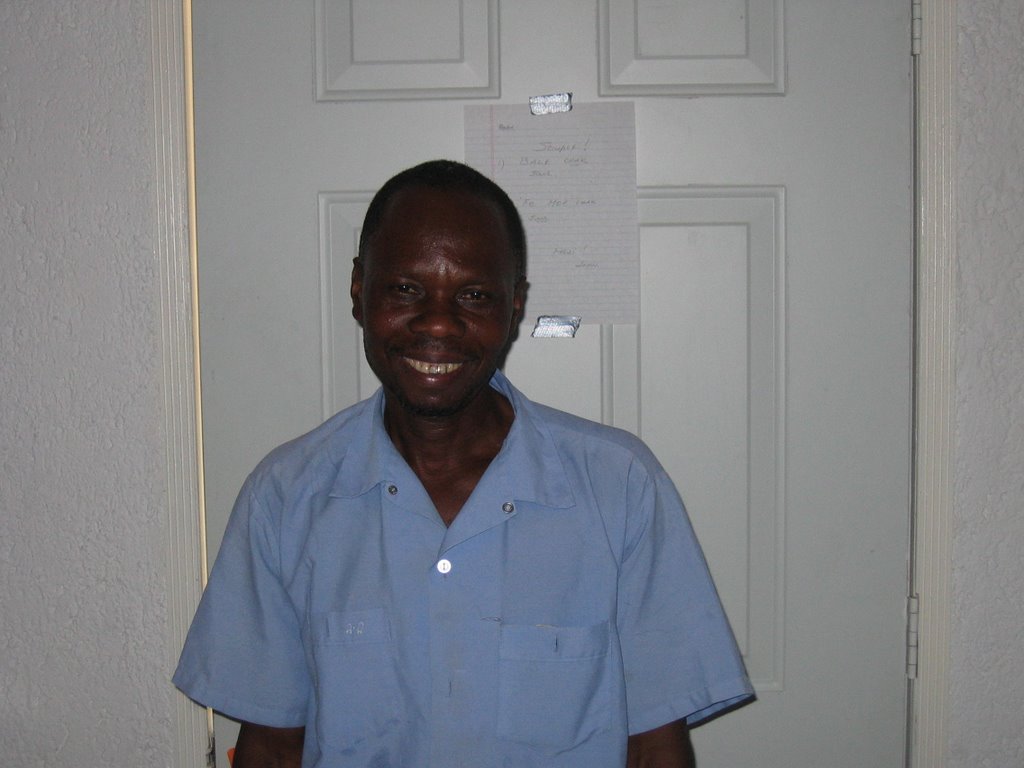
Jean Claude is pictured above with his truck, outside our guest house.

Monday, July 13, 2009

Roldolphe Richeme 1985-2009


This is an e-mail that my husband John received, regarding a young medical student/doctor in Haiti, Roldolphe, who died of severe liver disease. The e-mail was written by Rodolphe's brother, who prior to this, had campaigned with all his heart, mind, and effort to get Rodolphe medical care in the United States. He even offered part of his liver to be transplanted into his brother. Rodolphe was never granted a visa to the United States, and he died in Haiti

Dearest Friends,

God has made everysingle 1 of his creature for one purporse like he has made ROLDOLPHE RICHEME borned in our family, for us to have a sense of lifestyle in the Heaven as he was pure angel living temporarily on this earth for 24 years 7 months old (DOB 12-5-84). The Richeme's family was blessed by God to benefit that grace of having Roldolphe in the family.

No one can come in direct competion with God as we (the Richeme family+yourselves) through Roldolphe's illness end stage were pleading, fighting, shaking the earth and heaven for Rodolphe to live longer on this earth. God wins always the battle as he indeed retrieved Rodolphe prematurely from this earth on a mourning day of july the 4th while some earthly people were rejoycing where 1 other was agonizing, putting out all his blood from his body resulting from the sevrity of his unassessed medical affection experimenting in 3 months on the pitiful eyes of the Lord.

Some would have emphasixed that I would correlate Rodlophe's death on the account of the USA since he could have had better assistance and care there, but no, it's to more emphasize that weirdly according to Independence day celebration in the USA, Rodolphe took his independence from this earth which is an even better fulfillment of Lord's willing. After much sufferings, God decided that RODOLPHE worths more in Heaven then on this failing earth where he had to face sins of all nature and now HOME FREE and away from all pain, sorrows and diseases and iniquities of all kinds.

RODOLPHE's departure would live a unfilling huge gap in the Richeme's heart and yours as my grandma 86 years old fainted last night on hearing that sad news and taken right away to general hospital las night in Port-au-Prince as she wanted to make trip before Rodolphe and asking herself why Rodolphe but not her. Though through this toughFUL experience, we remain more faithful to God and praising Him more than ever not only in good times but as well in bad times like this as each of the trial takes us to a different growth maturity level and the TO BE READY AT ALL TIMES for this EARTH-HEAVEN TRANSITION as Rodolphe is not dead and just ahead of us and we are already anguish to join him to continue to rejoyce with him in songs of Honor and reverence to the Lord.

RODOLPHE HAS CHARGED ME AND FAMILY TO THANK YOU FOR ALL YOUR CONTRIBUTIONS AND ASSISTANCE FROM ALL NATURE but felt unsecure about you being ready for that transition as the Kingdom of Heaven is freely open to all of us as we get Lord's redemption.

Rodolphe's funeral is scheduled for this saturday the 11th of july and you are part of our guests to join us for that symbolic event but be sure that Rodolphe won't rest in peace as he is alive in our heart and alive in heaven eternally.

You may want to stop all medical and financial donations regarding Rodolphe's case at this point. The prayer supports are indeed requested for my family as God is the only one comforter and body and soul healer.

GOD BLESS YOU

THE RICHEME'S FAMILY

Wednesday, February 18, 2009

Walls


In the past year, my 77-year-old father Ed has been to Haiti twice. These have been his first trips to the island nation. Each time, my husband John has invited dad to help escort patients back to the States.

I must admit that I have been a little nervous about my dad going, mainly because if he were to have a health problem there would be little chance that he could get adequate care. But each trip has gone well.

There's really no substitute to going to Haiti for understanding the country. Hmm. . . understanding might not be the right word to use; perhaps encountering would be better. I have spent so much time in Haiti that I was interested in what a first time visitor's impressions were. Following are some comments John made about my dad's observations.

The first morning Ed looked at me, chuckled, and said, "We are surrounded by walls." Ed had surveyed the neighborhood that morning. And he was right. There were walls everywhere. The top of the walls that surround private homes in Haiti have broken glass and razor wire embedded in cement. One would really have to want to get inside the walls to run the risk of going over top. . .The formidable walls in our neighborhood in Haiti's capital startled him since he has spent most of his adult life trying to tear down walls.

Later that first morning in Haiti we piled into a pickup and traveled south and east of Port-au-Prince to an elite suburb called Petionville. We wanted to visit the site of La Promesse, the school that had collapsed suddenly one morning in early November. This tragedy had riveted the world's attention on Haiti and its courageous people. The UN soldiers in Haiti dug through the rubble. International disaster experts were flown in. Pope Benedict sent his condolences. The world seemed to care about these Haitian students and their families.

When we arrived at the site, a small contingent of UN forces from Jordan was walking up the street from the collapsed three story building. A big empty spot was apparent on the side of the street overlooking a steep ravine. About 30 Haitians were milling about on top of broken cement, rubble, and twisted rebar. Many were staring down into the ravine. Most people were quiet. . . I wondered about crushed little bodies that may lie just beneath my dirty shoes. One mother had lost 5 kids in the crush at the school named " The Promise".

Madame Telemak, a neighbor lady, standing in the debris with us, told me she heard a loud noise at 10 AM the morning the school fell. She ran over and witnessed the panic and screaming that enveloped the neighborhood. Family members and neighborhood people dug with their bare hands attempting to free anyone they could get to.

Walls of adjacent homes that had been attached to La Promesse were hanging in various states of disarray and shambles. The walls had been partially ripped off when the school collapsed and again with the process of extrication of survivors and victims. . .After a short time, there wasn't much more to see or talk about. Helpless doesn't describe the situation. A few pictures and collective shaking of heads, and it was time to leave. . . I agree with my sagacious father-in-law. Walls everywhere, not just in Haiti, need to be removed so places like La Promesse don't collapse and crush the future for all of us.

Thursday, February 05, 2009

Frandy

Life is very hard for poor people in poor countries. All their energy and attention is focused on survival: getting enough food to eat, having safe shelter, obtaining clean water. It's hard for people to try to better their lives or the lives of their children in these circumstances.

Once in awhile, though, you come across a person who for many reasons, is able to think of and work toward a better life. We know such a person in 20-year-old Frandy. We met Frandy seven years ago when he came to John about his heart.

Frandy lives on top of a mountain with his mother and two older brothers in the seaside slum of Carrefour, next to Port-au-Prince. He is very thin. I remember when we went to Frandy's home. We hiked and hiked and came to a two room, concrete block structure with a tin roof. Frandy welcomed us, and his mother served us Coca Cola that they had gotten for the occasion of our visit.

Frandy had a hole in his heart, and he came to St. Louis for medical care. His mother accompanied him. On the first night here, as his mother soaked up the incredible luxuries of this country, she said, "We are in paradise."

Frandy did not have to have surgery, which was a blessing. Another blessing for him was an opportunity to experience the blessings of the United States.

He returned to Haiti after a two month stay. Frandy was already a driven person who excelled in school. He was now motivated to work even harder and with the support of people in the States, he saw a way that he might attain the almost impossible goal for a poor Haitian of going to college.

Frandy's supporters paid for his education in Haiti. He studied and studied. He listened to the Voice of America. He practiced writing English through sending e-mails and speaking English with anyone he could. He became quadralingual in the process. Frandy speaks French, Haitian Creole, English, and Spanish.

He passed the Haitian equivalent of high school, a huge achievement for someone from Frandy's background. Later this month, he will take the TOEFL (Test of English as a Foreign Language). Passing TOEFL is a requirement for a foreign student to attend college in the United States. Say a prayer that he does well, will you?

I think Frandy is succeeding because he is: intelligent and driven. These may be God-given qualities, but Frandy is making the most of them. He also has people willing to invest in him. Without this, attending college in the United States would be a cruel dream.

Frandy sees a better life for himself and his family and that vision draws him on. I admire him a lot. God willing, he will succeed.

Tuesday, September 19, 2006

Hard Life, Big Smile


Smiles seem more dazzling in Port-au-Prince, where they stand out against the harshness of life and the bleakness of the cityscape. This man is one of the lucky poor. He has a job. He cleans our floors and bathroom, and he cleans them very well. He removes his shoes when he comes into the room so that he does not track while he mops; he puts one of those white paper bands over the toilet bowel when he has finished cleaning it; he scrubbed part of the floor extra hard to get up a sticky substance. He has pride in his work. This is not true of all of his counterparts. Some of them beg from us, an offense that would get them fired if the owners of the hotel knew about it.

But many of the staff here are very competent. As I was writing this, a waiter we particularly admire handed me a piece of paper with the word “saucers” written on it and asked me how to pronounce it. He got it correct on the first try. This waiter, with his quiet dignity, is always trying to improve himself. This morning another waiter saw our almost-empty water jug sitting on the table and filled it for us. This may seem rather basic, but in Haiti we learn not to expect the basics. John has said of a few of the workers, I would hire him.”


The employees here have a nice place to work. They make a wage that helps them support their families. They all look like they have enough to eat. This is why I call them lucky. Many Haitians, including some who work here, have a dream, and that dream is to get to the United States. For a poor Haitian, this is not a very realistic dream, equivalent to an American’s dream of winning the lottery. And even those of us who are largely satisfied with our lives and have endless options, seem to want more: more money, more happiness, more love, more things. More. More. More. I watch the way the man in the picture cleans our room, with almost a Zen-like involvement in the process and attention to detail and I think: For those of us with enough to eat, this man teaches us a lesson, to live our days well, wherever we find ourselves, and to give our best to others.

Friday, September 15, 2006

A Living Saint


Can't you see how good this woman's soul is by looking at her eyes? Her name is Madame Therese (pronounced Thereze). She is a devout Catholic, who prays the Rosary at least four times a day. Actually, Madame Therese prays all day long--starting with kneeling by the side of her bed in the morning, giving thanks and praise to God for another day. She ends the day this way also. You can tell by her peaceful, warm presence that she spends a lot of time with God. You don't have to ask Madame Therese what the most important thing in her life is to know it's her faith. She walks to Sacre Coeur, her church in downtown Port-au-Prince. When Madame Therese received a gift of a rosary and a picture of Our Lady of Perpetual Help, Haiti's patron saint, she reacted as if she had been given silver and gold.

Madame Therese represents the rubric "poverty with dignity." By American, material standards, she is poor. But she has enough to eat, clothes to wear, a small home, and some education behind her. She speaks French as well as Creole. You can see this dignity in the neatness of her dress and her deliberate, graceful movements. People aren’t more valuable because they have more money.

Madame Therese says that the biggest problem in Haiti is that, "Haitians don't love each other." Certainly we have found that to be the case; many rich Haitians have nothing to do with the poor, and the poor are too busy fighting for survival to care for each other.

Madame Therese spent some time caring for the little boy she is holding in the picture. She would sit on the edge of the bed, watching him as he napped on his mattress on the floor. She laid sideways on the bed when she slept so that she could easily see him. She cared for him with kindness and gentleness, as if he was a temple for the Holy Spirit.

Madame Therese is 54. She looks older than this because life is hard in Haiti, even for those who aren't sick and starving. But her soul is fresh, lively, gleaming, eternal.

Madame Therese is what is good about Haiti.