Maybe you've heard of mud cookies before. If you have, you probably try not to think about it. We have a couple sitting on top the piano in our living room. They are a reality check. They are a perspective check.
Wednesday, October 27, 2010
Mass Production of Mud Cookies. Really.
Maybe you've heard of mud cookies before. If you have, you probably try not to think about it. We have a couple sitting on top the piano in our living room. They are a reality check. They are a perspective check.
Here's the reality: people are so hungry in Haiti they will resort to eating mud cookies to fill their stomachs. In Cite Soleil, John came upon a place where, as you can see in the pictures above, they mass produce mud cookies. The woman who makes them say that the dirt comes from Hinche, a town of 50,000 in central Haiti. We haven't been able to discover why the dirt from Hinche is special. The woman making the cookies said that pregnant women eat the mud cookies.
It is really difficult to think about people eating mud cookies. Sometimes when we've shown people in the United States our mud cookies, we get blank faces in response, as if they can't or don't want to acknowledge the reality of what the mud cookie means. It does put one's own problems into perspective. To some, it may seem cruelly unnecessary to show people the mud cookies when it doesn't seem as if there is anything they can directly do about the conditions that cause people to eat mud cookies. But you never know when an experience like this will change a person's life. And at the least, as Dr. Albert Schweitzer says, the encounter may encourage people to "Think occasionally of the suffering of which you spare yourself the sight."
Tuesday, October 26, 2010
Cholera: A Terrible Disease
"We found Radha lying on a thin blanket in her hut. Her body was twisted into a knot of pain. Her hair was wet, saturated with sweat, as was the pink sari she wore. The smell in the hut was terrible. . . (her) mother was trying to keep her clean, but Radha's fever rendered her incoherent and incontinent. She vomited again violently as we watched, and that provoked a new dribble of diarrhea. . . what kills people who are contaminated with the cholera bacterium is dehydration . . The word cholera comes from the Greek word kholera, meaning diarrhea. The diarrhea of the cholera sickness has a singularly vile smell, and you never get used to it."
I shuddered when I read the above passage, just a few months ago, from the novel Shantaram by Gregory David Roberts. The novel is based on Roberts' experiences in India. I remarked to John how horrible cholera sounds and he confirmed that it is.
Cholera hasn't occurred much in Haiti. Back in 1990 when I went to the country for the first time, the health department recommended many vaccinations (typhoid fever, hepatitis) for travel to Haiti but not cholera, though the vaccination was suggested for travel to other parts of the world. (Note: if I read the literature properly, for the last several years, cholera vaccinations have not been recommended for travelers going anywhere).
Things have changed in the last few days and now Haiti is battling this terrible scourge. Cholera can kill in hours. The loss of fluids causes extreme dehydration, which leads to dangerous electrolyte imbalances.
The treatment for cholera is Oral Rehydration Therapy (ORT), a solution of sugar, salt, and other minerals dissolved in water that is administered to patients to keep them from getting dehydrated. In time, the bacteria works its way out of the patient's system.
We hope and pray that the cholera is contained and does not spread to the camps or other places in Port-au-Prince.
Monday, October 18, 2010
Valses to Voodoo

This past Friday we attended a piano concert at Bradley University's Dingledine Music Center. Pianist Joshua Russell played pieces composed by Haitian pianist and composer Ludovic Lamothe, pictured above.
The concert was a revelation. I didn't know that Haiti had a tradition of classical music. The music was energetic and full of surprises. Russell, who teaches at Bradley and who has taught music in Haiti and did his doctoral dissertation on Lamothe, described hearing a recording of Lamothe's playing as life changing. He said that even though the compositions were all written, Lamothe sounded as if he was inprovising, playing with a captivating freedom. Russell has recently released a CD of Lamothe's music called Valses to Voodoo.
In Lamothe's compositions, one can hear the influences of Haitian folk music, the rhythms of voodou drums, Latin American rhythms, and the music of Frederic Chopin. Lamothe was sometimes referred to as the black Chopin.
It's impossible to convey the magic of music in words, but if you want to learn more about Joshua Russell's interpretation of Lamothe's music, check out his website.
Wednesday, September 29, 2010
Big Problems; Little Solutions

The illnesses and injuries that John saw in patients on his most recent trip to Haiti were staggering. One woman's foot was literally rotting off her leg due to untreated diabetes. Because there was no anesthestist available, the woman had to wait a week for surgery. So instead of having her foot amputated, she had to have her leg amputated below the knee because the gangrene had spread.
The left side of one man's face was swollen to unbelievable proportions because of untreated tongue cancer that had spread to his jaw and neck. All John could do was give him pain medication.
One man had lockjaw from tetanus. His family would bring him liquid food that they were able to feed him.
A 30-year-old man fell out of a tree and broke his back. The staff was trying to figure out the best way to tell him that he would never walk again.
A married woman was trying to come to terms with the fact that both she and her husband tested positive for HIV.
Delayed treatment, lack of prevention, a hazardous envirnoment, lack of adequate medical care--these are some of the reasons that people are so ill. It can be overwhelming to learn about, so much so that we can throw up our hands and say, "It's beyond me."
But that attitude ensures that things will stay the same. I want to challenge everyone reading this to do one small thing to help Haiti. Think about what that could be.
Sunday, September 26, 2010
Haiti and Murphy's Law
This past Friday just after 3:30 pm, John received an e-mail from our friend Frandy in Haiti. It was short and in its entirety read:
A big wind is hitting Port-au-Prince this afternoon.I wished i could take pictures but i had to run in order to protect myself.Please pray for Haiti!
We didn't know exactly what to make of this e-mail. A big wind? There were no hurricanes heading toward Haiti. However, we found out just how big of a wind over the next couple of days. This from a contributor to Bob Corbett's list:
We've just gone through an hour of the worst Wind and rain storm I've
encountered in my 13 years here. It was worse than any hurricane I;ve gone
through. I kept thinking it was like a typhoon - it was so strong and very
frightening.I was sure all the trees would come down with the force. It was just awful. There's still thunder around but the rain and the wind have calmed down now.
I'm trying to find out something on the Radio. A friend rang me from Jacmel
and he said he had heard that there was a problem in Delmas so this is why
he called. He said people were saying the "earth had turned" - not an
earthquake, but "terre viré". He said people said that many people had died,
but I don't know if this is true.What I can say is, I don't know how the tent people have survived this, if indeed it is throughout PauP and not just in Delmas.
A big wind is hitting Port-au-Prince this afternoon.I wished i could take pictures but i had to run in order to protect myself.Please pray for Haiti!
We didn't know exactly what to make of this e-mail. A big wind? There were no hurricanes heading toward Haiti. However, we found out just how big of a wind over the next couple of days. This from a contributor to Bob Corbett's list:
We've just gone through an hour of the worst Wind and rain storm I've
encountered in my 13 years here. It was worse than any hurricane I;ve gone
through. I kept thinking it was like a typhoon - it was so strong and very
frightening.I was sure all the trees would come down with the force. It was just awful. There's still thunder around but the rain and the wind have calmed down now.
I'm trying to find out something on the Radio. A friend rang me from Jacmel
and he said he had heard that there was a problem in Delmas so this is why
he called. He said people were saying the "earth had turned" - not an
earthquake, but "terre viré". He said people said that many people had died,
but I don't know if this is true.What I can say is, I don't know how the tent people have survived this, if indeed it is throughout PauP and not just in Delmas.
We're still finding out how many "tent people" died, but according to one report, the freakish storm destroyed or damaged at least 8,000 tents.
Let's do more than just pray for Haiti.
Saturday, September 11, 2010
See No Evil
When we are in Haiti, we take a lot of pictures and use them in our blogs. Some of the pictures are of people who are suffering terribly due to illness or injury. We sometimes send these pictures to people in efforts to find medical care in the U.S. for people who are beyond the help of Haiti's meager system. Such is the case with the man pictured above who likely has cancer of the tongue and has received no treatment for it. All John can do for him is medicate his pain. Sometimes we send pictures to show people the kinds of problems that people in Haiti have. We also give presentations at home and we use the pictures to illustrate the difficulties of life in Haiti. Sometimes, as with the picture above, these pictures are hard to look at.
At least on the surface, people's responses to disturbing pictures fall into one of a few categories: shock and sadness; apathy (what can I do about these problems that have been around as long as human beings themselves); anger (either at the situation or at us for showing them the pictures); or a non-response (perhaps this is a form of overwhelm).
With our 24 hour media beaming images of the latest disaster into our living rooms round the clock it's not surprising that people can become jaded. We're all busy with important things and having our attention grabbed however momentarily by a picture like the one above isn't a pleasant experience. For myself, though, and despite the much greater exposure we have to the world's suffering than we did even 25 years ago, I find seeing pictures like this a necessary experience. For despite my access to information, it's too easy for me to forget.
As I was pondering the above issues earlier in the week, I came across a bumper sticker with the following wisdom:
Think occasionally of the suffering of which you spare yourself the sight.-Albert Schweitzer
So at least for today, we are not spared.
Monday, August 23, 2010
A Grateful Family
Poor people with heart problems in Haiti are in a lot of trouble. Most of the time, they die deaths that could be avoided with surgery that we in the United States take as our birthright if we need it. Once in awhile, though, a miracle occurs, and a patient is accepted for medical care in the United States or another country. I call it a miracle, and given the rarity of the situation, it is. But it takes a lot of hard work on the part of my husband John. Through his efforts, a man with a serious heart problem was accepted for medical care in Florida. As you can read from his nephew's letter below, Haitian people have a great capacity for gratitude and a beautiful manner of expressing it, even in another language.
Dear doctor,
May God Bless you and your family for longer! doctor me and all my family we're very happy that God sent you on our way just to help us with this great problem.Beleive me we haven't enough words to show you franckly our joys for that.In more ,say to you only "Thank you"it's too light.Cause you merit more.So,as we know God has eyes open on everything we do good or bad.Of there,we hope deeper of our heart he will reward you not only for today.But for all the rest of your life.And why not of generation in generation.
In fact doctor,as i said to you we had an appointment yesterday to the american consulate.thanks to the lord they gave to my uncle the visas for a short time,three months.then we are grateful toward jesus for that.Cause he's done the main thing for us.And then ,after all things you did also,i see it's not good to keep on calling you:dear doctor, dear doctor... it could be better to consider you as a member in our family.cause the job that you've just done for our family seems like the job of a cousin,a brother a father and so on.For all things, i decide to pray for you and write you every time i get chance to do it just to get informed about you.Of all my heart you're a good one. . .
Don't forget to let the other doctor to know how much we were so happy when he did accept to write the American consulate a kind of letter to help my uncle found the visas.We need to think your wife also doctor.Cause,we saw her determination to help us to succeed too.Please say "hi" to her for us.
Doctor,as a good one. stay like that,don't be changed.Cause God has a plan for you too.Beleive in that,there will be a day you will feel it.Yeah! you deserve that!!!!!!
Blessing,
D
Dear doctor,
May God Bless you and your family for longer! doctor me and all my family we're very happy that God sent you on our way just to help us with this great problem.Beleive me we haven't enough words to show you franckly our joys for that.In more ,say to you only "Thank you"it's too light.Cause you merit more.So,as we know God has eyes open on everything we do good or bad.Of there,we hope deeper of our heart he will reward you not only for today.But for all the rest of your life.And why not of generation in generation.
In fact doctor,as i said to you we had an appointment yesterday to the american consulate.thanks to the lord they gave to my uncle the visas for a short time,three months.then we are grateful toward jesus for that.Cause he's done the main thing for us.And then ,after all things you did also,i see it's not good to keep on calling you:dear doctor, dear doctor... it could be better to consider you as a member in our family.cause the job that you've just done for our family seems like the job of a cousin,a brother a father and so on.For all things, i decide to pray for you and write you every time i get chance to do it just to get informed about you.Of all my heart you're a good one. . .
Don't forget to let the other doctor to know how much we were so happy when he did accept to write the American consulate a kind of letter to help my uncle found the visas.We need to think your wife also doctor.Cause,we saw her determination to help us to succeed too.Please say "hi" to her for us.
Doctor,as a good one. stay like that,don't be changed.Cause God has a plan for you too.Beleive in that,there will be a day you will feel it.Yeah! you deserve that!!!!!!
Blessing,
D
Friday, July 02, 2010
Some Thoughts from the Ground in Haiti
Here is an excellent guest post from my husband John. It describes what we saw in Haiti on our recent trip and some thoughts about it.
My wife Maria and I worked in Haiti during part of the months of May and June. We stayed in a guesthouse-orphanage just outside of Port-au-Prince.
A lady named Yolande lived right across the street from us.
Yolande is 78 years old and lives under a blue tarpaulin which encloses a small pup tent inside.
During the earthquake on January 12 her shack, which was located several miles away, was so damaged that she had to move out. Yolande suffered some leg injuries at the time of the quake and still has one lower leg wrapped in a rag. But Yolande smiled and told me that her legs were "much better".
One afternoon shortly after we arrived, I entered an opening in Yolande's blue tarp. The stifling heat, humidity, mosquitoes, and flies were overwhelming.
The tarp was fastened to thin wooden poles and tied above with shoe laces and other fragments of cloth.
Yolande's family brings her rice and vegetables when they can and she cooks in a metal bowl over pieces of charcoal.
I found Yolande to be a practical and pleasant woman. She did not complain about her living arrangements and even said that Americans are the most charitable people in the world. I sure did not feel that way right then as I hurried out from under the tarp so I could get a breath of cooler air in the street.
During this time of the year in Haiti, the rain comes in torrents in the late afternoon or evening, and now this rain seeps through Yolande's tarp and leaks into her tent. So on top of roasting, Yolande and her family are wet much of the time too.
These hardships are not isolated to Yolande.
Haiti has an estimated 9 million people with one third of the population living in the capital, Port-au-Prince. In this city there are over one thousand tent cities, and an estimated 1.5 million people are still homeless five months after the quake. Many people told me that they are simply too afraid to move back inside of their houses. If their houses are still standing, the walls may have been fissure (cracked) and people fear they will collapse on top of them.
Several miles from us downtown Port-au-Prince looks like a nuclear bomb struck it. The once beautiful Haitian National Palace is collapsed and the majority of nearby Haitian government ministry buildings downtown were destroyed in the 47 second earthquake. Haiti's tax building is pancaked just across from the Palace with its director's body and many employees still inside under tons of concrete.
A densely populated tent city now sits in front of the vacant Palace in Port-au-Prince's largest square called Champs de Mars. A young man who identified himself as Carlos told me some of their problems after I walked through his section of the tent city. Carlos seemed fatalistic and did not see any end in sight to their misery.
Rape is common in Port-au-Prince's tent cities and seldom gets reported. Poor women in tent cities have no rights.
Fountains and small decorative pools in Champs de Mar have turned into large toilets filled with stagnant sewage. Kids play nearby with their family's tent abutting these toxic cesspools. Sewage drainage and treatment facilities are more or less nonexistent.
In the chaotic months following the quake, millions of dollars flowed into Haiti from generous people all over the world. (One out of two American households gave to the Haitian relief efforts.)
And five billion more dollars from the international community has been pledged to Haiti over the next two years. Bill Clinton who is UN Special Envoy to Haiti. Recently Mr. Clinton along with Haitian officials have been in charge of the Interim Haiti Reconstruction Commission. One of the objectives of this Commission is to allocate these funds to ensure that the money is used in a transparent fashion for Haiti's post earthquake reconstruction.
Mr. Clinton and Haiti's Prime Minister Belleriviere announced the Commission's first approved spending projects:
- $45 million from Brazil and Norway in direct funds for the Haitian government, closing a quarter of its estimated $170 million budget shortfall.
- $1 million from the Clinton Foundation for buildings that can be used as storm shelters in the quake-ravaged towns of Leogane and Jacmel, which are often in the path of Atlantic hurricanes.
- A $20 million fund to provide loans to small- and medium-sized Haitian businesses.
But despite international pledges of some $5 billion over two years at the United Nations donors' conference for Haiti in March, only a fraction has actually been delivered - just $40 million from Brazil.
Even though other pledges are supposed to be delivered soon, I spoke to no Haitians during our entire time in Haiti who trusts that the money will be spent properly. People that I spoke with don't really trust Mr. Clinton any more than they do their own fragmented and dysfunctional government. Many are very angry with Haitian President Preval for his perceived lack of leadership and poor communication through Haiti's largest crisis in its history. They also feel he is cuddling up to international powers for business interests that will exclude the majority of poor Haitians.
And why should 9 million poor Haitians trust any one? They and their ancestors have been on the short end of the stick since Haiti was founded as a Republic more than 200 years ago. The corrupt Haitian state is considered to be a fact of life... not unlike corrupt Illinois politics.
So what do "we" do with hundreds of thousands of displaced and homeless Haitian people? Although Haitians are a tough lot, they are not as resilient as our defense mechanisms would like us to believe. And on top of this earthquake which was "biblical" in size, the U.S. National Oceanic and Atmospheric Administration has predicted a terrible tropical storm season coming Haiti's way in several months.
But so far (as of this writing) the Haitian government has relocated only about 7,000 vulnerable people to two safer camps. The relocation is slow because the crippled government doesn't have enough money to complete a job that includes not just setting up new tents, but providing work, schools and services.
First of all, should the tent cities continue to exist? Are they good enough?
No. These places are inhuman and horrible. Lack of food and water, lack of security, and the rain are a few reasons.
And the rain is quickly bringing more problems.
Malaria and typhoid fever were everyday occurrences in the area of the city where I was working. Stagnant dirty puddles of water are everywhere and are good breeding grounds for mosquitoes who will carry disease. I saw a teen-aged boy scooping up water in his hands drinking from a puddle in the road. Medical and public health interventions will not help the majority of Haitians unless their dangerous living environment is changed.
Also, heavy rains tempt unstable hillsides to unleash their mud. And serious flooding and mudslides could endanger not only Haitians but relief workers also.
Port-au-Prince, before the earthquake could have accommodated 300,000 people, not three million people. There has been decades of urban decay. This city is doomed right now unless a paradigm shift in thinking takes place.
We need to be honest and understand that many people are dying now and are still going to die no matter what is done. I saw children starving in front of me. I often wondered what good was my stethoscope in times like this.
So what needs to happen? What interventions will minimize the final death count? How can Haiti's problems be prioritized and triaged appropriately? What can be done to give some dignity to the life of over one million displaced Haitians? How do we stop the violence aimed at Haitian society's unfortunate losers?
Haitians tell me they want jobs. Who would have thought?
Jobs earn them money to repair their lives and their family's lives. Jobs allow one parent to stay at home during the day and take care of their babies and toddlers. Kids suffer alot mentally and physically when they are alone or being watched by a neighbor who is already swamped with problems. Children are literally down in the dirt and sewage and their chances for survival diminish without a parent home.
Mother's can breastfeed if they are home. And when mother's breastfeed, they save money because they do not need to purchase milk. And if they purchase powdered milk, they may accidentally prepare it with dirty water which can sicken their children.
With the billions of dollars that hopefully will come to Haiti, big firms with heavy equipment should be hired. Skillful urban planners from all over the world need to work with the Haitian government.
And most importantly poor Haitians need to be hired.
Hundreds of thousands of young, strong Haitian men and women that live in the capital would jump at the chance for a job. Hire them and pay them fairly so they can feed their families while they make a new and better Haiti. The billions of dollars of international pledges need to go for displaced Haitians while they perform the back breaking reconstruction of Haiti.
Pay Haitians in tent cities to repair or rebuild their own homes--the structures where they were living pre earthquake. Or pay the man that rents the home to these people. And these homes need to be earthquake proof homes using Western building codes. Earthquakes don't kill people, bad buildings do.
The huge mounds of rubble on the Port-au-Prince streets needs to be cleared so the streets can be navigated by cars and big equipment. The traffic jams in the capital now slow progress for everyone.
Many people have returned to their neighborhoods after inspections found their homes safe, but often return to the tent camps when word of aid distribution spreads. So food and water distribution needs to be local--- brought to people in their neighborhoods as their homes are rebuilt.
Port-au-Prince needs to be decentralized. The earthquake negatively influenced 80% of Haiti's economy because PAP was and is the hub of the country. Now the hub is critically ill. The capital is built over fault lines and this all could happen again. Three million miserable people living on top of each other need to be spread back out to Haiti's provinces.
But for people to move to the Haitian countryside or smaller cities outside of PAP, there has to be jobs, family members with adequate housing that can accept their homeless relatives, and some basic services like schools, roads, water, electricity, and medical care.
Trees need to be planted and gardens started in these communities. Listening to Haitian grass roots organizations and the Haitian farmer is very important. These people know what they need to stay alive.
The local Haitian community in the province needs to be involved in all decision points.
Foreign aid that flowed into Haiti after the quake has hurt the Haitian farmers. Most of the people in Haiti's central plateau (L'Artibonite) earn their living by growing and selling rice, Haiti’s staple food. But the influx of foreign food aid has meant that many Haitians can now get rice for free. As a result, the price of rice grown in Haiti has plummeted and the Haitian farmer finds himself in more trouble.
Several months ago even Mr. Clinton was quoted as saying, "...we made a devil's bargain" when he was President. He publicly apologized for forcing Haiti to drop tariffs on imported, subsidized US rice. His policy hurt Haitian rice farming and, as reported by Kim Ives, "seriously damaged Haiti's ability to be self sufficient".
And let us not forget that Haiti, believe it or not, is in the digital age. The Haitian people in the countryside have cell phones and access to the Internet. Many Haitians are adept at using both. This means that they still communicate with Haitian relatives, the diaspora, overseas.
Haiti's diaspora has sent back billions of dollars over the past few decades to needy Haitian relatives, but this obviously has not been enough. The diaspora need to physically come back to Haiti and revitalize Haiti's industrial sector. But they won't come back and invest in Haiti unless than can do so safely. Most diaspora tell me they fear for their personal safety in Haiti. Security everywhere needs to be improved. And the economic climate for joint business ventures, to stimulate Haiti's diaspora to invest in Haiti, has to be improved by the Haitian government.
In conclusion, Haiti was a severely damaged country before the January earthquake and is even more damaged now.
Haitians are a beautiful and wonderful people, but they are not as "resilient" as we would like to believe.
Yolande, the little old tent lady who lived near us, should not be living like this. If Yolande were your grandmother, you wouldn't refer to her as "resilient" as she suffers the Haitian heat and mosquitoes, would you?
The huge international monetary pledges need to be allocated in a transparent fashion to help these neediest Haitians.
My wife Maria and I worked in Haiti during part of the months of May and June. We stayed in a guesthouse-orphanage just outside of Port-au-Prince.
A lady named Yolande lived right across the street from us.
Yolande is 78 years old and lives under a blue tarpaulin which encloses a small pup tent inside.
During the earthquake on January 12 her shack, which was located several miles away, was so damaged that she had to move out. Yolande suffered some leg injuries at the time of the quake and still has one lower leg wrapped in a rag. But Yolande smiled and told me that her legs were "much better".
One afternoon shortly after we arrived, I entered an opening in Yolande's blue tarp. The stifling heat, humidity, mosquitoes, and flies were overwhelming.
The tarp was fastened to thin wooden poles and tied above with shoe laces and other fragments of cloth.
Yolande's family brings her rice and vegetables when they can and she cooks in a metal bowl over pieces of charcoal.
I found Yolande to be a practical and pleasant woman. She did not complain about her living arrangements and even said that Americans are the most charitable people in the world. I sure did not feel that way right then as I hurried out from under the tarp so I could get a breath of cooler air in the street.
During this time of the year in Haiti, the rain comes in torrents in the late afternoon or evening, and now this rain seeps through Yolande's tarp and leaks into her tent. So on top of roasting, Yolande and her family are wet much of the time too.
These hardships are not isolated to Yolande.
Haiti has an estimated 9 million people with one third of the population living in the capital, Port-au-Prince. In this city there are over one thousand tent cities, and an estimated 1.5 million people are still homeless five months after the quake. Many people told me that they are simply too afraid to move back inside of their houses. If their houses are still standing, the walls may have been fissure (cracked) and people fear they will collapse on top of them.
Several miles from us downtown Port-au-Prince looks like a nuclear bomb struck it. The once beautiful Haitian National Palace is collapsed and the majority of nearby Haitian government ministry buildings downtown were destroyed in the 47 second earthquake. Haiti's tax building is pancaked just across from the Palace with its director's body and many employees still inside under tons of concrete.
A densely populated tent city now sits in front of the vacant Palace in Port-au-Prince's largest square called Champs de Mars. A young man who identified himself as Carlos told me some of their problems after I walked through his section of the tent city. Carlos seemed fatalistic and did not see any end in sight to their misery.
Rape is common in Port-au-Prince's tent cities and seldom gets reported. Poor women in tent cities have no rights.
Fountains and small decorative pools in Champs de Mar have turned into large toilets filled with stagnant sewage. Kids play nearby with their family's tent abutting these toxic cesspools. Sewage drainage and treatment facilities are more or less nonexistent.
In the chaotic months following the quake, millions of dollars flowed into Haiti from generous people all over the world. (One out of two American households gave to the Haitian relief efforts.)
And five billion more dollars from the international community has been pledged to Haiti over the next two years. Bill Clinton who is UN Special Envoy to Haiti. Recently Mr. Clinton along with Haitian officials have been in charge of the Interim Haiti Reconstruction Commission. One of the objectives of this Commission is to allocate these funds to ensure that the money is used in a transparent fashion for Haiti's post earthquake reconstruction.
Mr. Clinton and Haiti's Prime Minister Belleriviere announced the Commission's first approved spending projects:
- $45 million from Brazil and Norway in direct funds for the Haitian government, closing a quarter of its estimated $170 million budget shortfall.
- $1 million from the Clinton Foundation for buildings that can be used as storm shelters in the quake-ravaged towns of Leogane and Jacmel, which are often in the path of Atlantic hurricanes.
- A $20 million fund to provide loans to small- and medium-sized Haitian businesses.
But despite international pledges of some $5 billion over two years at the United Nations donors' conference for Haiti in March, only a fraction has actually been delivered - just $40 million from Brazil.
Even though other pledges are supposed to be delivered soon, I spoke to no Haitians during our entire time in Haiti who trusts that the money will be spent properly. People that I spoke with don't really trust Mr. Clinton any more than they do their own fragmented and dysfunctional government. Many are very angry with Haitian President Preval for his perceived lack of leadership and poor communication through Haiti's largest crisis in its history. They also feel he is cuddling up to international powers for business interests that will exclude the majority of poor Haitians.
And why should 9 million poor Haitians trust any one? They and their ancestors have been on the short end of the stick since Haiti was founded as a Republic more than 200 years ago. The corrupt Haitian state is considered to be a fact of life... not unlike corrupt Illinois politics.
So what do "we" do with hundreds of thousands of displaced and homeless Haitian people? Although Haitians are a tough lot, they are not as resilient as our defense mechanisms would like us to believe. And on top of this earthquake which was "biblical" in size, the U.S. National Oceanic and Atmospheric Administration has predicted a terrible tropical storm season coming Haiti's way in several months.
But so far (as of this writing) the Haitian government has relocated only about 7,000 vulnerable people to two safer camps. The relocation is slow because the crippled government doesn't have enough money to complete a job that includes not just setting up new tents, but providing work, schools and services.
First of all, should the tent cities continue to exist? Are they good enough?
No. These places are inhuman and horrible. Lack of food and water, lack of security, and the rain are a few reasons.
And the rain is quickly bringing more problems.
Malaria and typhoid fever were everyday occurrences in the area of the city where I was working. Stagnant dirty puddles of water are everywhere and are good breeding grounds for mosquitoes who will carry disease. I saw a teen-aged boy scooping up water in his hands drinking from a puddle in the road. Medical and public health interventions will not help the majority of Haitians unless their dangerous living environment is changed.
Also, heavy rains tempt unstable hillsides to unleash their mud. And serious flooding and mudslides could endanger not only Haitians but relief workers also.
Port-au-Prince, before the earthquake could have accommodated 300,000 people, not three million people. There has been decades of urban decay. This city is doomed right now unless a paradigm shift in thinking takes place.
We need to be honest and understand that many people are dying now and are still going to die no matter what is done. I saw children starving in front of me. I often wondered what good was my stethoscope in times like this.
So what needs to happen? What interventions will minimize the final death count? How can Haiti's problems be prioritized and triaged appropriately? What can be done to give some dignity to the life of over one million displaced Haitians? How do we stop the violence aimed at Haitian society's unfortunate losers?
Haitians tell me they want jobs. Who would have thought?
Jobs earn them money to repair their lives and their family's lives. Jobs allow one parent to stay at home during the day and take care of their babies and toddlers. Kids suffer alot mentally and physically when they are alone or being watched by a neighbor who is already swamped with problems. Children are literally down in the dirt and sewage and their chances for survival diminish without a parent home.
Mother's can breastfeed if they are home. And when mother's breastfeed, they save money because they do not need to purchase milk. And if they purchase powdered milk, they may accidentally prepare it with dirty water which can sicken their children.
With the billions of dollars that hopefully will come to Haiti, big firms with heavy equipment should be hired. Skillful urban planners from all over the world need to work with the Haitian government.
And most importantly poor Haitians need to be hired.
Hundreds of thousands of young, strong Haitian men and women that live in the capital would jump at the chance for a job. Hire them and pay them fairly so they can feed their families while they make a new and better Haiti. The billions of dollars of international pledges need to go for displaced Haitians while they perform the back breaking reconstruction of Haiti.
Pay Haitians in tent cities to repair or rebuild their own homes--the structures where they were living pre earthquake. Or pay the man that rents the home to these people. And these homes need to be earthquake proof homes using Western building codes. Earthquakes don't kill people, bad buildings do.
The huge mounds of rubble on the Port-au-Prince streets needs to be cleared so the streets can be navigated by cars and big equipment. The traffic jams in the capital now slow progress for everyone.
Many people have returned to their neighborhoods after inspections found their homes safe, but often return to the tent camps when word of aid distribution spreads. So food and water distribution needs to be local--- brought to people in their neighborhoods as their homes are rebuilt.
Port-au-Prince needs to be decentralized. The earthquake negatively influenced 80% of Haiti's economy because PAP was and is the hub of the country. Now the hub is critically ill. The capital is built over fault lines and this all could happen again. Three million miserable people living on top of each other need to be spread back out to Haiti's provinces.
But for people to move to the Haitian countryside or smaller cities outside of PAP, there has to be jobs, family members with adequate housing that can accept their homeless relatives, and some basic services like schools, roads, water, electricity, and medical care.
Trees need to be planted and gardens started in these communities. Listening to Haitian grass roots organizations and the Haitian farmer is very important. These people know what they need to stay alive.
The local Haitian community in the province needs to be involved in all decision points.
Foreign aid that flowed into Haiti after the quake has hurt the Haitian farmers. Most of the people in Haiti's central plateau (L'Artibonite) earn their living by growing and selling rice, Haiti’s staple food. But the influx of foreign food aid has meant that many Haitians can now get rice for free. As a result, the price of rice grown in Haiti has plummeted and the Haitian farmer finds himself in more trouble.
Several months ago even Mr. Clinton was quoted as saying, "...we made a devil's bargain" when he was President. He publicly apologized for forcing Haiti to drop tariffs on imported, subsidized US rice. His policy hurt Haitian rice farming and, as reported by Kim Ives, "seriously damaged Haiti's ability to be self sufficient".
And let us not forget that Haiti, believe it or not, is in the digital age. The Haitian people in the countryside have cell phones and access to the Internet. Many Haitians are adept at using both. This means that they still communicate with Haitian relatives, the diaspora, overseas.
Haiti's diaspora has sent back billions of dollars over the past few decades to needy Haitian relatives, but this obviously has not been enough. The diaspora need to physically come back to Haiti and revitalize Haiti's industrial sector. But they won't come back and invest in Haiti unless than can do so safely. Most diaspora tell me they fear for their personal safety in Haiti. Security everywhere needs to be improved. And the economic climate for joint business ventures, to stimulate Haiti's diaspora to invest in Haiti, has to be improved by the Haitian government.
In conclusion, Haiti was a severely damaged country before the January earthquake and is even more damaged now.
Haitians are a beautiful and wonderful people, but they are not as "resilient" as we would like to believe.
Yolande, the little old tent lady who lived near us, should not be living like this. If Yolande were your grandmother, you wouldn't refer to her as "resilient" as she suffers the Haitian heat and mosquitoes, would you?
The huge international monetary pledges need to be allocated in a transparent fashion to help these neediest Haitians.
Wednesday, June 23, 2010
Driving in Haiti--or even being driven--is nothing if not a adventure. The poor condition of the roads and the vehicles--and poor is a nice word to describe them--makes the strap hanging down from the car ceiling by the window, not just for decorative purposes. The holes and rocks in the road, the lack of driving patterns and lanes, the road-clogging number of cars trying to get someplace in a hurry all combine to make driving challenging at the least and dangerous at the worst.
Drivers in Haiti have to have the reflexes and judgment of expert video game players as negotiating the roads of Haiti, particularly Port-au-Prince, is like being in a real-life video game. More trucks than not have cracked wind shields. They belch black smoke, their interiors are stripped of all but the necessities (and seatbelts aren't considered necessities), and often there are empty beer cans rolling around on the floor.
We were fortunate on our most recent trip to have a fine driver, Jean Claude. He drives for the sisters who run the clinic in Cite Soleil. Besides being a good driver, Jean Claude, like most Haitian drivers, has to know how to keep his truck running. I can't even guess how many miles it has on it, and one Haitian mile has to be about the equivalent of 100 U.S. miles. Jean Claude faithfully and cheerfully got us where we needed to go, and we are grateful to him.
Jean Claude is pictured above with his truck, outside our guest house.
Monday, June 21, 2010
Earthquake Stories
It's been remarkable to hear people's stories about where they were when the earthquake hit. Our friend L was driving home from work. As his vehicle bounced over the rutted roads, he thought, "I need to slow down." He braked but his car continued to rock back and forth. He wondered if he had a flat tire until he looked up and saw the telephone wires swaying wildly. Earthquake. When it was finished, in less than a minute, he continued his drive to his home, part way up the mountain, having no idea of the devastation.
L's wife, who teaches at a school, was home and worried about him. Their cell phones and television were out, and they didn't find out about the extent of the damage until much later. Even until today, there is no cable television in Haiti. It apparently ended with the earthquake.
L was lucky in that his factory wasn't damaged much. Donations from his business associates abroad flooded in, and he and his co-owner divided up the money between his 500 plus employees. One of his employees, Nadia, is the sister of Jackson Jean-Baptiste, a Haitian Hearts patient who died in 2006. L often gives her a ride to and from work.
When we went to supper with L and his wife, he told us about how for fun he had an American Idol-type talent competition among the workers in his factory. He was impressed with some of the singing and dancing talent and would like to have them perform at restaurants, like the one we were at.
L's wife, N, worked at the Union School, a private, American-style, college prep, English language school with grades pre-K through 12. Fortunately, the quake occurred after regular school hours and those who were still on the premises managed to get out safely. Before the earthquake, the school had an enrollment of 300 plus; months after the earthquake when the school started up again, there were only 35 students, as many left for the United States or other countries.
L & N opened their home to medical teams from the United States. For them, life has now largely returned to normal.
Wednesday, June 16, 2010
Through A Mirror Dimly
We talk to all kinds of different people when we're in Haiti, and we hear different opinions of what the problems and solutions are. One of the last nights we were in Port-au-Prince, we went out to eat with an American couple who have been in Haiti for more than 30 years and raised two children there. The man, L, owns a manufacturing business, and the woman, N, is a teacher.
We had dinner in a restaurant. Our friends had to fight a lot of Saturday night traffic on Delmas to pick us up, so we didn’t sit down to eat until about 8 pm. We asked the couple what they thought the solution was to the tent cities. We agreed that it is a difficult problem to solve. L has met with one of the camp leaders to offer employment to some of the people living in camps who qualify.
We heard from another man who runs a business and offered to help one of his employees who lives in a tent get back into a house that his employee didn't want to leave the tent because he didn't have to pay rent and he and his family received free food and medical care. Going along with this, L said that a man who sells water reported that his sales are up, despite free water being available. They decided that some people have more money to spend because, again, they aren't having to pay rent. As we think about this, we have to take into account how terribly inferior housing conditions were for the Haitians before the earthquake for them to view living in tents as not that big of a step down.
This reminds me of a statement that John made earlier in the trip. We were walking along the partially destroyed street of Delmas 31 when we heard, "Clank! Clank! Clank!" the sound of metal on metal. It was a man, whom we've dubbed the "clanking man." Prior to the earthquake, he lived in a tent below a bridge and fashioned items out of scrap metal. After the earthquake, same thing. Back then, we went into his tent and it was hot and mosquito-ridden. As we walked by him this time, John said, "You know who was affected least by the earthquake? Clanking man." His life was so awful already ("We are living in misery," he told us before) that it could hardly get worse.
But it has. A good day in Haiti, particularly Port-au-Prince, before the earthquake, was like a natural disaster. It is imperative that we understand how bad things are now that they have had a most devastating one. Hundreds of thousands of people are living in tents, which won't last long and will be inadequate when hard rains come. Poor sanitation and people living on top of each other create conditions that can breed epidemics.
I can't imagine what the environment inside the tent is like at night. We spent our last night in Port-au-Prince in a guest house. The heat and humidity were stifling, suffocating. During the night, I didn't think I was going to be able to take it, I was so uncomfortable. And then I thought about all the people sleeping, or trying to, zipped up in the tents, and I was ashamed of myself.
Sunday, June 13, 2010
A Haitian Bus Ride
The day before yesterday, we travelled by bus from Les Cayes back to Port-au-Prince. We decided to take the bus instead of fly back because it is cheaper and we would be able to see some beautiful coastline scenery.
Departure times in Haiti are a moving target. First, our bus was going to leave at 4 am, then at 3 am and finally at 2:30 am. As John says, if you can't take a joke, don't blame Haiti. A group of hardworking gentlemen from Grand Rapids, Michigan had to get to the PAP airport to catch their flight, and they chartered the bus to take them. These men had been doing construction projects at the hospital near our guest house in Cite Lumiere. There was room for us on the bus, though, and we decided to go with them, rather than try to catch a bus later in the day when the traffic would be worse. We wouldn't be able to see the scenery but we would arrive in PAP early in the day. Plus we heard the driver of the 2:30 bus was good, nothing to be taken lightly in the challenging driving conditions of Haiti.
The bus was able to go fast on the smooth road, lightly trafficked road (at this hour) leading out of Les Cayes. As we left the coast line and crossed the southern peninsula, the sun was rising and we began driving through some towns as we approached PAP. Even at 5:30 am on a Sat. morning, the streets and towns were filled with people and vehicles. Haiti is on the same time as the midwest, giving them early morning light.
As the traffic picked up, our bus began passing other vehicles. We had one scary moment in the passing lane when we were barrelling toward a truck and it didn't seem as if we had time to get over. "Yikes!" I said right before our bus driver pulled back into the right lane ahead of the truck we were passing, avoiding an accident by the hair of his chinney-chin-chin. "I can't believe there aren't bodies all over the road," muttered the man next to me.
We drove through what was left of Leogane, the epicenter of the earthquake. Lots of tent cities. Carrefour, a sprawling suburb of Port-au-Prince was in bad shape. Carrefour is an oceanside town that then goes up the mountains. In between the ocean and the mountain is a flat, fairly narrow piece of land. It seemed as if all of the rubble from the earthquake had been swept into this flat area and was competing for space with all of the people, markets, and structures that didn't collapse. It is a jumbled mess.
We arrived at the airport and got a ride to Gertrude's guest house, where he headed out on another adventure. More in the next post.
Saturday, June 12, 2010
Digging Up Haitian History
Since John's last trip to Les Cayes, he had been wanting me to meet a German man, Johannes, who lives in the area and knows a lot about Haitian history. As you will see, in fact, he and his wife Luise are living on top of it.
We met them at their home just up the hill from our guest house. Johannes and Luise have been living in Haiti since 1975. Since then, Johannes has learned a lot about Haitian history. He explained to us the difference between the two native groups who populated Haiti before Christopher Columbus arrived. The Tainos, the majority group, were originally from Brazil and were peaceful. The more aggressive Arawks, who came from the northern islands of South America, like Guyana, would send attacking parties to fight the Tainos, and, according to Johannes, also practiced cannibalism.
Johannes then brought out some of the pottery and other artifacts that he has found on his property.
The dirt holds layers of history: the lower you go, the more ancient the history. He has also found bottles and other things that the French brought over. Johannes held out a part of a bone and said, "Here's just a little piece of someone's body that tells how they died." It was a vertebrae with part of a iron rod through it.
The Haitian Revolution, which started in the 1790s was a bloody war. "It was based on dishonesty," said Johannes. The French told the slaves that if they helped them defeat the Spanish, who were attacking from the east side of the island and the English, who were attacking from the sea, that the French would give the slaves their freedom. Napoleon reneged on the deal, though, and things got ugly. With its massive production of coffee, sugar, and other products, he thought Haiti, the richest French colony and one of the richest colonies in the world, was too valuable of a colony to lose. When the Haitian slaves defeated Napoleon's troups, the first and only black republic started by freed slaves was born.
The picture at the top of this post is a view from Johannes' backyard. After breakfast, we went outside and Johannes showed us a wall of dirt where he began picking out little pieces of property. It's amazing what history we are living on top of!
Friday, June 11, 2010
Of Amputees and Assumptions
For most of our week at the guest house near Les Cayes, a couple of guys from the United States have also been residents. One of them Peter, a recent high school graduate, was born in Haiti, but grew up in Florida. He was assisting Derek, a doctor and the other resident, with translating in a clinic where they were working. Peter's father is from this area, as his some of his family.
One evening, I was sitting at the desk in our room typing, I heard the front door slam. When I got up to look in the living room I saw it was Peter along with a man who didn't have any arms. "Wow, that guy really suffered in the earthquake," I thought as I ran through a list of everything he wouldn't be able to do: feed himself, get dressed, write, or even give someone a hug
Later in the evening, I asked Peter if the man he was with was one of his patients. Peter looked puzzled, so I continued. "The man who didn't have any arms."
"Oh," said Peter. "That was my dad."
Wow, talk about false assumptions.
We found out that Peter's dad lost his arms in a sugar cane auger when he was 13. One arm got trapped and he instinctively went for it with his other arm and it was trapped. He lost both of his arms right below his shoulders.
This was a reminder to me that Haiti was a dangerous place with numerous people who lost limbs BEFORE the earthquake. Now this awful natural disaster may have created 100,000 or more amputees.
Because the need for prosthetic limbs has always been great in Haiti, the hospital in Cite Lumieure, down the road from where we are staying, has a prosthetic unit that is pictured at the top of the page. It has been extra busy lately as teams from the United States and other countries fly to Haiti to make and fit prosthetics for people who need them.
This week we saw a young woman, whose leg was amputated well above the knee, receive her prosthetic limb. One of the woman on the team explained that it is much more difficult to learn to use an artificial limb when the loss of limb occurred above the knee. We watched this young woman walk gingerly back and forth across the room, getting used to the way the prosthetic bent.
Making prosthetics isn't a quick process; it involves making casts of legs. A kiln, pictured below, is used. The team made eight prosthetics this past week. They will also see the patients for adjustments as they get used to their new legs.
Hopefully, like Peter's dad, who has gone on to earn two degrees and raise a wonderful family, these people who have had such loss, can go on to lead productive lives.
Wednesday, June 09, 2010
Haitian Resilience?
I subscribe to the Bob Corbett list serve about Haiti. Recently on the Corbett site was a link to an interview of Michele Montas, a Haitian journalist and former spokesperson for UN Secretary General Kofi Ban Ki-moon by journalist Alice Speri. Here is an excerpt:
You talked about Haitian resilience. What does that mean really? What are some examples? Can that still happen?
It is happening. It has been happening since the quake. The day after the quake, when you had kids from the slums going into the university and getting students out of the rubble. There was no international assistance there, it was Haitians helping Haitians. It was people with their bare hands getting other people out of danger. The way people have bounced back… The way we have had for instance, life coming back to the streets, street sellers being back selling vegetables, selling rice, different things… The informal sector bounced back in an incredible way. Resilience is the Haitian’s way of accepting conditions. In any country of the world you would have what you had in Chile, you would have people looting, people just reacting violently. Haitians were incredibly disciplined after what happened. And I think it is something which is linked to Haitian experience, within the last two centuries. It’s something which is linked to a long history of resistance first and way after that facing incredible conditions of life.
You talked about Haitian resilience. What does that mean really? What are some examples? Can that still happen?
It is happening. It has been happening since the quake. The day after the quake, when you had kids from the slums going into the university and getting students out of the rubble. There was no international assistance there, it was Haitians helping Haitians. It was people with their bare hands getting other people out of danger. The way people have bounced back… The way we have had for instance, life coming back to the streets, street sellers being back selling vegetables, selling rice, different things… The informal sector bounced back in an incredible way. Resilience is the Haitian’s way of accepting conditions. In any country of the world you would have what you had in Chile, you would have people looting, people just reacting violently. Haitians were incredibly disciplined after what happened. And I think it is something which is linked to Haitian experience, within the last two centuries. It’s something which is linked to a long history of resistance first and way after that facing incredible conditions of life.
I think this is true. In our work in Haiti and in spending time with our Haitian Hearts patients, who are so sick and then usually come through major surgery in good fashion, we have seen this resilience. We also see it in our seven-year-old son. John often reminds us that it was Luke's ancestors who more than 200 years ago defeated Napoleon's troops. Haitians are tough and resilient.
Then, also recently, the following anonymous comment was posted on the Corbett list.
I have never posted due to the fact I live and work here as a private individual and have done for many years. I employ people and would not want to jeopardise mine or my friends' livelihoods by offending the wrong people with my subversive thoughts about reality, dignity and decency.
Anyway, my point -
The thing that troubles me is that I keep reading how resilient Haitians are.
Well the truth is that they are just like anybody else - they are upset and badly shaken by events like anybody would be. It is almost as if one has to worry less about Haitians in peril because
they can handle more stress than your average human being. Almost an excuse not to afford them the concern that one would an American, Frenchman, Paraguayan or whatever.
This is wrong.
I also agree with this comment. There is something self-serving, especially now, about focusing on the resilience of Haitians. If we think they are so tough, perhaps it gives us a pass on doing our part to help them. You know, "Oh, they're Haitians. They're tough. They'll be alright. Yes, I know they are missing limbs and family members, but they are used to things like this and it doesn't bother them as much as if it happened to, well, me." In some ways emphasizing Haitian resilience is dehumanizing.
If we want to speak of the Haitians' resilience, let's speak of admiring it, of it inspiring us to act, to show our own toughness in responding to a catastrophe of huge magnitude.
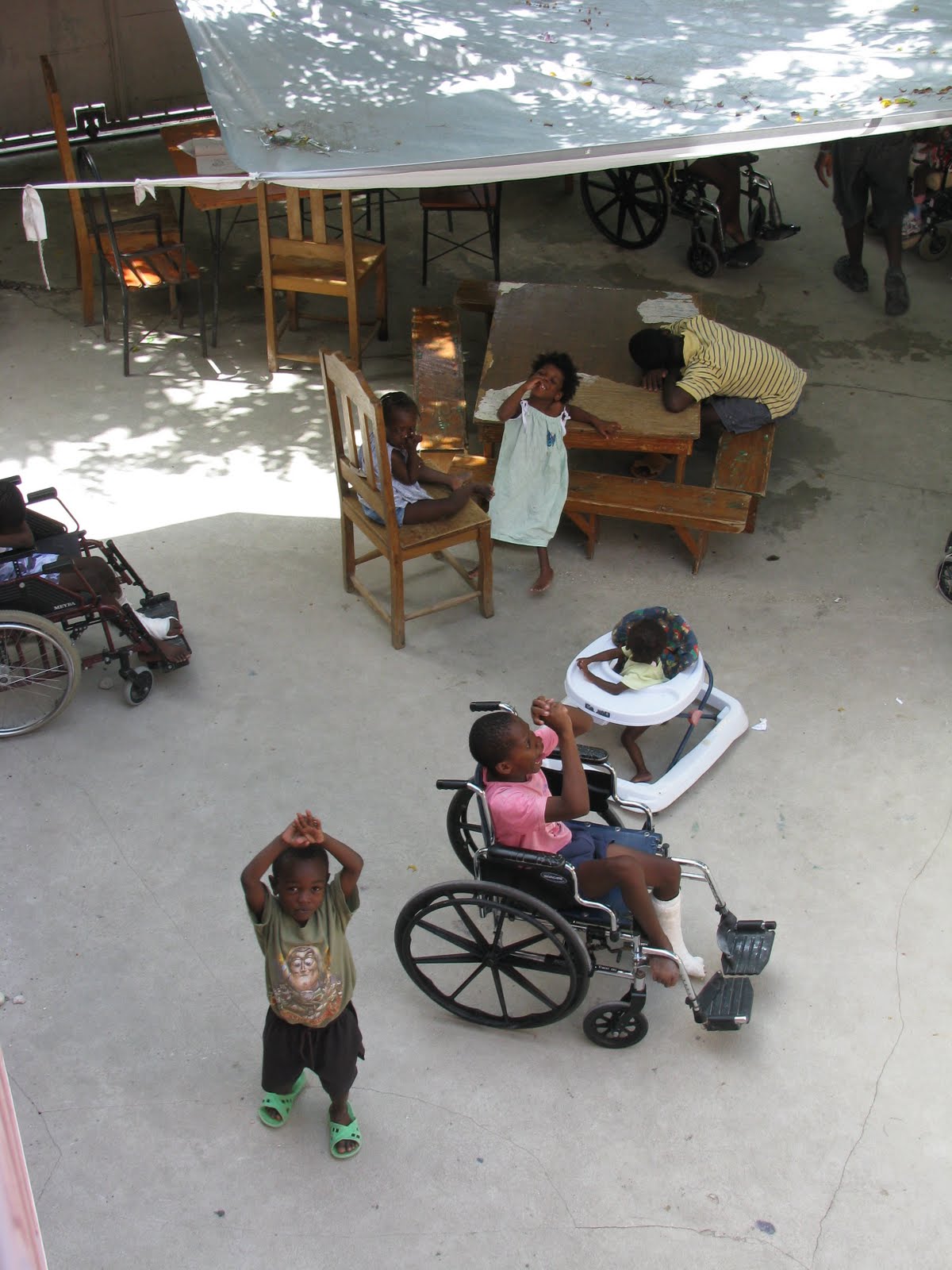
I'm sure the little girl pictured above is resilient. She is one of the children living at Gertrude's orphanage.
You Can Always Pray
Yesterday, John taught a clinical lesson at the Missionaries of Charity compound to the nurse practitioner students. One hundred or so children live here some temporarily and some permanently. One of the sisters was holding a three-year-old who was understandable sad: she came to the sisters after the earthquake and no one knows anything about her family. She must feel so incomplete and empty, as if an important part of her is missing.
I described the Missionaries of Charity to a couple of people in Haiti as the Marines of Catholic nuns: they can only go home once every ten years; they are never seen eating or drinking; and they wear these habits that I hardly see how they keep from passing out in. It is hot and humid in Haiti now; it seems like 30 seconds after you take a shower, you need another one and this is without wearing a couple of layers of head to toe clothing. Despite these hardships (or perhaps because of them?) the sisters are productive and do very difficult work caring for the poorest of the poor.
On our way home, our hostess Beth Newton asked me what I thought of the Sisters' place. I said that I had been to their building in Port-au-Prince, but, still, it was a shock to see so many children without parents. On the wall of the building, sayings from Mother Teresa, the founder of the order, are painted in Haitian Kreyol including, "Every child is precious and a gift from God." I wish the world's priorities reflected this truth. As we go about our busy days, it's never a waste to offer up a prayer for the abandoned children of the world.
Two Haitis
"There are two Haitis: Port-au-Prince and everything else," is a statement we hear a lot. Flying into Les Cayes, one of the passengers on the plane said, "I tell everyone that Port-au-Prince is not the real Haiti." As someone who has spent most of her time in Haiti in the capital, I had to agree that at least from the air, the Les Cayes area looked much different than Port-au-Prince. It was shockingly green, for one. And then on the ground, there aren't as many people around. Many of the roads in Les Cayes are much better than those in PAP.
The above photograph is from the balcony of the home of our friends, Tim and Joan Reinhold. They are Christian missionaries who live 10 months of the year in Haiti. They, with a lot of Haitian help, built their beautiful home by hand, which is how so many things are done in Haiti. Tim and Joan help put roofs on school and churches throughout the southern peninsula of Haiti. Teams from different Apostolic Christian churches in the United States come and aid them in their mission. Their accomplishments are very impressive.
After the earthquake, many of the Port-au-Princians headed to the provinces where they had family or friends they could stay with. But after a few months, it was time to return home, which in many cases was now a tent. The lives of the people in the provinces aren't exactly easy on a regular day and they couldn't continue to support their extended families any longer.
We have heard Gertrude's suggestion several times by our American friends in Les Cayes: that hopefully Haiti will become more decentralized after the earthquake with Port-au-Prince not having such a stranglehold on all the government functions. If there was more infrastructure and commerce in the rest of the country, people could find employment outside Port-au-Prince and the terrible crowding in the city would decrease. And then, maybe, we would speak of one Haiti instead of two.
Tuesday, June 08, 2010
A Teaching Stint in Les Cayes
One of the reasons that we are in Haiti now is because John was asked to teach at a school for nurse practitioners. This is his second stint teaching at the school in Les Cayes. Yesterday, he lectured on pediatric appendicitis and shock. Today, we will go to a clinic run by the Missionaries of Charity, and John will give the students a clinical lesson with the pediatric patients.
The students are very motivated. They work full time and then come to class in the late afternoon. Yesterday, they had taken a pharmacology exam prior to John's class. They paid close attention during John's lecture and took lots of notes. It helps that John can teach in Haitian Creole.
The nursing classes are held at a business/technology school downtown, next to the new Coast Guard building that is being constructed. Here is the view from campus:
Yes, that is a cow grazing by the ocean. A new pier is also being constructed and many of our American friends hope that container ships will be able to dock and unload at Les Cayes. Many people have told us that they hope one of the responses to the earthquake is that governmental control and functions are decentralized from Port-au-Prince, making functioning throughout the rest of the country more effective and efficient. We will see.
Monday, June 07, 2010
Tent City, Haiti
Almost six months out from the earthquake, the most noticeable change to my eye is the tents: they are everywhere, some places in huge camps, sometimes in small groups, and occasionally there will be a lone canvas pitched off by itself. The tents are in industrial areas, on private property, on government property. They are often found where houses were once located. There are even tents in the medians of roads.
This is not to say that other effects of the earthquake aren't obvious. Rubble is strewn everywhere, more than usual. Half completed buildings hang in ruins. Certain parts of the city were damaged more than others: the Delmas section of Port-au-Prince appears to have been particularly hard hit, A portion of the road Delmas 31 was destroyed and we had to hike down through a steep gully and cross a dirty stream to make our way down the street. The inpatient unit at Grace Children's Hospital on Delmas 31, a special place to us, is not functioning and tents serve as the outpatient clinics.
One of our Haitian Hearts patients, Jenny G., pictured below, is standing next to the car she slept in the first two months after the earthquake and the tent that served as her bedroom after this.
So it is the tents that may be the most ubiquitous symbol of the earthquake.
Saturday, June 05, 2010
Providence Guest House
Our friend Gertrude is doing a hero's work in Haiti. She runs a guest house/orphanage in LaPlaine. Gertrude's original guest house in Delmas was destroyed in the earthquake. Gertrude was sleeping at 4:52 pm when the earthquake struck. It woke her up and she was disoriented. She fell three times as she tried to run. "Jesus, help me," she cried. The rumbling stopped and she ran outside as her guest house was crashing down.
Prior to the earthquake, Gertrude had the house in LaPleine where abandoned children were staying. Fortunately, none of them was hurt in the earthquake. Some of the children she cares for were abandoned at the General Hospital. Some of them are disabled. The orphanage currently has 37 children. Her guest house, Providence, helps fund the orphanage. She has 22 staff members to care for these children. As you might imagine, there are many expenses in running an orphanage.
When I asked Gertrude what she would do if she were in charge of Haiti, she gave a three-part answer. First, she would feed the people. Next, she would focus on the long-term progress of the country, creating housing and jobs. Finally, she would build infrastructure throughout Haiti, not just in Port-au-Price. "If people had what they needed in the provinces, they wouldn't come to Port-au-Prince," she said.
"In the hour of our poverty, this is the time for it," she said.
Subscribe to:
Posts (Atom)